Seven of Wands and Five of Pentacles Tarot as Feelings

- Arcana
- Seven of Wands — Minor Arcana, Wands; Five of Pentacles — Minor Arcana, Pentacles
- Elements
- Seven of Wands — Fire; Five of Pentacles — Earth
- Elemental interaction
- Neutral elements — energies coexist without conflict
- Numerology
- 7 + 5 = 12 → 3
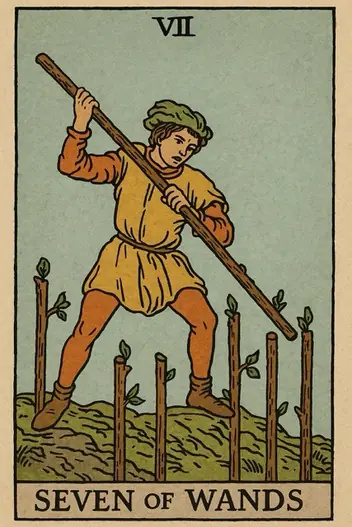
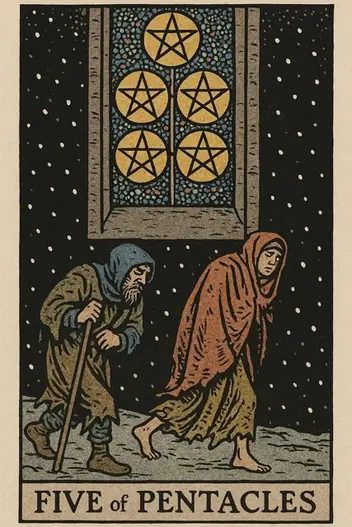
When the Seven of Wands—a card of defensive struggle, standing your ground, and proving your worth—collides with the Five of Pentacles—a card of material lack, isolation, and feeling left out in the cold—you get a potent psychological cocktail. This pairing often describes a person who is fighting tooth and nail to protect a position they feel is precarious, or defending themselves against a perceived threat of loss.
From a Jungian perspective, this is the Shadow of the Warrior archetype meeting the Poverty complex. The seeker may be over-identifying with a scarcity mindset, interpreting every challenge as a survival threat. The practical reality is that you are likely in a high-stakes situation where your resources (time, money, energy) are limited, and you feel you must constantly push back against external pressures. The key insight here is to distinguish between a genuine threat and a projection of your own fears of inadequacy.
Core Dynamics & Interpretation
The psychological state created by the Seven of Wands and Five of Pentacles is one of defensive hypervigilance. You are likely operating from a baseline assumption that you are at a disadvantage—that others have more resources, more support, or better positions. This triggers a fight-or-flight response, where every minor setback feels like a confirmation of your worst fears about lack and exclusion.
The core dynamic is a paradox: you are fighting to hold ground that you believe is already failing. The Seven of Wands shows you successfully defending your position, but the Five of Pentacles whispers that the foundation is crumbling. This creates a cognitive dissonance where your efforts feel both necessary and futile. In practical terms, this means you may be working twice as hard for half the results, burning out while trying to prove your worth to an audience that may not even be watching.
The Jungian shadow here is the "Scarcity Warrior" —someone who picks fights not because they are necessary, but because the fear of being left behind feels more real than the actual situation. The path forward requires a reality check: are you defending against a tangible threat, or are you fighting ghosts from past experiences of loss? The answer will determine whether your struggle is strategic or self-sabotaging.
Career and Finances
Strategic Opportunities:
Recognize that your defensive struggle may be protecting a position that is no longer serving you. The fight itself may be the opportunity to reassess your priorities and pivot to a more sustainable path.
Strategic Opportunities:
Use your current adversity to build resilience and a stronger professional network. The Five of Pentacles suggests isolation; actively seek out mentors or collaborators who can provide the support you lack.
Calculated Risks:
Avoid making financial decisions based on fear of loss. Do not take on debt to "keep up appearances" or over-invest in defending a failing project. The real risk is burning out your energy and resources on a losing battle.
In your career, this combination often appears when you are overworking to compensate for perceived instability. You may be the person who says "yes" to every project because you fear not having enough work, or you may be in a competitive environment where you feel you must constantly prove your worth to avoid being laid off or overlooked. The financial warning here is clear: scarcity thinking leads to poor resource allocation. You may be spending money or energy on "defense" (like legal fees, unnecessary certifications, or office politics) rather than on "offense" (investing in growth, learning, or new opportunities).
Strategic tip:
Instead of fighting for your current position, invest energy in creating a new position of strength. The Five of Pentacles is a temporary state; the Seven of Wands is a call to choose your battles wisely. Ask yourself: "Is this fight worth winning, or am I just afraid of what happens if I let go?"
Your pair is already on the table. Ask your question and draw the clarifying card
or simply focus on it
Seven of Wands and Five of Pentacles in Love Tarot
If you are single:
This pairing suggests you may be approaching potential partners from a defensive posture, expecting rejection or competition before it happens. Your fear of being "not enough" is making you fight for validation rather than connect authentically.
If you are in a relationship:
You and your partner may be locked in a cycle of defensiveness and perceived deprivation. One or both of you feels emotionally or materially unsupported, leading to arguments about who is giving more or who is being left out.
In relationships, the Seven of Wands and Five of Pentacles often signals a power struggle rooted in insecurity. One partner may feel they are constantly defending their position—financially, emotionally, or in terms of status—while the other feels neglected or undervalued. The key relationship advice here is to stop fighting for dominance and start addressing the underlying fear of abandonment or inadequacy. Instead of defending your position, ask yourself: "What am I actually afraid of losing?" The answer is rarely the argument itself; it's usually a deeper fear of being unworthy or unloved.
Bold advice:
If you are in a conflict, step back from the defensive stance and acknowledge the other person's feeling of lack. This combination thrives on mutual misunderstanding; breaking the cycle requires one person to stop fighting and start listening.
Your unique Tarot reading
See how these cards interact with your destiny. Start a free personal reading now.
Seven of Wands and Five of Pentacles: Warning Signs
The shadow manifestation of this pairing is paranoid defensiveness and self-imposed isolation. When the energy is blocked or misdirected, the seeker becomes their own worst enemy. Cognitive biases at play include the "scarcity heuristic" (overvaluing what is limited and undervaluing what is abundant) and "confirmation bias" (interpreting neutral events as proof that you are under attack). You may find yourself pushing away allies because you mistake their help for condescension, or rejecting opportunities because they feel "too good to be true."
Self-sabotage appears as a martyr complex:
you believe that if you just suffer enough, or fight hard enough, the universe will reward you. This is a trap. The Five of Pentacles is not a badge of honor; it is a signal to change your strategy. If you are feeling isolated, ask yourself if you have erected walls to protect yourself from perceived threats that no longer exist. The shadow warns against confusing "standing your ground" with "stubbornly staying in a bad situation."
What If Seven of Wands or Five of Pentacles Appears Reversed?
When cards appear in reversed positions, the dynamic shifts from external conflict to internal sabotage.
Seven of Wands reversed:
Blocked potential. You are not defending your boundaries; instead, you are surrendering positions without a fight. This manifests as reckless capitulation: you abandon your own interests out of fear of conflict. Advice: reclaim your right to defend yourself, but do so strategically, not impulsively.
Five of Pentacles reversed:
Internal resistance to help. You deny obvious resource problems or reject support out of pride. This is a trap: "I can handle it myself, I don't need help." Warning: such behavior turns temporary hardship into chronic isolation.
BOTH reversed:
Complete dynamic imbalance. You are simultaneously failing to defend your boundaries and refusing to accept help. This is a state of paralysis of will: you are stuck between fear and pride. Correction: start small—acknowledge one problem and accept one specific form of help. Break the cycle of inaction.
Seven of Wands and Five of Pentacles Combined Message
To constructively harness the energy of this pair, it is necessary to separate strategy from tactics. The Seven of Wands grants you the will to resist—this is an excellent resource for defending your values. The Five of Pentacles points to a real scarcity—this is not "evil forces" but an objective map of the terrain. Your task is to stop fighting for every inch and start seeking a new path.
Strategic advice: Use the energy of the Seven of Wands not for defense, but for reconnaissance. Instead of fending off competitors, conduct an audit of your resources. What are you defending? Status? Habit? Or genuine value? If you discover you are defending a void (an old position, toxic relationships, a loss-making asset), immediately cease resistance and channel your energy into creating something new.
The Five of Pentacles in this combination is a call to regroup. You cannot solve a problem of scarcity using the same methods that led to it. You need to seek allies, ask for help, and reassess your budget. Clarity comes when you acknowledge: "I lack resources, and that's okay. Now I know what to look for." The constructive way out is not a heroic victory, but a tactical retreat aimed at conserving strength for a future breakthrough.
Applying This to Your Situation
The Seven of Wands and Five of Pentacles together deliver a clear message: you are fighting a battle that feels existential, but your real opponent is your own fear of scarcity. The path forward requires a strategic shift from defense to offense—not by fighting harder, but by re-evaluating what you are actually defending and whether it's worth the cost. Your worth is not proven by how hard you struggle, but by how wisely you choose your ground.
While this article provides the general archetype, the true power of Tarot lies in its application to your unique situation. The meaning of this combination shifts dramatically depending on whether you are asking about a job, a relationship, or a personal project. To get a deep, personalized interpretation of this exact combination for your specific question, use the Fortune Cards app. Available on the web or for download, it analyzes your cards in the context of your life, giving you actionable insights tailored to your path. Stop fighting in the dark—get the clarity you deserve.
Interpretation by the Fortune Cards editorial team, based on the Rider–Waite tradition and Jungian archetypes. About our methodology · Updated: 2026-08-26
Other Combinations with Seven of Wands
Other Combinations with Five of Pentacles
Explore Individual Card Meanings
Table of Contents
- Core Dynamics & Interpretation
- Career and Finances
- Seven of Wands and Five of Pentacles in Love Tarot
- Seven of Wands and Five of Pentacles: Warning Signs
- What If Seven of Wands or Five of Pentacles Appears Reversed?
- Seven of Wands and Five of Pentacles Combined Message
- Applying This to Your Situation
Ready to find answers to your questions?
Start your first reading now and look at your situation with fresh clarity. The cards are ready to reveal deeper meaning.