Six of Cups and Six of Pentacles Reversed in Tarot
- Arcana
- Six of Cups — Minor Arcana, Cups; Six of Pentacles — Minor Arcana, Pentacles
- Elements
- Six of Cups — Water; Six of Pentacles — Earth
- Elemental interaction
- Friendly elements — energies support each other
- Numerology
- 6 + 6 = 12 → 3
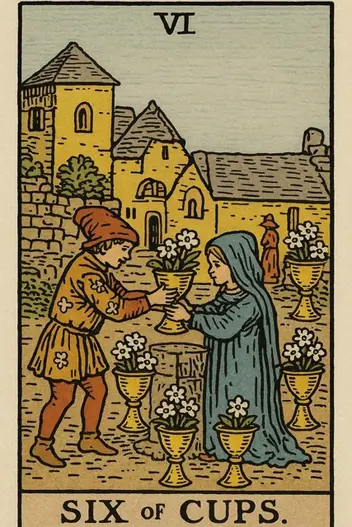
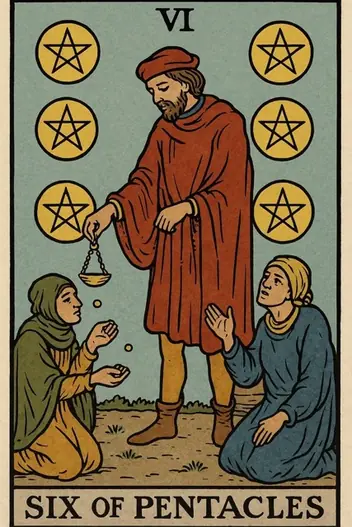
When the Six of Cups—a card of nostalgia, innocence, and giving from the heart—collides with the Six of Pentacles—a card of material exchange, generosity, and power dynamics—the result is a powerful psychological intersection. Here, emotional history meets tangible action, and the past becomes a currency for present stability.
This combination asks: What are you willing to give, and what are you expecting in return? It’s not about pure altruism or cold transaction; it’s about conscious reciprocity. The seeker is called to examine whether their generosity is a genuine gift or an unconscious attempt to buy love, approval, or security. Pragmatically, this pair signals a time when emotional debts and material assets must be balanced with clear eyes and a steady hand.
Six of Cups and Six of Pentacles: How These Energies Interact
The psychological state created by the Six of Cups and Six of Pentacles is one of conditional nostalgia. You are not simply reminiscing; you are evaluating which memories, relationships, or past favors can be leveraged to build a more secure future. The Six of Cups provides the emotional warmth and trust, while the Six of Pentacles provides the structure and boundaries. Together, they form a mature reciprocity that avoids both naive giving and cynical hoarding.
On a practical level, this pairing often emerges when a person is revisiting a past connection—a former colleague, an old friend, or a family member—with the intent to formalize support. This could be a loan, a partnership, or a mentorship. The key insight here is that this exchange must be explicit. Without clear terms, the emotional charge of the Six of Cups can blur the lines of the Six of Pentacles, leading to resentment or exploitation. The healthy path is to acknowledge the history while setting realistic expectations for the transaction.
A critical risk in this dynamic is romanticizing the past. The seeker may believe that because a relationship was once loving, it can now serve as a safety net. In reality, the Six of Pentacles demands a power assessment: Who holds the resources? Who is the giver, and who is the receiver? This combination urges you to honor the past without being ruled by it, using emotional intelligence to negotiate a fair exchange.
Your pair is already on the table. Ask your question and draw the clarifying card
or simply focus on it
Six of Cups and Six of Pentacles as Feelings
If you are single:
This pair suggests evaluating a new connection through the lens of shared history or mutual support. You may be drawn to someone from your past, but the key is to assess whether they can offer consistent, practical generosity—not just nostalgic charm.
If you are in a relationship:
The dynamic here revolves around balancing emotional gifts with material contributions. One partner may feel they are giving more emotionally, while the other provides financial stability. Open negotiation is essential to avoid resentment.
In relationships, the Six of Cups and Six of Pentacles combination highlights a mature love that integrates memory with responsibility. This is not about grand romantic gestures; it’s about small, consistent acts of care that honor the past while building a stable future. For couples, this card pair often signals a time to renegotiate roles—perhaps one partner has been the primary emotional supporter, while the other has been the primary breadwinner. The healthiest path is to acknowledge these imbalances and agree on a fair redistribution of both emotional and material duties.
Key relationship advice is to avoid using past kindness as emotional leverage. Do not say, “I did this for you then, so you owe me now.” Instead, focus on what each person can freely offer in the present moment. This combination also warns against rescuing a partner out of guilt or nostalgia. True generosity comes from a place of surplus, not obligation. If you feel compelled to give, ask yourself: Is this a gift, or a debt I’m trying to pay?
Deepen your understanding
Find out exactly what this reading means for your current life situation with our oracle.
Six of Cups and Six of Pentacles: Career and Money
Strategic Opportunities:
Use your professional network and past collaborations to secure a new contract, mentorship, or referral. The Six of Cups provides the emotional trust; the Six of Pentacles provides the transactional structure.
Strategic Opportunities:
Offer pro bono work or a discounted service to a client from your past. This can build goodwill and lead to a long-term, paid partnership. Frame it as a calculated investment, not a favor.
Calculated Risks:
Avoid lending money to a friend or former colleague without a written agreement. The emotional history can cloud your judgment, leading to financial loss or damaged relationships. Always formalize the terms.
Professionally, this combination suggests a strategic use of your history. You may have a former boss, mentor, or client who respected your work. Now is the time to reconnect with a specific proposal in mind. The Six of Pentacles demands that you value your time and skills appropriately. Do not undervalue your expertise out of a desire to be liked or to relive a past success. Instead, offer a fair exchange: your experience for their resources.
A critical financial warning is to beware of the “gift with strings attached” mentality. If you are in a position to help someone financially, ensure that the help is unconditional or clearly defined as a loan. The shadow of the Six of Pentacles is hidden control—using money or resources to manipulate a relationship. Be transparent about your intentions, and if you are the receiver, ask for clarity on what is expected in return. The healthiest financial strategy here is mutual benefit with clear boundaries.
Six of Cups and Six of Pentacles Reversed: How to Read It
When cards are reversed, the constructive dynamic collapses, revealing the root of the problem.
If the Six of Cups is reversed:
The past becomes a prison. You are stuck in grievances or idealizations of "the good old days." Instead of using old connections, you are destroying them. The blocked potential manifests as an unwillingness to accept help out of fear of being indebted. Advice: break the link between "I remember" and "I must." The past is experience, not a contract.
If the Six of Pentacles is reversed:
Internal resistance to hierarchy. You either refuse to pay your dues (financial or emotional), or conversely, you feel like a victim being used by everyone. The weakness manifests in extremes: you are either a spendthrift or a miser. Advice: reconsider your relationship with resources. Generosity without boundaries is wastefulness, and saving without purpose is poverty.
If BOTH are reversed:
Complete imbalance. You can neither give nor receive. The past torments you, the present is unstable, the future is frightening. Cognitive dissonance: you want warmth but fear intimacy; you want money but despise those who earn it. The way to correct this: start small. Restore one old contact without expectations. Make one small investment in yourself. Synchronize emotions and finances — they operate by the same laws of balance.
The Shadow Side of Six of Cups and Six of Pentacles
The shadow manifestation of this pairing is transactional nostalgia—using the emotional currency of the past to manipulate present outcomes. This can appear as guilt-tripping (“After all I did for you, you owe me this”), covert contracts (giving with the unspoken expectation of return), or fear-based generosity (giving to avoid being abandoned). The cognitive bias at play is the sunk cost fallacy: believing that because you invested time or resources in a relationship, you must continue to do so, even if it’s no longer healthy.
Another pitfall is emotional bankruptcy disguised as altruism. The seeker may give material support (Six of Pentacles) to avoid dealing with unresolved emotional wounds (Six of Cups). For example, buying a partner a gift instead of having a difficult conversation about trust. This combination can also trigger poor judgment when assessing others’ motives. You may project your own nostalgic feelings onto someone who is simply looking for a transactional benefit. The shadow asks you to check your intentions: Are you giving freely, or are you trying to buy peace, love, or control?
Overall Meaning of Six of Cups and Six of Pentacles
Constructive use of the Six of Cups energy to balance the Six of Pentacles requires a shift from "gift" to "investment." Stop thinking of the past as a bank from which you can endlessly withdraw emotional credit. Begin to perceive it as seed capital for a new project. Your task is to transform nostalgia into strategy. For example, if you have old connections, do not ask them for help "for old times' sake." Offer them a deal: "I remember our collaboration, and I want to propose a partnership to you on new terms."
A deep strategic piece of advice: use the principle of "mutual benefit." In any situation where you feel the urge to give (money, time, care), ask yourself: "What do I want in return, and is the other person willing to give it?" If the answer is not obvious, replace the gift with an exchange. This is not cynicism; it is maturity. The Six of Pentacles teaches us that resources are finite, and the Six of Cups teaches us that connections are priceless. Combine them: invest resources only in those connections that bring mutual value. Clarity comes when you stop being "kind" and become "fair." Fairness is the highest form of love in the adult world.
Your Next Step: Personal Context Matters
The core message of the Six of Cups and Six of Pentacles is this: honor your history, but negotiate your future. Your past experiences and relationships are valuable assets, but they must be managed with the same rigor as any financial portfolio. Generosity is a strength when it is conscious, bounded, and reciprocal. Whether in love, career, or personal growth, this combination calls you to give from a place of abundance, not obligation, and to receive with gratitude, not guilt.
Ready to apply this insight to your unique situation? While this article covers the general archetype, the true power of Tarot lies in personalization. The Fortune Cards app offers a deep, AI-driven interpretation of this exact combination for your specific question—whether it’s about a relationship, a career move, or a financial decision. You can use it on the web or download it now to get a custom, actionable reading that considers your past, your present resources, and your next strategic step. Don’t just read about the cards—let them guide your next move.
Interpretation by the Fortune Cards editorial team, based on the Rider–Waite tradition and Jungian archetypes. About our methodology · Updated: 2026-08-26
Other Combinations with Six of Cups
Other Combinations with Six of Pentacles
Explore Individual Card Meanings
Table of Contents
- Six of Cups and Six of Pentacles: How These Energies Interact
- Six of Cups and Six of Pentacles as Feelings
- Six of Cups and Six of Pentacles: Career and Money
- Six of Cups and Six of Pentacles Reversed: How to Read It
- The Shadow Side of Six of Cups and Six of Pentacles
- Overall Meaning of Six of Cups and Six of Pentacles
- Your Next Step: Personal Context Matters
Ready to find answers to your questions?
Start your first reading now and look at your situation with fresh clarity. The cards are ready to reveal deeper meaning.