Love Tarot: Six of Pentacles and Ten of Pentacles

- Arcana
- Six of Pentacles — Minor Arcana, Pentacles; Ten of Pentacles — Minor Arcana, Pentacles
- Elements
- Six of Pentacles — Earth; Ten of Pentacles — Earth
- Elemental interaction
- Same element — energies intensify each other
- Numerology
- 6 + 10 = 16 → 7
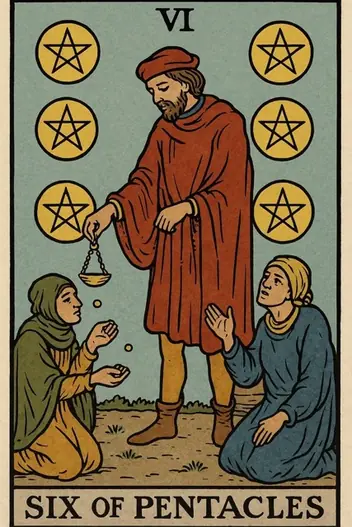
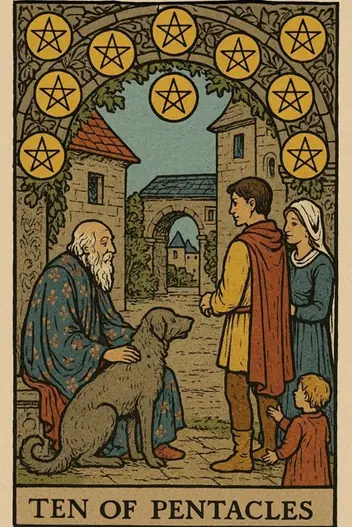
This combination represents a powerful psychological intersection between fair exchange (Six of Pentacles) and enduring legacy (Ten of Pentacles). When these archetypes collide, the core question becomes: How do you balance immediate generosity with long-term structural stability? The Six of Pentacles asks you to give and receive in the present moment, while the Ten of Pentacles demands you consider the family, community, or institutional systems that will outlast you.
In practical terms, this pairing often appears when you are navigating a resource transfer—whether of money, knowledge, or emotional support—that has multi-generational implications. You are not just solving a short-term problem; you are setting a precedent. The psychological state here is one of stewardship, where your actions today define the boundaries and expectations of a shared future. The key insight is that true abundance isn't hoarded—it's distributed wisely to strengthen the whole system.
Core Dynamics & Interpretation
The core dynamic of this combination is the tension between individual agency and collective responsibility. The Six of Pentacles represents a one-to-one transaction: a giver and a receiver, a clear power dynamic. The Ten of Pentacles, however, represents the network—the family business, the inherited wealth, the community trust fund. When these cards merge, the seeker is often forced to ask: Is my generosity building a sustainable structure, or is it creating dependency?
Psychologically, this is a test of your internalized value system. You may feel pressure to be the "provider" (Six of Pentacles) while also feeling the weight of family or institutional expectations (Ten of Pentacles). The healthiest path involves clear boundaries and transparent agreements. For example, lending money to a family member requires explicit terms about repayment, not just a vague promise. The Ten of Pentacles energy insists that these transactions be formalized or ritualized to protect the long-term health of the relationship.
The strategic takeaway is this:
You must balance compassion with pragmatism. The Six of Pentacles can lead to burnout if you give without limits, while the Ten of Pentacles can lead to rigid control if you prioritize legacy over human connection. The goal is to create a virtuous cycle—where your generosity strengthens the system, and the system, in turn, supports future generosity. This is the essence of sustainable abundance.
Your pair is already on the table. Ask your question and draw the clarifying card
or simply focus on it
What Do Six of Pentacles and Ten of Pentacles Indicate for Your Career?
Strategic Opportunities:
Position yourself as a bridge between generations—for example, mentoring junior staff while learning from senior leaders. This combination rewards those who can transfer knowledge and resources across hierarchies.
Strategic Opportunities:
Negotiate for long-term equity or profit-sharing rather than a one-time bonus. The Ten of Pentacles favors ownership stakes and residual income.
Calculated Risks:
Avoid taking on a "savior" role in a struggling family business or organization. The Six of Pentacles can tempt you to rescue others, but the Ten of Pentacles warns that you may become trapped in a dysfunctional system.
From a career perspective, this pairing is a powerful signal for strategic networking and legacy-building. You are not just climbing the ladder; you are building a platform that will support others after you. This could mean creating a training program, documenting processes for successors, or investing in a mentorship pipeline. The financial warning is clear: do not confuse generosity with charity. If you are giving away your time or expertise for free, ensure it is an investment in a system that will yield returns—whether that is goodwill, referrals, or future collaboration.
For financial planning, the message is about diversification and trust. The Ten of Pentacles suggests a need for estate planning, insurance, and legal structures that protect your assets across generations. The Six of Pentacles advises you to give with intention, not impulse. Before making a loan or investment, ask: Does this serve my long-term vision, or is it a short-term fix? The most strategic move is to create a "family constitution" or partnership agreement that outlines how resources will be shared, managed, and grown.
What Do Six of Pentacles and Ten of Pentacles Say About Love?
If you are single:
This combination suggests you may attract a partner who is either financially established or deeply embedded in a supportive family structure. Evaluate whether their generosity comes with strings attached—the Six of Pentacles can sometimes mask a caretaker dynamic that feels unequal.
If you are in a relationship:
Focus on aligning your financial and lifestyle values. Discussions about inheritance, joint accounts, or long-term care for parents are likely to surface. This is a practical, not emotional, conversation.
In relationships, the Six of Pentacles and Ten of Pentacles together highlight the power dynamics of giving and receiving within a long-term partnership. This is not about romantic gestures; it is about how you structure your shared life. For instance, one partner may earn significantly more, while the other manages the household. The Ten of Pentacles asks: Is this arrangement sustainable for the next decade? The key relationship advice is to create explicit agreements about money, chores, and future planning. Avoid the shadow of the "martyr" —where one partner gives endlessly and resents it later. Instead, practice balanced reciprocity: both partners should feel they are contributing value, even if the contributions are different in form.
Conflict resolution here requires emotional intelligence. If you feel you are giving more than you receive, state it as a structural problem, not a personal attack. Say: "Our system of sharing expenses feels unbalanced. Let's review it together." The Ten of Pentacles energy supports rituals of appreciation—like a weekly check-in or a shared financial goal—to reinforce that you are building a legacy together, not just managing a transaction.
Get a personalized interpretation
Unlock the combined meaning of your cards in the context of your unique question — for free.
Six of Pentacles and Ten of Pentacles: Warning Signs
The shadow of this combination manifests as entitlement and control. The seeker may feel they have "earned" the right to dictate how others live, especially if they are the primary provider (Six of Pentacles shadow) or the heir to a legacy (Ten of Pentacles shadow). This can lead to toxic generosity—giving with unspoken expectations of loyalty or obedience. Cognitive biases to watch for include the "endowment effect" (overvaluing what you have given) and the "sunk cost fallacy" (continuing to support a failing system because of past investments).
Another pitfall is the "golden cage" —where the seeker feels trapped by family obligations or financial responsibilities. They may give up their own autonomy to maintain the status quo, leading to resentment and burnout. Self-sabotage appears as either reckless generosity (draining your resources to please others) or hoarding (refusing to share out of fear of losing control). The key is to recognize that your worth is not tied to your ability to give or to preserve a legacy. True stewardship requires the courage to say "no" to demands that undermine the system's health.
Reversed Six of Pentacles and Ten of Pentacles Explained
When one or both cards are reversed, the constructive dynamic transforms into a dysfunctional one.
Six of Pentacles Reversed (Ten of Pentacles Upright):
You are confronting "the miser knight syndrome." You possess resources and structure (the Ten), but you block their distribution. This leads to stagnation and isolation. Advice: Re-examine your fear of loss. True power lies not in hoarding, but in the ability to delegate and share authority; otherwise, your empire will crumble for lack of successors.
Ten of Pentacles Reversed (Six of Pentacles Upright):
This is "the spendthrift syndrome." You are distributing resources left and right without creating a sustainable system. Your help is like water poured into sand. Advice: Before giving, ask yourself: "Will this help the person stand on their own feet, or will it create dependency?" You need to structure your philanthropy — stop being a sponsor and become a mentor.
Both Cards Reversed:
Complete imbalance — "chaos in the family budget." This can indicate financial machinations, inheritance disputes, or a situation where "good deeds" are destroying the family. Advice: You need an external auditor (a financial consultant or psychologist) to restore order. Focus on re-establishing basic rules — honest accounting, clear boundaries for help, and an end to toxic generosity.
What Is the Overall Message of Six of Pentacles and Ten of Pentacles?
Constructive use of this pair requires a shift from tactics to strategy. The Six of Pentacles is your tool for "sowing" the future, while the Ten of Pentacles is the "harvest" you plan to reap. To balance them, you must adopt the role of the "Gardener", not the "Benefactor" or the "Miser."
Deep Strategic Advice:
Create a "Three-Basket Model." The first basket is "Capital" (the Ten): savings, assets, real estate that are untouchable. The second is "Investments" (the Six): money and time you put into people, education, and new projects with risk. The third is "Donations" (the pure Six): irrevocable help for those truly in need, with no expectation of return.
Your task is to strictly monitor the proportions. If you empty the first basket for the second or third, you destroy the foundation. If you ignore the second and third, you become a miser whose inheritance no one wants. Clarity comes when you understand: your generosity must be as disciplined as your accumulation. Only in this union is a true legacy born—not just money, but a system that works even after you are gone.
Where to Go From Here
The Six of Pentacles and Ten of Pentacles together deliver a clear message: Your resources are a tool for building something that lasts, but only if you manage them with wisdom and boundaries. Whether you are navigating a family inheritance, a career transition, or a relationship dynamic, the core task is to balance generosity with structure. You are not just a giver or a receiver—you are a steward of a system.
To apply this insight to your unique situation, use the Fortune Cards app. While this article explains the general archetypes, the true power of Tarot lies in how these cards interact with your specific question, timeline, and personal history. The Fortune Cards app offers a deep, personalized reading of this exact combination, tailored to your relationship, career, or personal growth query. You can access it on the web or download it now to get the clarity and strategic direction you need to move forward with confidence.
Interpretation by the Fortune Cards editorial team, based on the Rider–Waite tradition and Jungian archetypes. About our methodology · Updated: 2026-08-26
Other Combinations with Six of Pentacles
Other Combinations with Ten of Pentacles
Explore Individual Card Meanings
Table of Contents
- Core Dynamics & Interpretation
- What Do Six of Pentacles and Ten of Pentacles Indicate for Your Career?
- What Do Six of Pentacles and Ten of Pentacles Say About Love?
- Six of Pentacles and Ten of Pentacles: Warning Signs
- Reversed Six of Pentacles and Ten of Pentacles Explained
- What Is the Overall Message of Six of Pentacles and Ten of Pentacles?
- Where to Go From Here
Ready to find answers to your questions?
Start your first reading now and look at your situation with fresh clarity. The cards are ready to reveal deeper meaning.