Love Tarot: Temperance and Knight of Cups
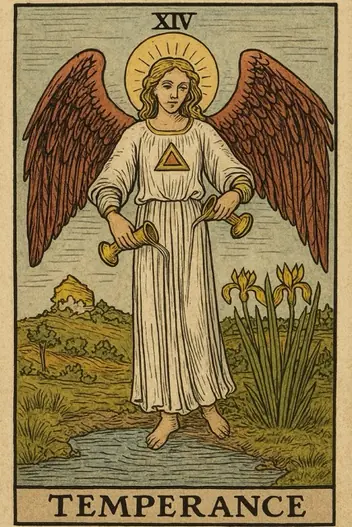
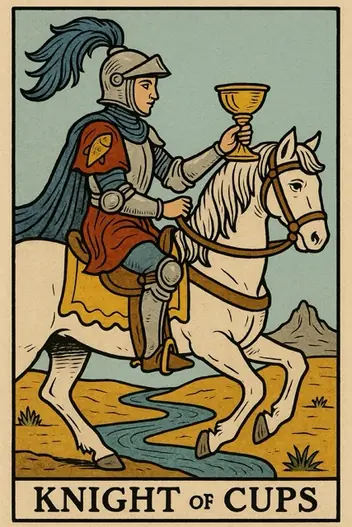
- Arcana
- Temperance — Major Arcana; Knight of Cups — Minor Arcana, Cups
- Elements
- Temperance — Fire; Knight of Cups — Water
- Elemental interaction
- Opposing elements — energies create tension
- Numerology
- 14 + 12 = 26 → 8
When Temperance meets the Knight Of Cups, the result is a sophisticated fusion of emotional depth and disciplined execution. Temperance represents the archetype of the Alchemist—someone who blends opposing forces into a harmonious whole through patience, moderation, and long-term perspective. The Knight Of Cups, by contrast, embodies the Lover archetype in motion—a figure driven by passion, idealism, and the pursuit of emotional fulfillment.
In real-world terms, this combination asks: How do you channel intense feelings into sustainable progress without burning out or losing your way? The Knight brings the fuel of inspiration, while Temperance provides the engine of measured pacing. Together, they create a psychological state where emotional intelligence becomes a strategic asset, not a liability. This pairing is less about dramatic breakthroughs and more about calibrating your passion to match reality’s demands—a crucial skill for anyone navigating high-stakes relationships, creative projects, or career pivots.
Core Dynamics & Interpretation
The core dynamic here is controlled idealism. The Knight Of Cups wants to rush toward a vision—a dream job, a soulmate connection, a creative masterpiece—while Temperance insists on checking the fuel gauge, mapping the route, and planning for detours. This tension is productive when managed well. The Knight’s enthusiasm prevents Temperance from becoming overly cautious or detached, while Temperance prevents the Knight from making impulsive decisions based on fleeting emotional highs.
Psychologically, this combination activates the Self-Regulation function of the psyche. You are being asked to hold two seemingly contradictory truths simultaneously: Your feelings are valid and important AND Your feelings must be integrated with practical reality. For example, you may feel a deep pull toward a new romantic partner, but Temperance urges you to observe how they handle conflict, finances, or stress before committing. The Knight provides the emotional data; Temperance provides the analytical framework.
In practice, this means slowing down without losing momentum. The Knight Of Cups often struggles with disappointment when reality doesn’t match the fantasy. Temperance mitigates this by encouraging incremental testing of your assumptions. Ask yourself: Is this feeling leading me toward growth or escapism? The answer often lies in whether you’re willing to do the slow, unglamorous work of building a foundation—or whether you’re only attracted to the initial spark. The key insight: Passion without patience becomes a liability; patience without passion becomes stagnation.
Career and Finances
Strategic Opportunities:
Use your emotional intelligence to negotiate from a place of empathy—understand your counterpart’s desires while staying grounded in your own needs. This is ideal for roles in counseling, coaching, creative direction, or any field requiring both vision and diplomacy.
Strategic Opportunities:
Launch a passion project that aligns with your values, but start with a pilot or prototype before scaling. The Knight provides the creative spark; Temperance ensures you don’t overextend resources.
Calculated Risks:
Avoid making financial commitments based on emotional highs—e.g., investing in a friend’s business out of loyalty rather than due diligence. Also, be wary of overpromising to please others; the Knight’s desire to be liked can lead to unrealistic timelines or budgets.
Professionally, this combination signals a time to blend artistry with discipline. You may feel inspired to pursue a career change, start a creative venture, or infuse more meaning into your current role. The Knight Of Cups gives you the courage to follow your passion, while Temperance provides the strategic patience to build it sustainably. For example, if you’re a writer, this might mean drafting a novel (Knight) while setting daily word count goals and revising methodically (Temperance). If you’re in sales, it means connecting authentically with clients while tracking metrics and refining your pitch.
Important financial warning:
The Knight Of Cups can be prone to sentimental spending—buying gifts, funding projects, or donating to causes based on emotional appeal rather than practical need. Temperance advises creating a cooling-off period before any significant financial decision. Ask: Would I still make this choice if I weren’t so emotionally invested? If the answer is no, wait 48 hours before acting. Strategic tip: Use the Knight’s creativity to generate multiple income streams, but use Temperance to allocate resources conservatively—save first, invest in passion second.
Your pair is already on the table. Ask your question and draw the clarifying card
or simply focus on it
What Do Temperance and Knight of Cups Say About Love?
If you are single:
This combination suggests you are attracting or considering someone who offers emotional depth and romantic gestures, but you must test their consistency over time. Don’t mistake intensity for intimacy; evaluate whether their actions align with their words in mundane situations.
If you are in a relationship:
You may be navigating a phase where one partner is more emotionally expressive (Knight) while the other seeks equilibrium (Temperance). The goal is not to suppress feelings, but to create a safe container for emotional expression without letting it destabilize the partnership.
In relationships, Temperance and Knight Of Cups highlight the art of emotional regulation within intimacy. The Knight brings a flood of affection, creativity, and vulnerability—qualities that can deepen connection when received with Temperance’s steady presence. However, the Knight’s tendency toward idealization can lead to disappointment if the partner fails to meet unrealistic expectations. Temperance counters this by fostering realistic hope: appreciating the beauty of the moment while accepting that all relationships have periods of dryness or conflict.
Key relationship advice:
Focus on rituals of connection—daily check-ins, shared projects, or structured time for emotional sharing—rather than grand gestures. The Knight’s energy is best channeled into consistent small acts of love rather than sporadic dramatic displays. If you feel the urge to “save” your partner or be rescued by them, Temperance asks you to pause and examine whether this dynamic is based on genuine reciprocity or a fantasy of wholeness. Bold boundary-setting is essential here: the Knight’s openness can blur lines, and Temperance provides the clarity to say, “I care about you, but I cannot carry your emotional burdens.”
Uncover hidden insights
Let our advanced Tarot system interpret these archetypes specifically for your personal path.
Shadow Side & Pitfalls
When this energy is blocked or expressed unconsciously, the shadow manifests as emotional addiction or passive aggression. The Knight Of Cups’ idealism can turn into a fantasy loop—endlessly dreaming about a better life, partner, or job without taking concrete steps. Temperance, when distorted, becomes over-control or emotional suppression, leading to resentment or sudden explosions of pent-up feeling. Together, they can create a push-pull dynamic where you oscillate between intense hope and cold withdrawal, unable to commit to a middle path.
Cognitive biases to watch for include confirmation bias (only seeing evidence that supports your romanticized view of a person or project) and sunk cost fallacy (staying in a situation because you’ve already invested emotionally, even when it’s not serving you). The shadow also includes people-pleasing—the Knight’s desire to be seen as loving can lead you to say yes to requests that drain your energy, while Temperance’s moderation might make you feel guilty for setting boundaries. Self-sabotage appears as procrastination on important but unexciting tasks, or perfectionism that prevents you from launching imperfect but viable work.
Reversed Positions: What Changes?
If Temperance is reversed, this indicates blocked potential and chronic indecisiveness. The energy of the Knight of Cups is present, but it finds no outlet due to fear or perfectionism. You may endlessly "weigh" options, missing the moment. Advice: You need to consciously lower the bar and take action, even if it's not perfect. Impulse is better than paralysis.
If the Knight of Cups is reversed, it signals internal resistance to feelings or emotional immaturity. A person may fear expressing their true desires, replacing them with passive aggression or sarcasm. In this situation, Temperance represents an attempt to control what has already spiraled out of control. Advice: Stop suppressing emotions—acknowledge their presence, but don't let them dictate your decisions.
If BOTH cards are reversed, a complete imbalance arises: you are either flooded with emotions without brakes, or completely frozen. This is a state of "emotional hangover" or burnout. A logical way to correct it: Return to basics. Cease any new beginnings. Focus on routine, sleep, and food. Reversed Temperance requires not control, but rest. Reversed Knight of Cups requires not action, but an analysis of the reasons for your emotional fatigue.
Temperance and Knight of Cups Combined Message
How to constructively use the energy of Temperance to balance the Knight of Cups? The main strategic advice is to institutionalize spontaneity. This means you do not suppress your impulses, but create a "container" for them. For example, set aside one day a week for creative experiments or spontaneous dates, and devote the rest of your time to systematic work. The Knight needs freedom, but Temperance demands that this freedom exist within a framework of rules.
The second key point is to use Temperance as a filter for "false" desires. The Knight of Cups can fall in love with an idea rather than reality. Temperance asks the question: "Does this impulse align with my long-term values and goals?" If not—it is not a true feeling, but merely an emotional surge that is better left unacted upon. This is a tough but honest form of self-diagnosis.
The third step is translating abstract love into concrete actions. The Knight of Cups says: "I want to make you happy." Temperance asks: "What exactly do you need to do at 10:00 AM on Thursday?" This combination is a powerful tool for building deep, lasting relationships and successful projects—provided you learn to discipline your passion without killing it.
Applying This to Your Situation
The Temperance and Knight Of Cups combination ultimately teaches that the highest form of love—whether for a person, a project, or a purpose—is disciplined devotion. It’s not about suppressing your passion, but about building a structure that can hold its weight over time. The Knight gives you the vision; Temperance gives you the vessel. Together, they remind you that sustainable fulfillment comes from integrating heart and head, not choosing one over the other.
To truly understand what this means for your specific situation—your unique question, context, and timing—you need a personalized reading that considers the cards’ positions, surrounding influences, and your own psychological landscape. Use the Fortune Cards app to get a deep, AI-powered interpretation of this exact combination for your exact question. Whether you’re navigating a relationship decision, a career pivot, or an inner conflict, the app provides actionable insights tailored to you. Try it now on the web or download it to transform archetypal wisdom into your next concrete step.
Interpretation by the Fortune Cards editorial team, based on the Rider–Waite tradition and Jungian archetypes. About our methodology · Updated: 2026-08-26
Other Combinations with Temperance
Other Combinations with Knight of Cups
Explore Individual Card Meanings
Ready to find answers to your questions?
Start your first reading now and look at your situation with fresh clarity. The cards are ready to reveal deeper meaning.