Temperance and Knight of Swords Tarot Combination
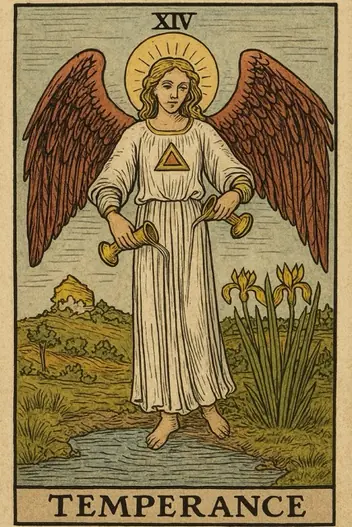

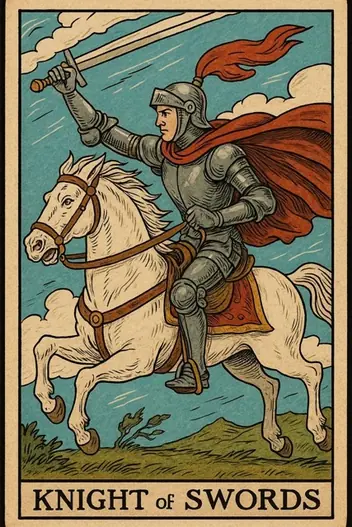
- Arcana
- Temperance — Major Arcana; Knight of Swords — Minor Arcana, Swords
- Elements
- Temperance — Fire; Knight of Swords — Air
- Elemental interaction
- Friendly elements — energies support each other
- Numerology
- 14 + 12 = 26 → 8
When the calm, measured energy of Temperance collides with the rapid, decisive force of the Knight of Swords, we encounter a powerful psychological paradox. Temperance represents the archetype of the Alchemist—the part of us that seeks integration, patience, and the middle path. The Knight of Swords embodies the Warrior of Intellect—the part that charges forward with a clear, sharp idea, cutting through obstacles without hesitation. In practice, this combination suggests a moment where you possess a compelling vision or a burning need to act, but you must apply emotional regulation and strategic pacing to avoid self-sabotage.
Psychologically, this pairing represents the tension between impulse control and decisive action. The Knight brings the clarity of a focused mind, but without Temperance, this can devolve into reckless aggression. Conversely, Temperance alone can lead to stagnation. Together, they create a state of high-functioning discipline: you know exactly what you want (Knight of Swords), and you have the patience to execute it step-by-step (Temperance). This is not about slowing down for the sake of it; it is about optimizing your energy so your actions are precise, not frantic.
Temperance and Knight of Swords: How These Energies Interact
The core dynamic here is the integration of speed with stability. The Knight of Swords represents a surge of mental energy—a new idea, a pressing deadline, or a conflict that demands immediate resolution. Temperance acts as the governor on this engine, ensuring that the Knight's thrust is not wasted on random targets. In a reading, this combination often indicates that you are on the verge of a breakthrough, but only if you can pause long enough to aim. The psychological state required is one of calm determination: you are fully committed to your goal, but you are not emotionally reactive to setbacks.
This is a highly pragmatic energy for problem-solving. The Knight provides the laser-like focus to identify the root cause of an issue, while Temperance provides the emotional bandwidth to handle the consequences without burning bridges. For example, in a negotiation, you can state your position firmly (Knight) while maintaining a collaborative tone (Temperance). The key insight is that you do not need to choose between being aggressive or passive; you can be assertive with grace. This combination asks you to trust your intellect but temper it with patience, recognizing that the fastest path is not always the straightest line.
Temperance and Knight of Swords for Career and Money
Strategic Opportunities:
This is an excellent time to pitch a new idea or launch a project that requires both speed and precision. Your mental clarity is high, and you can navigate bureaucratic hurdles with ease.
Strategic Opportunities:
Use this energy to resolve long-standing conflicts at work. You have the courage to address the issue head-on (Knight) and the diplomacy to find a win-win solution (Temperance).
Calculated Risks:
Avoid making impulsive financial decisions—the Knight's rush can lead to buying high or selling low. Temperance advises you to wait for the right moment, not the first moment.
In a career context, this combination is a strategic asset. You are likely in a position where you need to move quickly but without burning out. The Knight of Swords gives you the drive to tackle a complex problem, while Temperance ensures you pace yourself and delegate when necessary. This is not a time for reckless ambition; it is a time for focused execution. For financial planning, the message is to balance risk with caution. If you are considering an investment, do your due diligence (Knight) but also diversify and avoid putting all your eggs in one basket (Temperance). The pragmatic takeaway is to act with conviction, but revise your plan as new information emerges.
Your pair is already on the table. Ask your question and draw the clarifying card
or simply focus on it
Temperance and Knight of Swords Love Outcome
If you are single:
This pairing suggests you are attracted to someone intelligent and direct, but you must slow down the intellectual evaluation and allow emotional connection to develop naturally. Avoid over-analyzing the first few dates.
If you are in a relationship:
The dynamic may involve one partner pushing for a major decision (moving, commitment, confrontation) while the other seeks harmony. The goal is to find a compromise that honors both the need for progress and the need for peace.
In relationships, Temperance and Knight of Swords often signal a period where clear communication is essential, but so is emotional sensitivity. The Knight can come across as blunt or critical, while Temperance seeks to smooth things over. The healthiest expression of this energy is when you can state your truth directly (Knight) while remaining open to your partner's perspective (Temperance). Avoid the trap of intellectualizing emotions—the Knight's tendency to analyze feelings can undermine intimacy. Instead, use this combination to set clear boundaries with compassion. For example, if you need space to think (Knight), communicate that need without making it sound like a rejection (Temperance). The advice here is to lead with clarity, but follow with empathy.
Negative Meaning of Temperance and Knight of Swords
When this energy is blocked or distorted, the Knight of Swords can become overbearing and argumentative, while Temperance can become passive-aggressive or indecisive. The shadow side of this pairing manifests as self-sabotage through overthinking. You may have a brilliant idea (Knight) but then second-guess yourself into paralysis (Temperance taken too far). Alternatively, you might charge ahead without considering the emotional fallout, only to later regret your bluntness. Cognitive biases to watch for include "confirmation bias" —the Knight's sharp focus can blind you to contradictory evidence. You may also experience emotional suppression, where you prioritize logic over feelings, leading to burnout or strained relationships. The key pitfall is mistaking speed for progress. Just because you are moving fast does not mean you are moving in the right direction. Temperance is your check against this.
Your unique Tarot reading
See how these cards interact with your destiny. Start a free personal reading now.
Temperance and Knight of Swords Reversed: How to Read It
If Temperance is Reversed:
Blocked potential or chaotic haste. You lose your sense of proportion. The Knight of Swords without the brakes of Temperance turns into a destroyer. Advice: Consciously slow down. Introduce rituals or deadlines that force you to stop and double-check the facts.
If the Knight of Swords is Reversed:
Inner resistance and intellectual passivity. You have the resources and time (Temperance), but no will to act. You justify inaction with "wisdom," when in reality it is fear. Advice: Start with a small action. One phone call or one letter will break the vicious cycle.
If BOTH are Reversed:
A complete imbalance of dynamics. This is a state of "viscous aggression": you are angry but do nothing; you know something needs to change, but you are afraid. Advice: This is a signal for a deep revision of goals. Your strategy is not working because you are either heading in the wrong direction or using the wrong means. Come to a complete stop.
Temperance and Knight of Swords: Tarot Advice
Constructive use of this combination requires you to assume the role of a "strategist-diplomat." You must accept that the speed of the Knight of Swords is your trump card, but it needs to be applied in measured doses. Your task is not to suppress the energy, but to channel it into a course where it yields maximum benefit without destruction.
Think of Temperance as the cooling system for the Knight's engine. Without it, the engine overheats and explodes. Without the engine, the cooling system is useless. Your strategic plan should include stages: "Reconnaissance by Fire" (rapid data collection, like the Knight) and "Integration of Results" (a pause for reflection, like Temperance).
Deep advice:
Use the "Three-Step Method." Step 1 (Knight): Identify the most acute problem and formulate it in one sentence. Step 2 (Temperance): Write down three solution options, even if they seem absurd. Step 3 (Synthesis): Choose not the fastest or the safest, but the most sustainable option—the one that solves the problem without creating new ones. This is your "right solution."
Your Next Step: Personal Context Matters
The Temperance and Knight of Swords combination ultimately asks you to balance clarity with patience. You have the vision and the drive to achieve your goals, but the path requires careful modulation of your energy. The core message is that true mastery comes from knowing when to push forward and when to hold back. This is not a passive state; it is a dynamic, strategic approach to life.
Ready to apply this insight to your unique situation? While this article explains the general archetype, the real power of Tarot lies in personalization. Use the Fortune Cards app to get a deep, AI-driven interpretation of this exact combination tailored to your specific question. Whether you are navigating a relationship decision, a career pivot, or an internal conflict, the app provides actionable, psychologically-grounded guidance. Download Fortune Cards now or use it on the web to unlock your personalized reading and take your next step with confidence.
Interpretation by the Fortune Cards editorial team, based on the Rider–Waite tradition and Jungian archetypes. About our methodology · Updated: 2026-08-26
Other Combinations with Temperance
Other Combinations with Knight of Swords
Explore Individual Card Meanings
Table of Contents
- Temperance and Knight of Swords: How These Energies Interact
- Temperance and Knight of Swords for Career and Money
- Temperance and Knight of Swords Love Outcome
- Negative Meaning of Temperance and Knight of Swords
- Temperance and Knight of Swords Reversed: How to Read It
- Temperance and Knight of Swords: Tarot Advice
- Your Next Step: Personal Context Matters
Ready to find answers to your questions?
Start your first reading now and look at your situation with fresh clarity. The cards are ready to reveal deeper meaning.