Love Tarot: Ten of Cups and Ten of Swords
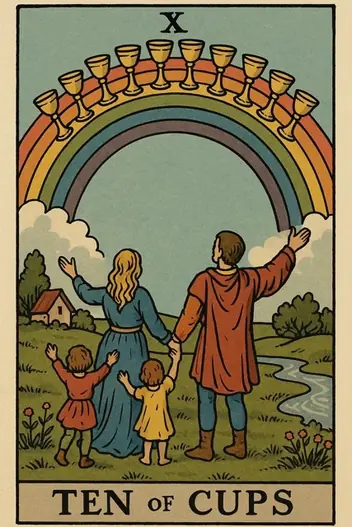
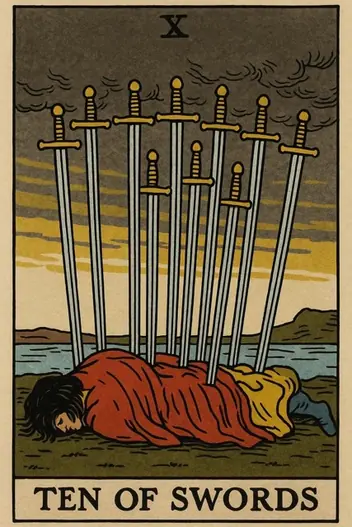
- Arcana
- Ten of Cups — Minor Arcana, Cups; Ten of Swords — Minor Arcana, Swords
- Elements
- Ten of Cups — Water; Ten of Swords — Air
- Elemental interaction
- Neutral elements — energies coexist without conflict
- Numerology
- 10 + 10 = 20 → 2
When the Ten of Cups—the archetype of emotional fulfillment, family harmony, and the "happy ending"—meets the Ten of Swords—the archetype of catastrophic endings, rock-bottom betrayals, and mental defeat—you are looking at a psychological paradox. This combination often represents the painful dissolution of a idealized dream. It is not a card of gradual erosion; it is a sudden, sharp rupture between what you believed was your destiny and what reality has delivered.
From a Jungian perspective, this pairing forces an encounter with the Shadow. The Ten of Cups projects a perfect, collective ideal onto a relationship or situation. The Ten of Swords then acts as the necessary, albeit brutal, disillusionment. The core conflict here is between the Ego’s need for completeness and the Reality’s demand for truth. The strategic question is not how to save the fantasy, but how to extract the wisdom from the wreckage before the pain becomes chronic.
Ten of Cups and Ten of Swords Combination Meaning
The primary dynamic is one of psychological rupture. The Ten of Cups represents a state of satisfied belonging, a feeling that "all is right with the world" within a specific container—be it a family, a couple, or a community. The Ten of Swords represents the logical conclusion of a mental pattern that has run its course. When they combine, you are likely experiencing a betrayal of trust that shatters your worldview. This is not a small disagreement; it is a revelation that the foundation you built your happiness upon was either a lie or fundamentally flawed.
This combination demands that you differentiate between genuine fulfillment and a performance of happiness. The Ten of Cups can sometimes represent a collective narrative we inherit (e.g., "marriage should look like this," "my career should bring me this joy"). The Ten of Swords then cuts that narrative down. Your mindset must shift from grief over a lost ideal to acceptance of a painful truth. The most important psychological insight here is that the ending is not the failure of you, but the failure of the story you were telling yourself. The real-world implication is that you must now rebuild from a place of radical honesty, not from a blueprint of fantasy.
Your pair is already on the table. Ask your question and draw the clarifying card
or simply focus on it
Ten of Cups and Ten of Swords in Love Tarot
If you are single:
This combination warns against projecting a "perfect life" onto a new person. If you are coming out of a painful breakup, do not rush to replicate the old fantasy with a new partner. The Ten of Swords suggests you need a period of cognitive reset before you can see a potential partner clearly.
If you are in a relationship:
You are likely facing a major rupture—a betrayal, a devastating argument, or the realization that your long-term goals are incompatible. The question is not whether the relationship can survive, but whether the shared illusion should.
In a relationship reading, this is a critical juncture for emotional intelligence. The Ten of Cups energy often masks resentment or unmet needs under a veneer of "everything is fine." The Ten of Swords is the explosion of that suppressed tension. Your strategic move is to stop defending the image of the relationship and start dealing with its broken structure. Boundaries are not optional here; they are survival mechanisms. If you try to smooth over the pain with forced positivity (Ten of Cups), you will only delay the inevitable, more painful conclusion. The key relationship advice is to acknowledge the ending of a specific phase—even if the partnership continues, the old dynamic is dead.
Career and Finances
Strategic Opportunities:
Clear the dead wood. This is the perfect time to end a toxic project, fire a destructive client, or walk away from a partnership that has become a liability.
Strategic Opportunities:
Reclaim your narrative. The failure is a data point. Use the clarity of the Ten of Swords to write a new, more realistic business plan that is not based on wishful thinking.
Calculated Risks:
Avoid "fixing" a sinking ship. Do not pour more money, time, or emotional energy into a professional situation that has already hit rock bottom. The Ten of Swords says the current form is over.
In a professional context, this combination is about strategic termination. The Ten of Cups often represents a "dream job" or a "perfect team culture" that you have outgrown or that has been corrupted. The Ten of Swords indicates a sudden, decisive failure—a contract lost, a public critique, or a restructuring that eliminates your role. Your pragmatic response must be to cut your losses immediately. Do not negotiate with a dead deal. The financial warning here is clear: sentimentality is your enemy. The Ten of Cups energy can make you cling to a failing venture because of the "family" you built there. The Ten of Swords demands you accept the bankruptcy of that emotional investment and move on to solvency.
Get a personalized interpretation
Unlock the combined meaning of your cards in the context of your unique question — for free.
Reversed Ten of Cups and Ten of Swords Explained
Reversed cards soften fatalism but add complexity to the psychological dynamic.
If the Ten of Cups is reversed:
Blocked potential and recklessness. You cannot achieve harmony not because of external circumstances, but due to internal sabotage. You yourself destroy your own happiness, fearing it. Advice: Stop looking for enemies on the outside. Your task is to understand why you do not allow yourself to be happy, and to start small, rather than trying to build a "paradise on earth" in a single day.
If the Ten of Swords is reversed:
Internal resistance and weakness. The crisis has already occurred, but you refuse to acknowledge it. You get up after the blow, not to move forward, but to fall again. Warning: This is a state of "stagnation" in pain. You are not processing the trauma; you are cultivating it. Advice: Make a decision for radical acceptance. The loss has already happened. Your resistance only prolongs the agony.
If BOTH are reversed:
Complete imbalance. Chaos in emotions and thoughts. You are simultaneously unable to find peace and unable to end the conflict. This is a state of "toxic stagnation". Method for correction: You need an external arbiter—a psychologist, coach, or mentor. It is extremely difficult to break out of this cycle on your own. Start with material ordering (cleaning the house, closing debts)—this will restore your sense of control.
What Are the Risks of Ten of Cups and Ten of Swords?
The shadow of this combination is a dangerous cycle of self-sabotage and martyrdom. You may unconsciously create a crisis to escape the "boring" perfection of the Ten of Cups, or you may cling to the role of the victim (Ten of Swords) to avoid the responsibility of building genuine happiness. A major cognitive bias here is the sunk cost fallacy: "I've invested so much in this relationship/dream, I can't give up now." This pair demands you confront the Shadow of the Victim—where you derive identity from your suffering. Another pitfall is idealizing the past, believing that the "perfect" time before the betrayal was real, and now everything is ruined. This prevents you from seeing the liberation that the Ten of Swords offers: a clean slate. If you act irrationally, you will either numb the pain with false harmony or wallow in the drama of the ending instead of extracting the lesson.
Ten of Cups and Ten of Swords Combined Message
How can the energy of the Ten of Cups be used constructively to balance the Ten of Swords? The answer is paradoxical: you must accept loss as part of mature happiness. The Ten of Cups in its pure form is a childlike fantasy of eternal bliss. The Ten of Swords is the harsh reality that says: "Your former form of happiness has died. Now you can create a new, more resilient one."
Strategic advice:
Instead of clinging to an "ideal picture" of the past or future, focus on creating a "safe space" for living through the crisis. Your task is not to return to a lost paradise, but to build a new home on the ashes. Use the lessons of the Ten of Swords (honesty, cutting away the excess, accepting finitude) to reassess your values. What does "happiness" actually mean to you? Perhaps it is not the absence of problems, but the ability to maintain inner peace amidst chaos.
Deep conclusion:
This combination is not a verdict, but an instruction for personal separation. It demands the courage to acknowledge that certain "ideal" chapters of your life have ended. Instead of trying to revive them, begin writing a new chapter, where happiness is not a given, but the result of conscious choice and acceptance of reality. Only by passing through the "swords" of truth can you fill your "cups" with authentic, rather than illusory, joy.
Applying This to Your Situation
The Ten of Cups and Ten of Swords together deliver a sobering truth: the dream must die for the real life to begin. The core message is not about despair, but about integrity through destruction. The happiness you seek cannot be built on a foundation that has already shattered. Your next step is to grieve the loss of the fantasy, then analyze the wreckage for its lesson, and finally, choose to build something smaller, truer, and more resilient.
While this analysis maps the archetypes, your specific situation—the exact nature of the betrayal, the history of the relationship, your personal triggers—will change the meaning dramatically. A generic interpretation can only take you so far.
To get a deep, personalized interpretation of the Ten of Cups and Ten of Swords for your exact question about love, career, or a life decision, use the Fortune Cards app. The app applies these archetypes to your unique context, giving you actionable, psychological insights you can use immediately. You can access it on the web or download it now to unlock the specific meaning of this combination for your life.
Interpretation by the Fortune Cards editorial team, based on the Rider–Waite tradition and Jungian archetypes. About our methodology · Updated: 2026-08-26
Other Combinations with Ten of Cups
Other Combinations with Ten of Swords
Explore Individual Card Meanings
Table of Contents
Ready to find answers to your questions?
Start your first reading now and look at your situation with fresh clarity. The cards are ready to reveal deeper meaning.