Ten of Wands and King of Swords Together in Tarot
- Arcana
- Ten of Wands — Minor Arcana, Wands; King of Swords — Minor Arcana, Swords
- Elements
- Ten of Wands — Fire; King of Swords — Air
- Elemental interaction
- Friendly elements — energies support each other
- Numerology
- 10 + 14 = 24 → 6
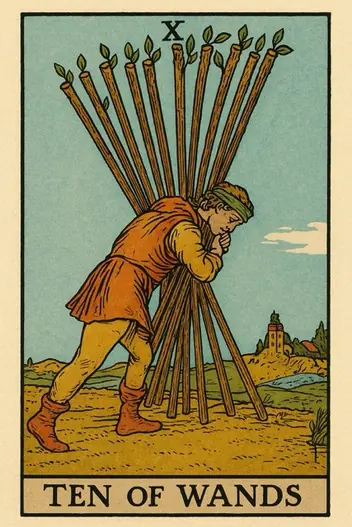
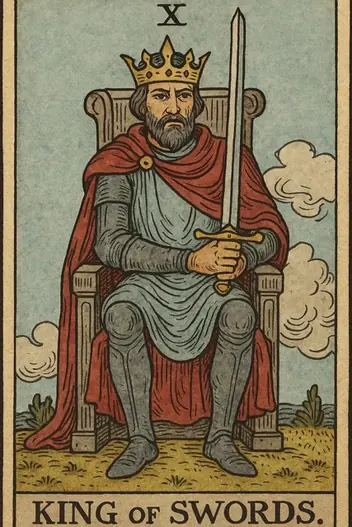
When the Ten of Wands meets the King of Swords, we encounter a complex psychological state where overwhelming responsibility collides with cold, analytical precision. The Ten of Wands represents the final stage of a burden—a pile of obligations, unfinished tasks, or sheer exhaustion from carrying too much. The King of Swords, by contrast, is the archetype of mental clarity, authority, and strategic command. Together, they depict a person who is using their intellect to manage an unsustainable workload, often at the cost of emotional well-being.
This combination is not about escape or rebellion. Instead, it signals a pivotal moment where the seeker must decide whether to apply ruthless logic to reorganize their life or risk burnout under the weight of their own commitments. The King of Swords offers a sharp, decisive mind; the Ten of Wands asks if that mind is being used wisely or merely to endure.
Ten of Wands and King of Swords Combination Meaning
The core dynamic here is a tension between capacity and control. The Ten of Wands shows you are carrying a heavy load—perhaps too heavy for one person. The King of Swords insists you can handle it through superior organization, clear boundaries, and disciplined thinking. This is a powerful but dangerous mindset: you may feel you must be the unshakeable authority in your own life, even when your resources are stretched thin.
Psychologically, this pairing activates the "Superego" archetype—the inner critic that demands perfection, efficiency, and stoic endurance. You may find yourself cutting off emotions or dismissing help because you believe only your own rational plan can succeed. The key insight here is that your logic is both your greatest asset and your greatest blind spot. You are solving problems, but you may not be solving the right problem—the need to offload, delegate, or accept limits.
In practical terms, this combination suggests a period of high-stakes decision-making under pressure. You are likely in a leadership role, managing complex systems, or dealing with legal/technical matters. The challenge is to use your analytical skills not to endure the burden, but to strategically dismantle it. Success comes from clarity of thought, not from willpower alone.
Love and Relationships
If you are single:
This combination suggests you are approaching new connections with a clinical, evaluative mindset. You may be carrying emotional baggage from past relationships and using logic to screen potential partners. Be careful not to over-analyze or reject someone prematurely—your standards are high, but your heart may need more space than your head allows.
If you are in a relationship:
The dynamic here can feel like one partner is overburdened and the other is detached or overly critical. The King of Swords energy may manifest as a partner who offers solutions instead of empathy, while the Ten of Wands energy shows exhaustion from carrying the emotional or practical weight of the relationship.
In relationships, this pairing often points to a power imbalance in communication and responsibility. The King of Swords partner may be intellectually dominant, offering logical arguments but failing to recognize the other’s emotional needs. The Ten of Wands partner may feel resentful, silently carrying chores, emotional labor, or sacrifices. The most critical relationship advice here is to establish clear, fair boundaries and to practice active listening. If you are the King of Swords, you must learn to validate feelings, not just facts. If you are the Ten of Wands, you must speak up about your limits before resentment builds. True intimacy requires vulnerability, not just efficiency.
Your pair is already on the table. Ask your question and draw the clarifying card
or simply focus on it
What Do Ten of Wands and King of Swords Indicate for Your Career?
Strategic Opportunities:
This is an excellent time to audit your workload and delegate tasks. Use your analytical skills to identify which responsibilities are essential and which can be handed off. Streamlining is your path to sustainable success.
Strategic Opportunities:
You are well-positioned for leadership roles that require tough decisions, such as restructuring a team, negotiating contracts, or resolving complex disputes. Your clarity is an asset.
Calculated Risks:
Beware of micromanagement and burnout. The King of Swords can become a tyrant when stressed, alienating colleagues. Also, avoid taking on additional debt or financial commitments to fund a "sure thing"—your judgment is sharp, but the burden is already heavy.
In career and finances, this combination signals a phase of high responsibility and high mental demand. You may be a manager, entrepreneur, or professional handling a critical project. The King of Swords gives you the strategic vision to see the big picture, but the Ten of Wands warns that you are at your limit. The smartest financial move is to consolidate and simplify—pay down debt, cut unnecessary expenses, and avoid new ventures until the current load is managed. In negotiations, you will excel at presenting facts and logic, but avoid becoming rigid; flexibility can prevent costly stalemates. Your greatest professional risk is overconfidence in your own plan—seek a second opinion or a trusted advisor.
Shadow Side & Pitfalls
The shadow side of this combination emerges when logic becomes a defense mechanism against acknowledging overwhelm. Instead of using the King of Swords’ clarity to solve the problem, you may use it to justify the unsustainable status quo. Common cognitive biases here include "sunk cost fallacy" (continuing because you've already invested so much) and "overconfidence effect" (believing you alone can handle it). This can lead to self-sabotage through perfectionism: you refuse to ask for help because no one else meets your standards, so you burn out alone.
Another pitfall is emotional suppression. The King of Swords values rationality over feelings, but the Ten of Wands is a deeply emotional card about exhaustion and sacrifice. If you ignore the emotional toll, you risk psychosomatic stress, irritability, or sudden outbursts that damage relationships. The shadow also manifests as ruthlessness—cutting people or projects out with cold logic, without considering the human cost. The warning here is clear: your mind is powerful, but it cannot replace rest, connection, or self-compassion. If you feel isolated or resentful, you are likely in the shadow expression of this pair.
Get a personalized interpretation
Unlock the combined meaning of your cards in the context of your unique question — for free.
Reversed Positions: What Changes?
When cards appear reversed, the dynamic is distorted but does not disappear. This signals internal resistance or a poorly chosen strategy.
If the Ten of Wands is reversed:
The burden becomes unbearable, and the sense of duty turns toxic. You may drop the load impulsively and without a plan, leading to chaos. Advice: do not quit or abruptly end relationships. First, find a "fallback airfield" — at least one day of rest or a helper.
If the King of Swords is reversed:
Rationality transforms into passive aggression or sarcasm. You are not managing the situation, merely criticizing it from within. Warning: you risk becoming a "smart idler." Honestly assess whether you are using analysis as an excuse for inaction. Step out of your head and start doing something.
If BOTH are reversed:
Complete imbalance. You simultaneously feel like a victim of circumstances (reversed Ten) and are unable to make a decision (reversed King). Corrective measure: a full stop. No new projects, no serious conversations. Take a 24-48 hour pause to release stress, and only then start small — perform one simple action.
Synthesis: Strategic Conclusion
How to constructively use the energy of the Ten of Wands to balance the King of Swords? The key lies in shifting focus from "how to do everything" to "what is most important." The Ten of Wands is fuel, the energy for a breakthrough. The King of Swords is a scalpel, a tool for precise cutting. Your task is not to carry the entire burden, but to cut away everything that is not critically important. This requires courage: to admit that you are not obligated to be a hero, and that your worth is not measured by the number of tasks heaped upon your shoulders.
The strategic advice is to apply the "80/20" rule with surgical precision. Analyze which 20% of your current obligations yield 80% of the result (or happiness, if it concerns relationships). Everything else is noise that needs to be eliminated. The King of Swords will give you the clarity to see this, and the Ten of Wands will give you the strength to take the first step. Use your mind not to withstand the pressure, but to shed it. The true victory in this combination is not to carry the burden to the finish line, but to consciously leave it halfway, choosing freedom and effectiveness over exhaustion.
Applying This to Your Situation
The Ten of Wands and King of Swords together deliver a powerful message: you are capable of handling immense pressure, but only if you apply your intellect wisely—not just to endure, but to reorganize and release. The core lesson is to balance strategic thinking with self-care, and to recognize that true authority includes knowing when to delegate or let go. This combination is a call to lead yourself with both clarity and compassion.
To unlock the full depth of this reading for your unique situation, use the Fortune Cards app. While this article explains the general archetype, the true power of Tarot lies in how these cards speak to your specific question—whether about a relationship, career decision, or personal crossroads. The app provides a personalized, context-aware interpretation of this exact combination, tailored to your life. Try it on the web or download it now for a deep, actionable insight that goes beyond the generic.
Interpretation by the Fortune Cards editorial team, based on the Rider–Waite tradition and Jungian archetypes. About our methodology · Updated: 2026-08-26
Other Combinations with Ten of Wands
Other Combinations with King of Swords
Explore Individual Card Meanings
Ready to find answers to your questions?
Start your first reading now and look at your situation with fresh clarity. The cards are ready to reveal deeper meaning.