Ten of Wands and Six of Pentacles Tarot as Feelings
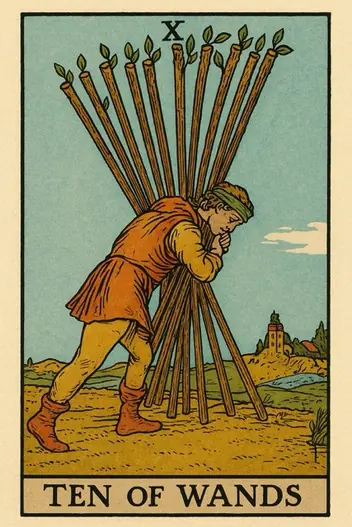
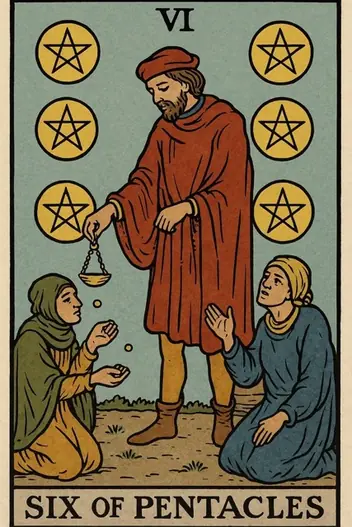
- Arcana
- Ten of Wands — Minor Arcana, Wands; Six of Pentacles — Minor Arcana, Pentacles
- Elements
- Ten of Wands — Fire; Six of Pentacles — Earth
- Elemental interaction
- Neutral elements — energies coexist without conflict
- Numerology
- 10 + 6 = 16 → 7
The intersection of the Ten of Wands and Six of Pentacles presents a powerful psychological tension. The Ten of Wands embodies the archetype of overburden—a state where responsibility, effort, or obligation has exceeded sustainable limits. It is the exhaustion of carrying too many "wands" alone. In contrast, the Six of Pentacles represents transactional generosity—a dynamic of giving and receiving, often within a clear power structure (patron to recipient, helper to helped). When these two collide, the core question becomes: Are you giving too much for too little return, or are you accepting help that creates a hidden debt?
This combination forces a pragmatic audit of your exchange rates in relationships, work, and self-care. It is not a card of romantic altruism; it is a clinical assessment of resource flow. The burden you carry may be a direct result of an imbalanced "gift"—either you are giving without receiving, or you are receiving help that traps you in a cycle of obligation. The path forward requires strategic renegotiation of your terms, not just grit or gratitude.
What Do Ten of Wands and Six of Pentacles Mean Together?
The central psychological dynamic here is cognitive dissonance between effort and reward. The Ten of Wands screams "I am doing too much," while the Six of Pentacles whispers "But someone is helping—or you are helping someone." This creates a conflict: you feel overwhelmed, yet you cannot stop because you perceive a moral or practical debt. The Six of Pentacles introduces a hierarchy of power—someone is in a position to give, and you (or another) are in a position to receive. This imbalance can feel stabilizing, but it often masks the true cost of the burden.
In practice, this combination often appears when a person is working harder than their compensation warrants (Ten of Wands) while relying on intermittent or conditional support (Six of Pentacles). The Six may represent a boss, partner, or family member who provides just enough relief to keep the burden bearable, but never enough to resolve it. The key insight is that the "help" is often a bandage, not a cure. The seeker must ask: Is this generosity enabling my overwork, or truly alleviating it? The psychological trap is mistaking temporary relief for structural change.
From a Jungian perspective, this pair activates the Puer Aeternus (Eternal Child) and Senex (Old Man) archetypes. The overburdened figure (Ten of Wands) may be the Senex—rigid, responsible, exhausted. The giver or receiver (Six of Pentacles) may be the Puer—seeking rescue or offering it without sustainable boundaries. Integration requires moving from a one-way dynamic to a reciprocal, balanced exchange. The goal is not to eliminate help, but to transform it into a partnership where both parties carry appropriate weight.
Career and Finances
Strategic Opportunities:
Leverage your current workload to negotiate better terms. The visibility of your effort (Ten of Wands) can justify a request for a raise, promotion, or additional resources (Six of Pentacles).
Strategic Opportunities:
Delegate or outsource specific tasks. The Six of Pentacles suggests that help is available—you just need to ask for it clearly and without guilt.
Calculated Risks:
Avoid taking on more debt or favors to manage your workload. The Six of Pentacles can represent loans or conditional support that creates future obligation, not freedom.
In a career context, this combination is a call to audit your professional exchange rate. Are you working 60-hour weeks for a salary that barely covers your rent? Are you accepting "exposure" or "experience" as payment? The Six of Pentacles here is not a guarantee of fair compensation; it is a reminder that every transaction has a power dynamic. If you are the giver (e.g., a manager or freelancer), ensure you are not undercharging or over-delivering out of guilt. If you are the receiver (e.g., an employee or contractor), document your contributions and use them as leverage.
Bold important financial warnings or strategic tips:
Do not mistake a favor for a salary. The Six of Pentacles can be deceptive—a one-time bonus or a kind gesture from a boss does not replace a fair wage or sustainable workload. Calculate your hourly rate for the Ten of Wands effort. If the math does not work, you must renegotiate or leave. The most strategic move is to convert "help" into "systemic support" —e.g., asking for a permanent assistant instead of occasional help from a colleague.
Your pair is already on the table. Ask your question and draw the clarifying card
or simply focus on it
Love and Relationships
If you are single:
This combination warns against entering a relationship where you are expected to carry the emotional or financial weight alone. Look for partners who offer reciprocal effort, not just occasional gestures of support.
If you are in a relationship:
You may be the one doing most of the heavy lifting—emotionally, logistically, or financially—while your partner provides intermittent "gifts" that keep you from addressing the imbalance.
In relationships, the Ten of Wands and Six of Pentacles reveal a power dynamic dressed as generosity. One partner may be over-functioning—managing chores, finances, or emotional regulation—while the other offers periodic help that feels meaningful but does not address the core imbalance. This is not about love; it is about equity. The Six of Pentacles can also indicate a "savior complex"—you are giving to feel needed, or you are receiving to feel cared for, but the exchange is not truly mutual.
Bold key relationship advice:
Stop accepting temporary relief as a substitute for structural change. If you are always the one carrying the wands, have a direct conversation about redistributing responsibilities. If you are the one receiving, ask yourself if the help you get is enabling your passivity. The healthiest relationships under this pair are those where both partners actively negotiate their contributions rather than falling into a giver-receiver trap. Boundaries are not unkind; they are necessary for sustainable intimacy.
Deepen your understanding
Find out exactly what this reading means for your current life situation with our oracle.
Reversed Ten of Wands and Six of Pentacles Explained
If the Ten of Wands is reversed:
This indicates blocked potential or recklessness. The person may shed responsibility too early, failing to see things through, or conversely, refuse help when it is critically needed. Warning: Do not confuse the release of a burden with the abandonment of obligations. Your task is not to drop the load, but to learn how to carry it more effectively.
If the Six of Pentacles is reversed:
This is a signal of internal resistance or systemic weakness. Help may be ineffective, hypocritical, or offered with strings attached. On the other hand, the recipient may be unwilling to accept help due to pride or fear. Advice: Analyze whether your "help" is a form of hidden control, and whether your "request" is a manipulation.
If BOTH are reversed:
A complete imbalance in the dynamic arises. You are overwhelmed but reject any support, while those who could help are either incompetent or unwilling to do so. This is a dead-end situation requiring a radical reassessment of priorities. The logical way to correct this is to temporarily stop trying to "fix everything" and focus on restoring your own resources.
Ten of Wands and Six of Pentacles: Warning Signs
The shadow of this combination is martyrdom disguised as generosity. The Ten of Wands person may take on excessive burden to feel indispensable, while the Six of Pentacles person may give conditionally to maintain control. Cognitive biases at play include the "sunk cost fallacy" (I've already worked so hard, I can't stop now) and the "reciprocity trap" (I must accept this help because they gave it, even if it creates debt). The seeker may also suffer from impostor syndrome—feeling they do not deserve help, so they overcompensate by working harder.
Another shadow manifestation is resentment masked by gratitude. You feel exhausted (Ten of Wands) but cannot complain because you have received help (Six of Pentacles). This creates a toxic inner dialogue: "I should be grateful, so why do I feel angry?" The answer is that the help is not addressing the root cause. The shadow path leads to burnout, passive-aggression, or a sudden collapse of the relationship when the burden becomes unbearable. Avoid this by being honest about your limits before you reach them.
Ten of Wands and Six of Pentacles Combined Message
Constructive use of this pair's energy requires a shift from reactive "rescuing" to proactive resource management. The Ten of Wands should not be a permanent companion; it is merely a signal that your current strategy has exhausted itself. The Six of Pentacles is not simply a handout, but a tool for creating a sustainable system.
Your strategic move is to institutionalize assistance. Instead of being the sole source of resources (money, time, knowledge), create a structure that will function even without your constant involvement. For example, train a colleague, automate a process, establish a reserve fund. Key principle: your goal is not to give away everything you have, but to ensure your resources yield maximum benefit with minimal expenditure of your energy.
The strategic conclusion is as follows: true strength is manifested not in the ability to bear an excessive burden, but in the wisdom to distribute it so that the goal can be reached. Use the energy of the Six of Pentacles not to lighten someone's load once, but to teach others to carry their own. This is the highest level of management—transforming dependence into autonomy.
Your Next Step: Personal Context Matters
The core message of the Ten of Wands and Six of Pentacles is this: You are carrying too much, and the help you receive may be part of the problem, not the solution. Whether in love, career, or self-care, the path forward requires a clear-eyed assessment of your exchanges. Stop asking "How can I do more?" and start asking "What is this burden costing me, and is the support I receive truly fair?" The goal is not to eliminate help, but to transform it into a balanced partnership.
This article provides a general archetypal analysis, but your situation is unique. The true power of Tarot lies in applying these insights to your specific question, context, and timing. To get a deep, personalized interpretation of the Ten of Wands and Six of Pentacles combination for your exact situation, use the Fortune Cards app. You can access it on the web or download it to receive a tailored reading that considers your question, your energy, and the nuances of your life right now. Get the clarity you need to rebalance your load.
Interpretation by the Fortune Cards editorial team, based on the Rider–Waite tradition and Jungian archetypes. About our methodology · Updated: 2026-08-26
Other Combinations with Ten of Wands
Other Combinations with Six of Pentacles
Explore Individual Card Meanings
Table of Contents
Ready to find answers to your questions?
Start your first reading now and look at your situation with fresh clarity. The cards are ready to reveal deeper meaning.