The Hierophant and The Chariot Tarot Combination
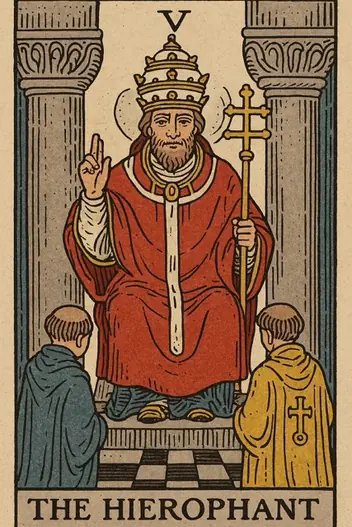

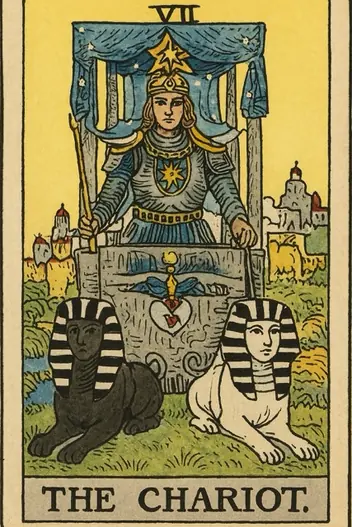
- Arcana
- The Hierophant — Major Arcana; The Chariot — Major Arcana
- Elements
- The Hierophant — Earth; The Chariot — Water
- Elemental interaction
- Friendly elements — energies support each other
- Numerology
- 5 + 7 = 12 → 3
When the conservative, tradition-bound Hierophant collides with the driven, victory-oriented Chariot, the result is a powerful tension between institutional authority and personal ambition. Psychologically, this pairing represents the seeker’s attempt to navigate the world by balancing external rules with internal drive. The Hierophant asks, “What has worked before?” while The Chariot demands, “What will I conquer now?”
In practice, this combination often appears when a person is ready to move forward but feels constrained by a system—be it a company, a relationship, or a family expectation. The key insight here is that structure does not have to be an enemy of progress. Instead, the seeker must learn to use established frameworks as a launchpad, not a cage. This is not a time for rebellion, but for disciplined negotiation between what is expected and what is desired.
The Hierophant and The Chariot Together: Meaning
The psychological state created by The Hierophant and The Chariot is one of controlled momentum. You possess a clear sense of direction, but you are also acutely aware of the rules, hierarchies, and social contracts that govern your environment. This is not a chaotic pursuit of a goal; it is a strategic campaign fought within an existing structure. The ego (The Chariot) is learning to work with the superego (The Hierophant) to achieve a result that is both personally fulfilling and socially acceptable.
This combination suggests that success will come through methodical action, not impulsive leaps. The seeker must demonstrate both competence (mastery of the system) and confidence (the will to push through obstacles). A common real-world example is a professional who secures a promotion by meticulously following company protocol while simultaneously demonstrating exceptional leadership and drive. The risk lies in becoming too rigid—overly identifying with the institution’s rules and losing the raw, adaptive willpower of The Chariot.
To harness this energy, focus on strategic patience. Break your larger goal into steps that align with existing protocols. Bold action is not the enemy; reckless action is. The most powerful stance here is that of a master strategist—one who knows the terrain, respects the rules of engagement, but is relentlessly committed to winning.
Your pair is already on the table. Ask your question and draw the clarifying card
or simply focus on it
The Hierophant and The Chariot in Career Readings
Strategic Opportunities:
Seek roles in established organizations with clear career ladders, where your drive can be channeled through a promotion path. Mentorship from senior leaders is a powerful catalyst.
Strategic Opportunities:
Use formal credentials, certifications, or industry standards to validate your skills and give you leverage in negotiations. Your reputation is your currency.
Calculated Risks:
Avoid overpromising on timelines to please authority figures. The Chariot’s speed can clash with the Hierophant’s bureaucracy. Do not sacrifice quality for speed.
This is an excellent combination for career advancement within a hierarchy, such as a corporate promotion, a government role, or a position in a professional guild. Financially, it favors conservative investment strategies that align with established market wisdom (e.g., index funds, blue-chip stocks) rather than speculative gambles. The psychological pitfall is becoming overly bureaucratic—using “the rules” as an excuse for inaction or lack of creativity. Balance your desire for control with flexibility. A practical step: create a 90-day action plan that maps your personal goals onto your organization’s quarterly objectives. Bold: This combination strongly warns against quitting your job impulsively before securing a structured exit strategy.
The Hierophant and The Chariot in Love and Relationships
If you are single:
This pairing suggests you may feel drawn to someone who embodies stability and tradition, but you also crave excitement and forward movement. Evaluate whether this person’s structure supports your growth or stifles it. Look for a partner who respects your ambition, not one who expects you to conform completely.
If you are in a relationship:
The dynamic here often involves a power struggle between commitment to the relationship’s framework and individual desires for autonomy or advancement. Bold communication about boundaries and shared goals is essential. One partner may feel the other is too controlling or too focused on external success.
In relationships, this combination often appears during periods of major life transitions—a move, a career change, or a family decision. The key psychological task is to align your personal will with your shared values. If one partner is solely in “Chariot mode” (pushing for personal goals) while the other is in “Hierophant mode” (enforcing routines and expectations), resentment builds. The healthiest outcome requires both partners to act as a unified chariot, steering the relationship toward a future that honors both individual ambition and collective stability. Couples therapy or structured communication rituals (like weekly check-ins) can be highly effective here.
Get a personalized interpretation
Unlock the combined meaning of your cards in the context of your unique question — for free.
When The Hierophant and The Chariot Signal Trouble
When this energy is blocked or misapplied, the seeker may experience cognitive dissonance—feeling torn between their personal ambitions and their loyalty to a group or system. This can lead to passive-aggressive behavior, where one outwardly complies with rules while inwardly resenting them. The shadow of The Hierophant appears as rigid dogmatism (“This is how it’s always been done”), while The Chariot’s shadow manifests as reckless overconfidence (“I can break the rules and still win”). Self-sabotage occurs when the seeker either abandons their ambition out of fear of conflict, or pushes so hard that they alienate their support network. A common cognitive bias here is the “sunk cost fallacy” —staying in a dysfunctional system because you’ve invested too much time or energy to leave. The real danger is losing your authenticity by becoming a puppet of the institution, or a lone wolf who burns bridges unnecessarily.
The Hierophant and The Chariot Reversed Meaning
When archetypes fall out of balance, their strengths turn into traps.
Hierophant Reversed, Chariot Upright:
You are a rebel without a cause. This is a dangerous combination of recklessness. You possess immense will and energy (The Chariot), but deny all authority and rules (The Hierophant). The result is chaotic movement, destruction for destruction's sake. Advice: Before breaking the system, make sure you have something better to replace it with.
Chariot Reversed, Hierophant Upright:
You are stuck in dogma. This is a state of internal resistance and weakness. You have a clear value system and knowledge of the rules (The Hierophant), but lack the strength and motivation to move forward (The Chariot). You become a conservative who fears change and clings to the status quo. Advice: Find a "coach" or mentor who can pull you out of passivity.
BOTH Reversed:
Complete imbalance. Nihilism mixed with apathy. The person accepts no rules but also has no strength to change them. This is a path to marginalization. The logical way to correct this is to find one single point of support. Return to basic social contacts (family, work) and start small, restoring at least a minimum of discipline.
The Hierophant and The Chariot: The Combined Message
Constructive use of this combination requires a meta-position in relation to the system. You must use the Hierophant (tradition) to discipline the Chariot (will), yet without becoming a slave to that tradition. Your task is to be a strategist, not a soldier.
How is this achieved? First, formalize your path. Write down your goals and the rules for achieving them. Create a personal "doctrine" for yourself to follow. This provides the structure of the Hierophant and the direction of the Chariot. Second, use authorities as a tool, not as the ultimate truth. Study the experience of successful people, but adapt it to your own situation. Do not copy blindly—rework it.
A deep strategic piece of advice: seek a "legitimate breakthrough." Do not try to change the rules of the game until you have become its champion. First, achieve success within the existing system (the Chariot), using its resources (the Hierophant). Once you have gained power and authority, you can change the rules from within. This is the path of evolution, not revolution. It is precisely this path that yields the most stable and long-term results.
Applying This to Your Situation
The core message of The Hierophant and The Chariot is that true power comes from mastering the system, not fighting it. You have the will to win, but you must also respect the structure you operate within. The most successful path blends discipline with drive, tradition with innovation. This is not a time for blind rebellion or passive conformity—it’s a time for strategic alignment.
Ready to see how this combination applies to your unique situation? The Fortune Cards app provides a deep, personalized interpretation of this exact pairing based on your specific question and life context. Whether you’re navigating a career decision, a relationship crossroads, or a personal growth challenge, the app uses advanced AI to analyze the cards in relation to your unique circumstances. Use Fortune Cards on the web or download the app now to get your custom reading and unlock the actionable insights you need to move forward with clarity and confidence.
Interpretation by the Fortune Cards editorial team, based on the Rider–Waite tradition and Jungian archetypes. About our methodology · Updated: 2026-08-26
Other Combinations with The Hierophant
Other Combinations with The Chariot
Explore Individual Card Meanings
Table of Contents
- The Hierophant and The Chariot Together: Meaning
- The Hierophant and The Chariot in Career Readings
- The Hierophant and The Chariot in Love and Relationships
- When The Hierophant and The Chariot Signal Trouble
- The Hierophant and The Chariot Reversed Meaning
- The Hierophant and The Chariot: The Combined Message
- Applying This to Your Situation
Ready to find answers to your questions?
Start your first reading now and look at your situation with fresh clarity. The cards are ready to reveal deeper meaning.