The Chariot and Nine of Swords Together in Tarot
- Arcana
- The Chariot — Major Arcana; Nine of Swords — Minor Arcana, Swords
- Elements
- The Chariot — Water; Nine of Swords — Air
- Elemental interaction
- Neutral elements — energies coexist without conflict
- Numerology
- 7 + 9 = 16 → 7
This pairing represents a high-stakes psychological battle between the drive to move forward and the paralyzing grip of fear. The Chariot embodies raw determination, control, and victory through sheer will. The Nine of Swords brings the opposite: anxiety, rumination, and a sense of impending doom. When these two cards appear together, it signals that your greatest obstacle is not external—it's the storm inside your own mind. You have the horsepower to charge ahead, but your mental chatter is threatening to throw you off course.
In real life, this often emerges during moments of high pressure: a career deadline, a relationship ultimatum, or a personal transformation. You feel compelled to act, yet plagued by worst-case scenarios. The key insight here is that the Chariot’s victory depends on mastering the Nine of Swords’ fear, not ignoring it. This combination demands that you harness anxiety as fuel for disciplined action, rather than letting it derail your momentum.
Core Dynamics & Interpretation
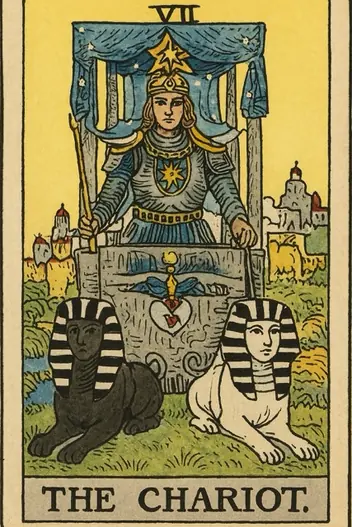
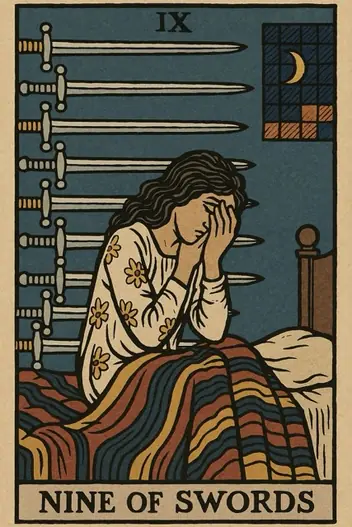
The core dynamic of The Chariot and Nine of Swords is a clash between conscious will and unconscious dread. The Chariot represents the ego’s attempt to steer life toward a goal—often symbolized by the black and white sphinxes pulling in opposite directions. The Nine of Swords reveals what those sphinxes actually represent: conflicting thoughts, sleepless nights, and the haunting voice of self-doubt. Together, they show a person who is externally moving forward but internally at war with themselves.
Psychologically, this combination points to cognitive dissonance: you want to succeed, but you’re replaying past failures or anticipating future catastrophes. The Chariot’s armor is a defense mechanism, but the Nine of Swords suggests that this armor is cracking under the weight of suppressed anxiety. The pragmatic solution is to shift from reactive worry to proactive planning. Instead of trying to banish fear, channel it into structured action. Use the Chariot’s discipline to schedule time for problem-solving, not endless rumination.
In practical terms, this pair often appears when you’re on the verge of a breakthrough but feel exhausted. The Nine of Swords can indicate burnout from overthinking. The most effective strategy is to break your goal into small, manageable steps. Each small victory builds evidence against your fears, weakening the Nine of Swords’ grip. The Chariot’s true strength lies not in brute force, but in strategic focus—choosing where to direct your willpower and when to rest.
What Do The Chariot and Nine of Swords Indicate for Your Career?
Strategic Opportunities:
Use your anxiety as a warning system to identify weak points in your project or plan. Channel nervous energy into rigorous preparation—create contingency plans for the worst-case scenarios that keep you up at night.
Strategic Opportunities:
This is an ideal time to lead a crisis management effort. Your ability to stay focused under pressure can turn a chaotic situation into a career-defining success. Delegate tasks to avoid burnout; the Chariot cannot do everything alone.
Calculated Risks:
Avoid making impulsive decisions based on fear. The Nine of Swords can trick you into overcorrecting or pulling back too early. Do not quit a stable position without a concrete backup plan. Also, watch for overconfidence—the Chariot’s ego may dismiss legitimate risks, leading to avoidable losses.
In a professional context, this combination signals a high-pressure period that tests your resilience. You may be facing a tight deadline, a difficult negotiation, or a competitive environment. The most practical approach is to treat your anxiety as data. Ask: What specific outcome am I afraid of? How likely is it? What can I do to reduce that probability? The Chariot excels at execution, but the Nine of Swords demands strategic risk assessment. Bold financial warning: Do not invest or expand based on emotion alone. Verify facts, run the numbers, and get a second opinion. For career moves, focus on building a reputation for calm under fire. This combination can actually be a powerful signal for promotion if you demonstrate the ability to manage both pressure and people. Key strategic tip: use the Nine of Swords’ hyper-awareness to anticipate obstacles, then let the Chariot’s discipline dismantle them one by one.
Your pair is already on the table. Ask your question and draw the clarifying card
or simply focus on it
Love and Relationships
If you are single:
This combination suggests you may be projecting past relationship traumas onto new possibilities. Objectively assess whether your anxiety stems from the current person or from unresolved patterns. The Chariot urges you to take a calculated risk, but the Nine of Swords warns against moving forward without first addressing your own insecurities.
If you are in a relationship:
Expect a period of tension where one partner feels driven to push the relationship forward, while the other is consumed by worry or regret. Communication must be direct and non-accusatory. The Chariot’s willpower can become controlling if fear is not acknowledged openly.
In relationships, this pair often indicates a power struggle fueled by unspoken anxieties. The Chariot partner may appear dominant or demanding, while the Nine of Swords partner feels overwhelmed and misunderstood. The key relationship advice is to create a safe space for vulnerability. The Chariot’s drive must be tempered with empathy; the Nine of Swords’ fears need validation, not dismissal. Establish clear boundaries around decision-making: agree on who handles what, and schedule regular check-ins to prevent resentment from building. If you are the one feeling anxious, write down your specific fears and ask yourself how many are realistic versus exaggerated. This cognitive reframing can reduce the Nine of Swords’ intensity and allow the Chariot’s forward momentum to serve the relationship, not sabotage it.
Uncover hidden insights
Let our advanced Tarot system interpret these archetypes specifically for your personal path.
Reversed Positions: What Changes?
The Chariot Reversed:
Complete loss of control and direction. Aggression gives way to apathy. Instead of moving toward your goal, you are standing still or moving chaotically. Advice: acknowledge that you are not in control of the situation and delegate some authority. Temporarily abandon your ambitions and focus on basic stability.
Nine of Swords Reversed:
Suppressed anxiety that bursts forth. Inner fears are denied but manifest through psychosomatic symptoms or inappropriate outbursts of anger. Warning: do not ignore your body's signals (insomnia, headaches). This is not weakness, but your psyche's cry for rest.
BOTH Reversed:
Complete imbalance: chaos and paranoia. You are simultaneously unable to move forward and unable to find peace. This is a state of emotional burnout. The logical way to correct this: a complete stop. Take a vacation or do a "digital detox." Your task is not to solve problems, but to restore your resources. Advice: consult a psychologist or coach, as it is extremely difficult to break out of this cycle on your own.
The Chariot and Nine of Swords: Warning Signs
The shadow side of this pairing emerges when the Chariot’s willpower becomes rigid denial and the Nine of Swords’ anxiety turns into paralyzing obsession. The seeker may push forward relentlessly, ignoring clear warning signs, while privately being consumed by fear of failure. This leads to burnout, poor decisions, and damaged relationships. Cognitive biases like confirmation bias (only seeing evidence that supports your plan) and catastrophizing (assuming the worst outcome is inevitable) are common. Self-sabotage appears as overworking to prove you’re worthy, or withdrawing from support systems because you feel you must handle everything alone. If you notice yourself snapping at loved ones, losing sleep, or making reckless choices, recognize that the Chariot’s armor is cracking. The shadow path is to double down on control instead of seeking balance. The antidote is humility: admit you are afraid, ask for help, and accept that some outcomes are beyond your control.
The Chariot and Nine of Swords Combined Message
Constructive use of this energy requires radical acceptance of your vulnerability. The Chariot must stop being a "tank" that crushes everything in its path and become an "explorer" who takes the terrain into account. Your task is not to get rid of anxiety, but to use it as a navigator. The Nine of Swords points out the weak spots in your plan. Analyze your fears: "What exactly am I afraid of? What are the objective risks? What can I do to minimize them?"
Strategic advice: implement a "morning planning" ritual. Every morning, before starting work, write down your 3 main tasks and 1 specific fear associated with each. Then, in writing, give yourself a rational response to that fear. For example: "I'm afraid I'll fail the negotiations. Response: I've prepared the presentation and I know all the client's objections." This will shift the anxiety from the emotional sphere to the rational one.
Remember: The Chariot without the Nine of Swords is recklessness, and the Nine of Swords without the Chariot is paralysis. Only a conscious synthesis of will and analysis allows you to achieve goals without destroying yourself. Your strength now lies not in suppressing fear, but in the ability to act in spite of it, yet with a full understanding of its causes.
Your Next Step: Personal Context Matters
The Chariot and Nine of Swords together deliver a clear message: your willpower is strong, but it must be guided by self-awareness, not fear. The path forward requires you to acknowledge your anxiety without letting it define your choices. Victory comes not from silencing your inner critic, but from using its energy to sharpen your focus and refine your strategy. Remember, the Chariot wins by steering—not by fighting the sphinxes.
To unlock the full power of this combination for your unique situation, use the Fortune Cards app. While this article explains the general archetype, the true insight comes from applying Tarot to your specific question. The app provides a deep, personalized interpretation of The Chariot and Nine of Swords based on your context—whether you’re navigating love, career, or personal growth. Start your free reading on the web or download the app now to get the clarity and strategic guidance you need to turn anxiety into action.
Interpretation by the Fortune Cards editorial team, based on the Rider–Waite tradition and Jungian archetypes. About our methodology · Updated: 2026-08-26
Other Combinations with The Chariot
Other Combinations with Nine of Swords
Explore Individual Card Meanings
Table of Contents
Ready to find answers to your questions?
Start your first reading now and look at your situation with fresh clarity. The cards are ready to reveal deeper meaning.