The Hierophant and Four of Pentacles Tarot Combination
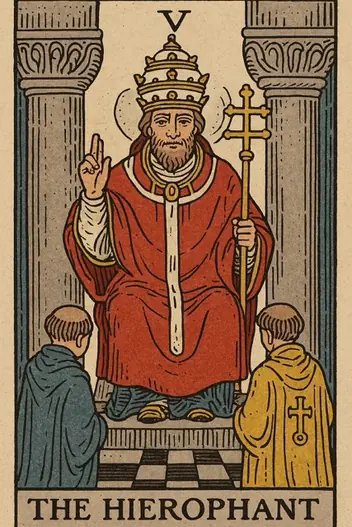
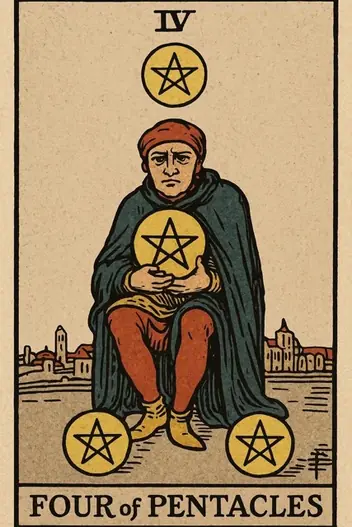
- Arcana
- The Hierophant — Major Arcana; Four of Pentacles — Minor Arcana, Pentacles
- Elements
- The Hierophant — Earth; Four of Pentacles — Earth
- Elemental interaction
- Same element — energies intensify each other
- Numerology
- 5 + 4 = 9
When The Hierophant—the archetype of institutional wisdom, tradition, and structured belief systems—collides with the Four of Pentacles—the archetype of hoarding, control, and rigid boundaries—the resulting psychological state is one of defensive conservatism. This pairing suggests a person who is not merely cautious but actively barricading themselves within a fortress of rules, routines, and resources. The core dynamic is a tension between the desire for external validation through established structures (The Hierophant) and the fear of losing what one has built (Four of Pentacles). In real-world terms, this often manifests as someone who clings to a job, relationship, or worldview long after it has ceased to serve them, mistaking stability for safety and habit for wisdom.
Psychologically, this combination activates what Jung called the Senex archetype—the old man who values order above all else. While this can produce reliable, disciplined behavior, it also risks rigid thinking, fear of change, and a resistance to innovation. The seeker may be using external rules (religious, corporate, familial) as a shield against the anxiety of uncertainty. The Four of Pentacles adds a layer of possessiveness: not just of money, but of time, energy, emotional intimacy, and even ideas. The key question becomes: Are you protecting your resources, or are your resources protecting you from living?
The Hierophant and Four of Pentacles for Career and Money
Strategic Opportunities:
Use your respect for procedure to secure a promotion or grant; formal qualifications and institutional backing are your allies now.
Strategic Opportunities:
Systematize your finances by automating savings and creating a clear budget—this satisfies the Four of Pentacles’ need for control without becoming miserly.
Calculated Risks:
Avoid over-investing in legacy systems or refusing to adapt to new market realities. The biggest risk is stagnation disguised as prudence.
In your professional life, The Hierophant and Four of Pentacles together point to a conservative, risk-averse career strategy. You may be a model employee who follows every rule, but you risk being passed over for more innovative colleagues. Financially, this is a time to audit your assets and eliminate waste, not to expand aggressively. However, beware the trap of false scarcity—the belief that there isn’t enough, which leads to hoarding rather than strategic investing. A critical financial warning: Do not confuse cash flow with net worth. The Four of Pentacles often signals someone who is rich on paper but poor in liquidity due to over-leveraging or refusing to sell underperforming assets. Your next move should be to review your portfolio with a trusted advisor (The Hierophant’s wisdom) rather than going it alone.
The Hierophant and Four of Pentacles Love Outcome
If you are single:
This pairing suggests you may be overly cautious about new connections, setting such rigid standards (The Hierophant’s checklist) that you reject potential partners before giving them a real chance. You might be guarding your heart so tightly that you appear emotionally unavailable.
If you are in a relationship:
The dynamic here often involves one partner enforcing traditional roles or financial control, leading to a power imbalance. The relationship may feel more like a contract than a connection, with each party hoarding their own emotional or financial resources.
The relationship dynamics under this combination are marked by emotional conservatism and a fear of vulnerability. The Hierophant emphasizes commitment to external forms—marriage, social expectations, shared values—while the Four of Pentacles suggests one or both partners are withholding intimacy or controlling shared assets as a way to manage anxiety. The psychological risk is that the relationship becomes a transactional arrangement where love is measured by adherence to rules rather than genuine connection. Key relationship advice: Identify one area where you can practice generosity—whether it’s your time, attention, or trust—without requiring immediate reciprocity. This breaks the hoarding pattern and invites authentic bonding.
Your pair is already on the table. Ask your question and draw the clarifying card
or simply focus on it
The Hierophant and Four of Pentacles Reversed: What Changes?
When cards appear reversed, the rigid structure develops a crack, and this can be either liberation or chaos.
If The Hierophant is reversed:
Blocked potential and recklessness. You lose your footing in tradition or authority. This can mean a break with family, dismissal from a stable company, or renouncing religion. Paired with the upright Four of Pentacles, this creates a dangerous combination of a "rebel with a tight purse." You reject the rules but continue to cling to resources. Advice: don't burn bridges without a new plan. Your rebellion must be conscious, not impulsive.
If the Four of Pentacles is reversed:
Internal resistance and financial weakness. You can no longer maintain control. This could be a forced expense, loss of property, or a psychological inability to say "no." Paired with the upright Hierophant, this means a crisis of the system. You follow the rules, but your resources (money, time, energy) are draining away. Advice: acknowledge that old methods of protection are not working. Seek new sources of resources rather than trying to patch old holes.
If BOTH are reversed:
Complete dynamic imbalance. This is a state of anomie—the destruction of norms and chaos in management. You have simultaneously lost faith in the system (Hierophant) and cannot hold onto resources (Four of Pentacles). This is the riskiest scenario, leading to burnout and a financial pit. The logical way to correct it: do not try to restore the old structure. First, regain control over basic resources (Four of Pentacles)—pay off debts, create a minimal buffer. Only after that, seek a new value system or mentor (Hierophant).
When The Hierophant and Four of Pentacles Signal Trouble
When this energy is blocked or acted upon unconsciously, the shadow manifests as dogmatic rigidity and miserly hoarding. The cognitive bias at play is the sunk cost fallacy—the inability to abandon a failing project, relationship, or belief system because of the time, money, or identity already invested. The seeker may also suffer from confirmation bias, only seeking advice that reinforces their existing worldview (The Hierophant’s shadow) while dismissing any evidence that challenges their financial or emotional fortress (Four of Pentacles’ shadow). This can lead to self-sabotage through isolation: pushing away friends, lovers, or colleagues who offer genuine help because they threaten the controlled order. The greatest danger is mistaking control for security, when in reality, true security requires flexibility and trust.
Ask your specific question
Don't rely on generic meanings. Get a customized reading tailored specifically to your energies.
Overall Meaning of The Hierophant and Four of Pentacles
How to constructively use the Hierophant's energy to balance the Four of Pentacles? The key lies in reframing the goal. The Hierophant is not merely "tradition"—it is the transmission of knowledge and initiation. The Four of Pentacles is not simply "hoarding"—it is care for the future. When these archetypes operate in a healthy manner, they create not a fortress, but a sustainable ecosystem.
Your strategic task is to transform "preservation" into "resource management for growth." Use the Hierophant's discipline to establish rituals of development, not rituals of defense. For instance, set aside a "risk hour" each week—time dedicated to trying something new with no guaranteed outcome. The Hierophant provides the structure for this hour, while the Four of Pentacles supplies the budget you are willing to lose without destabilizing your life.
A deep strategic insight: Separate your identity from your resources. The Hierophant teaches that your worth lies in your role and wisdom. The Four of Pentacles mistakenly equates worth with money and possessions. Choose the Hierophant's path: build your security on knowledge, reputation, and connections, not on a bank account. This will make you mobile and resilient to financial crises. Your true stability is your capacity to adapt, not your vault.
Your Next Step: Personal Context Matters
The core message of The Hierophant and Four of Pentacles is a call to examine the structures you cling to. Are your traditions and routines supporting your growth, or are they simply comfortable prisons? This combination asks you to hold your resources—time, energy, money, beliefs—with an open hand, not a clenched fist. The wisdom of The Hierophant is meant to guide, not imprison; the security of the Four of Pentacles is meant to be a foundation, not a cage.
To discover exactly how this archetypal tension applies to your unique situation—your specific relationship, career choice, or financial decision—you need a personalized reading. While this article reveals the general psychology, the true power of Tarot lies in its application to your life. Use the Fortune Cards app on the web or download it now to receive a deep, customized interpretation of The Hierophant and Four of Pentacles for your exact question. The app’s AI integrates Jungian psychology with your personal context, giving you actionable insights in seconds. Don’t just read about the cards—let them speak directly to you.
Interpretation by the Fortune Cards editorial team, based on the Rider–Waite tradition and Jungian archetypes. About our methodology · Updated: 2026-08-26
Other Combinations with The Hierophant
Other Combinations with Four of Pentacles
Explore Individual Card Meanings
Table of Contents
- The Hierophant and Four of Pentacles for Career and Money
- The Hierophant and Four of Pentacles Love Outcome
- The Hierophant and Four of Pentacles Reversed: What Changes?
- When The Hierophant and Four of Pentacles Signal Trouble
- Overall Meaning of The Hierophant and Four of Pentacles
- Your Next Step: Personal Context Matters
Ready to find answers to your questions?
Start your first reading now and look at your situation with fresh clarity. The cards are ready to reveal deeper meaning.