The Hierophant and Knight of Swords Meaning in Tarot
- Arcana
- The Hierophant — Major Arcana; Knight of Swords — Minor Arcana, Swords
- Elements
- The Hierophant — Earth; Knight of Swords — Air
- Elemental interaction
- Opposing elements — energies create tension
- Numerology
- 5 + 12 = 17 → 8
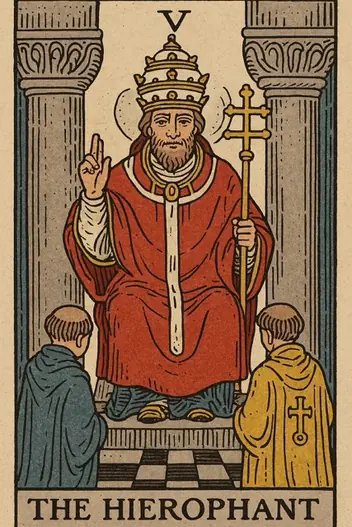
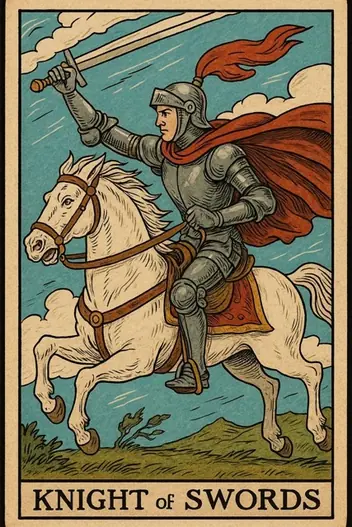
When the Hierophant—the keeper of established systems, institutions, and shared beliefs—collides with the Knight of Swords—the headlong charger of logic, debate, and swift action—you get a fascinating psychological tension. This isn't a peaceful alignment. It represents the moment when an individual's drive for intellectual freedom meets the weight of collective tradition.
In practical terms, this combination often surfaces when you are questioning a core belief system (religious, corporate, familial, or cultural) but are still operating within its boundaries. You have the tools to challenge the status quo, but you may lack the patience for the diplomatic process. The result is a high-stakes dynamic: you must either reform the system from within or risk a costly break. The key psychological insight here is cognitive dissonance—the discomfort of holding two conflicting ideas simultaneously. Your task is to resolve this tension with precision, not with a wrecking ball.
The Hierophant and Knight of Swords Card Meaning Explained
The core of this pairing is a strategic conflict between structure and speed. The Hierophant represents the slow, deliberate accumulation of knowledge through tradition, mentorship, and shared rituals. The Knight of Swords represents the rapid, laser-focused pursuit of a single truth, often at the expense of social harmony. When combined, they create a mindset that is analytically aggressive but institutionally constrained.
Psychologically, this is the archetype of the reformer or the iconoclast who still wants a seat at the table. You are not rejecting the system entirely; rather, you are convinced that your correct, logical solution can fix it. The danger lies in overconfidence in your own intellectual framework. The Knight of Swords wants to charge ahead with a solution, while the Hierophant demands respect for the process. Your best move is to use data and logic to build a compelling case, but to present it through proper channels. This is not the time for guerrilla tactics. It is the time for a well-prepared, fact-based proposal delivered to the right authority figure.
The practical implication is that you must balance speed with diplomacy. Move quickly on research and analysis, but slow down your delivery. The Knight of Swords can win the argument but lose the war if they alienate the gatekeepers (the Hierophant's domain). Your strategic advantage is your ability to see gaps in the system that others miss. Use that insight to propose targeted improvements, not wholesale destruction.
Your pair is already on the table. Ask your question and draw the clarifying card
or simply focus on it
The Hierophant and Knight of Swords in Love and Relationships
If you are single:
This combination suggests you are attracted to someone who is intellectually stimulating but may come from a very different background or value system. Do not rush into a commitment based solely on mental chemistry. Evaluate whether their core values align with yours before charging ahead.
If you are in a relationship:
You or your partner may be using logic to avoid emotional vulnerability. One person is pushing for change (Knight of Swords) while the other insists on stability and tradition (Hierophant). This creates a power struggle that can only be resolved through structured communication.
In relationships, this pairing often signals a clash between head and heart, or between individual freedom and partnership expectations. The Knight of Swords energy wants to dissect every problem, find the "correct" answer, and move on. The Hierophant energy wants to honor the relationship's history, rituals, and emotional contracts. The key to harmony is to create a shared framework for conflict resolution. Establish a rule: before debating a sensitive topic, both parties must first agree on the goal (e.g., "We are not trying to win, we are trying to understand"). Bold advice: If you feel the urge to "correct" your partner, pause and ask yourself if you are prioritizing being right over being connected.
The shadow risk here is that one partner becomes the "teacher" and the other the "student," creating an unhealthy power imbalance. If you feel you are constantly defending your choices against a barrage of logical arguments, you are in the shadow of the Knight of Swords. Reclaim your autonomy by setting a boundary: "I need you to listen without offering a solution right now."
The Hierophant and Knight of Swords in Career Readings
Strategic Opportunities:
Use your deep knowledge of industry standards (Hierophant) to identify a flaw or inefficiency that your competitors have overlooked. Pitch a targeted, data-backed solution to a senior decision-maker.
Strategic Opportunities:
Leverage your reputation for being both a "rule-follower" and a "sharp thinker." You are uniquely positioned to bridge the gap between old-guard management and new, innovative teams.
Calculated Risks:
Avoid publicly challenging a superior or a long-standing procedure without first building a coalition of support. The Knight of Swords can be perceived as arrogant; do not let your eagerness to prove yourself make you a target.
This is a powerful combination for career advancement, but it requires strategic patience. You have the intellectual firepower to innovate, but you must respect the chain of command. The most effective approach is to frame your new idea as an evolution of an existing tradition, not a rejection of it. For example, instead of saying "Your system is broken," say "I've analyzed our current process and found a way to improve efficiency by 20% while maintaining our core standards."
Financially, this combination warns against impulsive, "revolutionary" investments. The Knight of Swords wants to chase the next big trend, while the Hierophant advises sticking to proven, conservative strategies. Your best financial move is to research a new opportunity thoroughly (Hierophant) before making a decisive, calculated move (Knight of Swords). Do not let the fear of missing out override your due diligence. Bold warning: Avoid any scheme that promises a "new paradigm" without a track record.
Deepen your understanding
Find out exactly what this reading means for your current life situation with our oracle.
The Hierophant and Knight of Swords Reversed Meaning
When the cards are reversed, constructive tension turns into destructive chaos.
If The Hierophant is reversed:
Traditions and authorities lose their power, but are not replaced by anything new. The Knight of Swords is left without a counterbalance and simply becomes an aggressive arguer. You risk destroying a system without having a plan to rebuild it. Advice: do not rebel for the sake of rebellion — first formulate what you want to build in its place.
If the Knight of Swords is reversed:
The intellectual attack becomes passive or incompetent. You criticize but offer no solutions. The Hierophant oppresses you with its weight, causing a feeling of powerlessness. Warning: this is the state of the "smart victim" who knows how bad everything is but is afraid to act. You need to stop analyzing and start taking at least small steps.
If BOTH are reversed:
Complete imbalance. You simultaneously fear authorities and despise them. This leads to paralysis of the will and cynicism. Method of correction: temporarily abandon the search for an "absolute truth." Focus on practical, small tasks to regain a sense of control.
When The Hierophant and Knight of Swords Signal Trouble
The shadow of this combination manifests as dogmatic intellectualism—the belief that your logic is so pure that it justifies breaking any rule. You may become the person who "knows better" than everyone else, alienating allies and burning bridges. The cognitive bias at play is the Dunning-Kruger effect: you may overestimate your understanding of a complex system because you have mastered one part of it.
Another pitfall is paralysis by analysis, where the Knight of Swords' speed is blocked by the Hierophant's need for approval. You may find yourself endlessly preparing a perfect proposal, but never actually submitting it because you fear the gatekeepers' response. This is self-sabotage disguised as diligence. If you have been stuck in this loop for more than a week, recognize that you are avoiding a necessary conflict.
The most dangerous shadow is using tradition as a weapon to silence dissent. If you are in a position of authority (Hierophant), you may use your power to crush the Knight of Swords' valid critique, dismissing it as "disrespectful" or "too radical." This is a failure of leadership. True wisdom lies in creating a space where the Knight's sharp questions can be heard without being punished.
Overall Meaning of The Hierophant and Knight of Swords
Constructive use of this energy requires disciplined passion. The Hierophant provides you with a framework, structure, and respect for history. The Knight of Swords gives you speed, clarity, and courage. Your task is not to choose between them, but to use one as a tool to amplify the other.
Strategic advice: imagine yourself as a change management consultant. You have entered a company (your life, your relationships) not to destroy it, but to make it more efficient. First, study all the rules and processes (Hierophant). Then, armed with data, propose specific improvements (Knight of Swords). Your greatest ally is facts backed by authority.
This combination is ideal for situations where you need to reform, not revolutionize. It grants you the gift of seeing a system's flaws without losing respect for its value. Use this gift wisely: your criticism must be so precise that the system has no choice but to change. Remember: the best way to change the rules is to first prove you understand them better than anyone else.
Your Next Step: Personal Context Matters
The Hierophant and Knight of Swords combination is a call to action that requires both respect for structure and courage to challenge it. Your core task is to find the intersection where your brilliant idea can be implemented within the existing system. Do not burn the house down—reinforce it with better architecture. The answer lies in preparation, timing, and diplomacy.
While this article outlines the general archetype, the true power of Tarot lies in its application to your specific situation. Are you the Hierophant defending your authority, or the Knight of Swords pushing for change? The answer changes everything. To get a deeply personalized interpretation of this exact combination for your unique question—whether it's about a specific relationship conflict, a career move, or a financial decision—use the Fortune Cards app. You can access it on the web or download it now to receive a tailored reading that reveals the precise psychological dynamics at play in your life. Stop guessing. Start acting with clarity.
Interpretation by the Fortune Cards editorial team, based on the Rider–Waite tradition and Jungian archetypes. About our methodology · Updated: 2026-09-17
Other Combinations with The Hierophant
Other Combinations with Knight of Swords
Explore Individual Card Meanings
Table of Contents
- The Hierophant and Knight of Swords Card Meaning Explained
- The Hierophant and Knight of Swords in Love and Relationships
- The Hierophant and Knight of Swords in Career Readings
- The Hierophant and Knight of Swords Reversed Meaning
- When The Hierophant and Knight of Swords Signal Trouble
- Overall Meaning of The Hierophant and Knight of Swords
- Your Next Step: Personal Context Matters
Ready to find answers to your questions?
Start your first reading now and look at your situation with fresh clarity. The cards are ready to reveal deeper meaning.