The Hierophant and Seven of Swords Tarot Combination
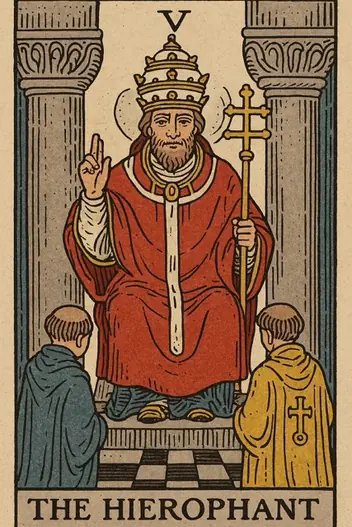
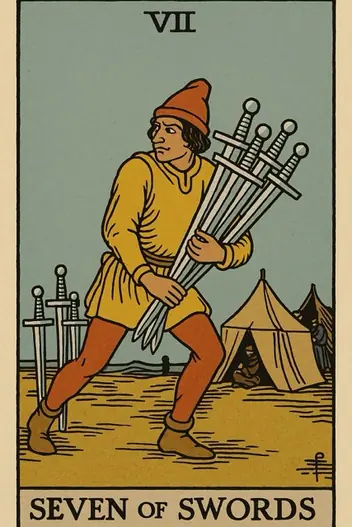
- Arcana
- The Hierophant — Major Arcana; Seven of Swords — Minor Arcana, Swords
- Elements
- The Hierophant — Earth; Seven of Swords — Air
- Elemental interaction
- Opposing elements — energies create tension
- Numerology
- 5 + 7 = 12 → 3
When The Hierophant—the archetype of structure, tradition, and institutional knowledge—collides with the Seven of Swords—the card of strategic withdrawal, deception, and calculated risk—you get a powerful psychological tension. This pairing asks: When does following the rules become a cage, and when does breaking them become a necessary act of self-preservation? It’s the moment a loyal employee considers taking confidential files to start their own firm, or a committed partner weighs the cost of keeping a secret to avoid a painful confrontation.
The core conflict here is between external authority and internal strategy. The Hierophant represents the collective, the "shoulds" of society—marriage, corporate hierarchy, religious doctrine. The Seven of Swords represents the individual, the "need to" of survival—sneaking out, bending the truth, or quietly moving pieces behind the scenes. When these two meet, the seeker is often in a position where honesty feels too costly, yet deception feels too risky.
The Hierophant and Seven of Swords: How These Energies Interact
The psychological state created by this combination is one of calculated dissonance. You are aware of the rules (The Hierophant) but you are also aware that following them blindly would lead to a suboptimal outcome (Seven of Swords). This is not a naive rebellion; it is a cold, rational assessment that the system you are in no longer serves your highest good. The key insight here is that the Seven of Swords does not always mean malicious theft—it often means reclaiming your own autonomy from a structure that has overstepped its bounds.
In practice, this manifests as a mindset of strategic exit or tactical silence. You may be in a job, relationship, or belief system where you feel the pressure to conform, yet you see a clear path to leaving that requires subtlety rather than confrontation. The danger is cognitive dissonance: justifying a small lie to protect a larger truth. The strength, however, is psychological agility: the ability to navigate complex social structures without sacrificing your core objectives. The real-world implication is that you must decide whether you are escaping from a system or escaping into a better one.
This pairing also highlights the shadow of institutional loyalty. The Hierophant can create an unhealthy attachment to "the way things have always been done," while the Seven of Swords can rationalize cutting corners. The healthier middle ground is strategic innovation within the system—finding a way to achieve your goals without burning the bridge entirely, unless the bridge is already on fire.
The Hierophant and Seven of Swords for Career and Money
Strategic Opportunities:
Leverage insider knowledge to negotiate a better position or exit package. If you know the company's weaknesses, you can position yourself as the solution—or prepare your own venture.
Strategic Opportunities:
Use the system to your advantage. Follow the rules of the game (Hierophant) while quietly building a side project or networking outside your current role (Seven of Swords). This is the "quiet quitting" or "side hustle" energy done with precision.
Calculated Risks:
Avoid outright theft or fraud. The Seven of Swords cautions that getting caught is a real risk. Do not confuse strategic planning with unethical shortcuts. If your plan relies on deceiving a partner or employer, the long-term cost of lost reputation will outweigh the short-term gain.
Financially, this combination warns against hiding debt or income from a spouse or business partner. The Hierophant represents legal and financial contracts; the Seven of Swords suggests a breach of that trust. However, it can also indicate a smart tax strategy or a legitimate loophole—as long as it is within the letter of the law. The most important financial warning is this: do not lie on official documents. The universe (and the IRS) tends to find out. Instead, focus on strategic restructuring—renegotiating terms, consolidating debt, or quietly saving for an exit.
Your pair is already on the table. Ask your question and draw the clarifying card
or simply focus on it
The Hierophant and Seven of Swords Love Outcome
If you are single:
This combination suggests you are evaluating a potential partner through a lens of social compatibility, but you suspect they are hiding something—or you are hiding your true intentions. Pause before committing; verify the story they are telling you. The attraction may be based on status or security (Hierophant) rather than genuine connection.
If you are in a relationship:
You or your partner may be withholding information to avoid conflict with family, religious, or social expectations. There is a power imbalance where one person feels they must "manage" the other's perception to keep the peace. This is a red flag for long-term intimacy.
In relationships, this card pair often reveals a silent contract where one partner sacrifices honesty for stability. For example, a person might stay in a marriage purely for social standing (Hierophant) while secretly having an emotional affair or hiding financial decisions (Seven of Swords). The key relationship advice here is to assess whether your secrecy is protecting you from harm or protecting you from growth. If you are hiding your true feelings to avoid upsetting a traditional structure (e.g., coming out to a conservative family, admitting you want an open relationship), you are trading authenticity for approval. The pragmatic step is to identify the smallest truth you can tell today that moves the relationship toward honesty, rather than continuing a pattern of strategic silence that erodes trust over time.
Deepen your understanding
Find out exactly what this reading means for your current life situation with our oracle.
Negative Meaning of The Hierophant and Seven of Swords
The shadow manifestation of this pairing is Machiavellian rationalization. The seeker convinces themselves that "the end justifies the means" because the system is corrupt or unfair. This leads to cognitive biases like the "sunk cost fallacy" (staying in a bad situation because you've invested so much) combined with "just-world hypothesis" (believing you deserve to cut corners because you've been wronged). The result is self-sabotage through overconfidence—you think you are being clever, but you are actually burning bridges you will need later.
Another pitfall is paranoia and isolation. The Seven of Swords energy can make you feel like you must go it alone, while the Hierophant energy can make you distrust institutions entirely. This leads to a lonely, hyper-vigilant state where you see every authority figure as an enemy and every rule as a trap. The psychological risk is losing the ability to collaborate, which ironically makes you more vulnerable to failure. If you find yourself constantly "sneaking around" or feeling like you must outsmart everyone, ask yourself: Am I being strategic, or am I being avoidant?
The Hierophant and Seven of Swords Reversed: What Changes?
When cards appear in reversed positions, the dynamic shifts from active to reactive, and hidden conflicts become overt.
Reversed Hierophant + Upright Seven of Swords:
Rebellion without Strategy. You reject authority (Hierophant), but do so chaotically and impulsively (Seven of Swords). Instead of a calculated tactic, this is childish disobedience. Advice: Before breaking the system, make sure you have a Plan B. Your rebellion can be easily suppressed because you haven't calculated the consequences.
Upright Hierophant + Reversed Seven of Swords:
Exposure. Secret maneuvers become public. You have been caught being dishonest, or you yourself feel overwhelming guilt and decide to confess. This is a painful but cleansing process. Warning: Do not try to justify yourself. The best strategy is to accept the consequences and show a willingness to make amends (sincere "repentance").
BOTH Reversed:
Total Imbalance. You have lost faith in the system (Hierophant), and your tactics have also failed (Seven of Swords). A paralysis of will sets in — you know neither how to submit nor how to fight. Logical Way to Correct: Exit the game. Temporarily step back from decision-making. Change the context — find a new "system" (job, relationship) where you won't have to resort to tricks.
The Hierophant and Seven of Swords: Tarot Advice
Constructive use of this combination requires integration, not suppression. You do not need to become a saint (pure Hierophant) or a swindler (pure Seven of Swords). Your task is to employ the tactical thinking of the Seven of Swords within the framework set by the Hierophant.
Think of diplomacy. A diplomat is someone who acts strictly according to protocol (Hierophant) while simultaneously using tricks, omissions, and strategic information leaks (Seven of Swords) to achieve goals. Your energy should be directed not at destroying the system, but at finding "gray zones" within it where you can act autonomously without violating public commitments.
Deep strategic advice:
Create a "transparent tactic." Announce to those around you (partner, colleagues) that you will act unconventionally, but within the framework of shared goals. For example: "I will use non-obvious methods to achieve KPIs, but I am accountable for the result, not the process." This will relieve tension and legitimize your cunning.
Use the Hierophant as a protective circuit and the Seven of Swords as a tool for maneuver. Remember: true wisdom lies not in deceiving the system, but in using its rules to achieve your own goals while remaining honest with yourself. Your strength lies in a clear awareness of the boundaries you will not cross, and in flexibility within those limits.
Applying This to Your Situation
The core message of The Hierophant and Seven of Swords is that wisdom is knowing when to follow the rules and when to quietly rewrite them. This is not a call to deception, but a call to strategic autonomy—using your intellect to navigate structures that may not have your best interests at heart. Your next step is to identify one area where you are following a rule out of fear, not conviction, and consider a more honest alternative.
But these archetypes play out differently for everyone. The true power of Tarot is not in a general meaning, but in a personalized reading that connects these symbols to your exact question. That is why I recommend using the Fortune Cards app. Whether on the web or downloaded, the app allows you to input your specific situation—your relationship, your career dilemma, your personal conflict—and receive a deep, psychologically nuanced interpretation of this exact card combination for your life. Stop guessing. Start strategizing. Use Fortune Cards to get the clarity you need to move forward with confidence.
Interpretation by the Fortune Cards editorial team, based on the Rider–Waite tradition and Jungian archetypes. About our methodology · Updated: 2026-09-17
Other Combinations with The Hierophant
Other Combinations with Seven of Swords
Explore Individual Card Meanings
Table of Contents
- The Hierophant and Seven of Swords: How These Energies Interact
- The Hierophant and Seven of Swords for Career and Money
- The Hierophant and Seven of Swords Love Outcome
- Negative Meaning of The Hierophant and Seven of Swords
- The Hierophant and Seven of Swords Reversed: What Changes?
- The Hierophant and Seven of Swords: Tarot Advice
- Applying This to Your Situation
Ready to find answers to your questions?
Start your first reading now and look at your situation with fresh clarity. The cards are ready to reveal deeper meaning.