Three of Wands and Five of Swords Tarot as Feelings

- Arcana
- Three of Wands — Minor Arcana, Wands; Five of Swords — Minor Arcana, Swords
- Elements
- Three of Wands — Fire; Five of Swords — Air
- Elemental interaction
- Friendly elements — energies support each other
- Numerology
- 3 + 5 = 8
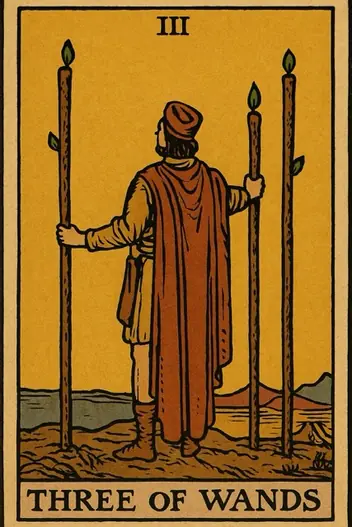
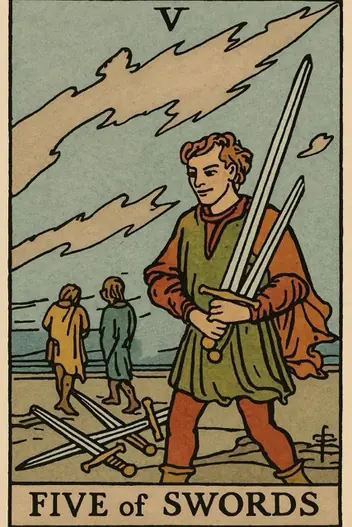
The intersection of the Three of Wands and the Five of Swords presents a powerful psychological tension: the drive to expand your horizons versus the necessity of winning a difficult battle. The Three of Wands represents foresight, planning, and the initial steps of a long-term venture. It’s the archetype of the Explorer, ready to launch a ship into uncharted waters. The Five of Swords, in contrast, represents conflict, defeat, and the bitter taste of a Pyrrhic victory. It is the archetype of the Tactician, who understands that some battles are won at a high personal cost.
When these cards appear together, the core message is that your next phase of growth will require you to engage in a strategic confrontation. You cannot simply sail away from a problem. The expansion you seek (Three of Wands) is currently blocked by a power struggle, a disagreement, or a competitive dynamic (Five of Swords). This combination forces you to ask: What am I willing to fight for, and what am I willing to lose to get it? The psychological work here is about reconciling ambition with the reality of conflict—recognizing that not all obstacles are meant to be avoided; some must be actively dismantled.
Three of Wands and Five of Swords Combination Meaning
The core dynamic of the Three of Wands and Five of Swords is a strategic power play within a larger plan. You are not fighting a random skirmish; you are clearing a path for a significant expansion. The Explorer archetype provides the vision, while the Tactician provides the method. This creates a mindset of calculated aggression. You are not acting out of anger or impulse; you are acting because you have identified a specific obstacle that, if left unchecked, will undermine your entire long-term strategy.
This combination often appears when a person is facing a win-lose scenario that feels necessary for their future. The psychological state is one of determined isolation. The Three of Wands encourages you to look outward and collaborate, but the Five of Swords warns that this particular situation may require you to stand alone and make an unpopular decision. You may have to cut ties, enforce a boundary, or take a victory that leaves others feeling defeated. The key insight is that this is a temporary phase, not a permanent state. You are fighting for the expansion, not against a person.
The real-world implication is that progress requires trade-offs. You cannot have peace and progress simultaneously in this moment. The cognitive challenge is to avoid the trap of moral superiority (Five of Swords shadow) while maintaining the visionary optimism (Three of Wands light). The most pragmatic approach is to define your win condition clearly before engaging in the conflict. Know exactly what ground you are willing to take and what you are willing to concede.
Your pair is already on the table. Ask your question and draw the clarifying card
or simply focus on it
Love and Relationships
If you are single:
This combination suggests you may need to consciously walk away from a potential connection that feels competitive or draining. The expansion you seek in your love life requires you to stop fighting for someone who isn’t aligned with your future.
If you are in a relationship:
You are likely in a power struggle over the direction of the partnership. One partner wants to expand (new home, new city, new lifestyle), while the other is resistant. The conflict is about control, not love.
In relationships, the Three of Wands and Five of Swords point to a critical juncture where ambition clashes with partnership dynamics. The primary advice is to separate the conflict from the person. You are not fighting your partner; you are fighting for a shared vision that currently feels misaligned. Bold emphasis on emotional intelligence is crucial here: the victory you seek must not come at the cost of the relationship’s foundation. If you “win” this argument but destroy trust, you have achieved a Pyrrhic victory.
The psychological work is to identify the core fear driving the conflict. Is one partner afraid of being left behind (Five of Swords) while the other is afraid of being held back (Three of Wands)? The solution is not to win, but to negotiate a third path that honors both the need for expansion and the need for security. If negotiation fails, the cards suggest that maintaining your individual growth path is the healthier choice than sacrificing your future for a stagnant peace.
Deepen your understanding
Find out exactly what this reading means for your current life situation with our oracle.
Career and Finances
Strategic Opportunities:
A competitive market or promotion where you must outmaneuver a rival to secure a key resource or position.
Strategic Opportunities:
The launch of a new project that requires you to enforce your authority or intellectual property rights.
Calculated Risks:
Avoiding a legal or ethical battle that could drain your resources and damage your reputation, even if you are technically “right.”
In a professional context, this card pair is a powerful indicator of strategic advancement through conflict. You are not a passive participant; you are actively shaping your career trajectory. The Three of Wands gives you the long-term vision, while the Five of Swords gives you the short-term tactics. Bold important financial warning: do not spend your capital—emotional, financial, or social—on a battle that does not directly serve your five-year plan. Every fight must have a clear ROI.
The most pragmatic approach is to view this as a negotiation, not a war. The Five of Swords often suggests that you can win by being smarter, not harder. Use the foresight of the Three of Wands to anticipate your opponent’s moves. Understand their motivations and weaknesses. If you are launching a new product or service, this combination suggests you will face aggressive competition. Your strategy should be to differentiate, not destroy. Focus on your unique value proposition (Three of Wands) rather than trying to undercut or humiliate a competitor (Five of Swords shadow).
Financially, this is a high-risk, high-reward period. The cards do not promise a clean victory. You may have to accept short-term losses (e.g., a severance package, a legal fee, a lost client) to secure a long-term gain. The key is to track your resources meticulously and be willing to walk away if the cost exceeds the strategic benefit.
Shadow Side & Pitfalls
The shadow manifestation of this combination is aggressive overreach. The seeker may become so focused on “winning” that they lose sight of the original vision. The cognitive bias at play is the sunk cost fallacy—continuing to fight long after the battle has lost its strategic value, simply because you have already invested so much. This can lead to burnout, damaged relationships, and a reputation for being ruthless.
Another pitfall is paranoia and isolation. The Five of Swords can make you see enemies everywhere, causing you to push away allies who could help you expand. You may become secretive, mistrustful, and unwilling to delegate. This blocks the collaborative energy of the Three of Wands. The shadow of the Tactician is winning the battle but losing the war, because you have alienated everyone who could have been part of your future team.
Finally, there is the risk of moral injury. If you win through manipulation or cruelty, you may feel a deep sense of shame afterward. The cards ask you to check your intentions. Are you fighting for a legitimate expansion, or are you fighting to prove you are right? The latter is a trap that will leave you isolated and empty, even with the trophy in your hand.
Reversed Positions: What Changes?
When cards appear in a reversed position, the dynamic becomes distorted, and the key risks become more apparent.
If the Three of Wands is reversed:
Your potential is blocked by fear or indecision. You see opportunities but are afraid to take a step. In combination with the upright Five of Swords, this creates a situation of an "envious observer": you criticize and attack those who take action, instead of acting yourself. Advice: stop wasting energy criticizing others' successes and focus on removing your own internal barriers.
If the Five of Swords is reversed:
This indicates internal resistance and self-sabotage. You are not fighting an external enemy but waging war with yourself. Your aggression is directed inward: you devalue your own achievements, doubt your plans, and create conflicts out of nowhere. Paired with the upright Three of Wands, this looks like a "perfectionist" who will never begin the journey for fear the map isn't perfect. Advice: acknowledge that your main enemy is your inner critic. Take the first step without demanding perfection from yourself.
If BOTH are reversed:
Complete imbalance. Apathy and powerlessness. You see no prospects (Three of Wands reversed) and lack the strength even for internal struggle (Five of Swords reversed). This is a state of learned helplessness. The logical way to correct it: start small. Find one micro-victory (Five of Swords) — for example, clear the clutter off your desk — to regain a sense of control, and then set one tiny goal for the day (Three of Wands). Restore your will gradually, through action.
Synthesis: Strategic Conclusion
How can the energy of the Three of Wands be used constructively to balance the Five of Swords? The answer lies in a paradigm shift from "winning against someone" to "winning for something." Your ambition (Three of Wands) must become the compass that prevents you from getting bogged down in tactical squabbles. Every time you feel the urge to enter a conflict or prove you are right, ask yourself: "Does this argument bring me closer to my larger goal?" If not, you are losing, even if you win the argument.
In this combination, the Five of Swords is not an enemy, but a tool. It represents your capacity for decisive action, your ability to defend your boundaries, and to cut away the superfluous. Your task is to cultivate this aggression, directing it not at people, but at problems. Instead of "defeating" a colleague, "defeat" the task that is hindering the project. Instead of dominating a partner, "defeat" the crisis in the relationship by becoming the leader who guides the way out.
Strategic Advice:
Imagine you are the captain of a ship (Three of Wands) who sees the promised land. The Five of Swords is the cannon on your deck. Use it to fight off pirates and clear the path, but do not waste your gunpowder shooting at seagulls. Your goal is to reach the shore, not to sink every boat in the sea. Only the combination of clear vision (Three of Wands) and disciplined, purposeful force (Five of Swords) will lead you to sustainable success.
Your Next Step: Personal Context Matters
The core message of the Three of Wands and Five of Swords is that growth often requires a difficult battle, but the battle must serve the vision, not the ego. You are being asked to act with both foresight and tactical precision. Define your win, protect your resources, and be willing to walk away from a fight that costs more than it yields.
While this analysis provides the general archetype, the true power of Tarot lies in applying it to your unique situation. The Fortune Cards app can give you a deep, personalized interpretation of this exact combination for your specific question right now. Whether you are navigating a career conflict, a relationship power struggle, or a personal growth challenge, the app uses your context to reveal the exact path forward. Use it on the web or download it to get the clarity you need.
Interpretation by the Fortune Cards editorial team, based on the Rider–Waite tradition and Jungian archetypes. About our methodology · Updated: 2026-08-26
Other Combinations with Three of Wands
Other Combinations with Five of Swords
Explore Individual Card Meanings
Ready to find answers to your questions?
Start your first reading now and look at your situation with fresh clarity. The cards are ready to reveal deeper meaning.