Love Tarot: Three of Wands and Nine of Swords
- Arcana
- Three of Wands — Minor Arcana, Wands; Nine of Swords — Minor Arcana, Swords
- Elements
- Three of Wands — Fire; Nine of Swords — Air
- Elemental interaction
- Friendly elements — energies support each other
- Numerology
- 3 + 9 = 12 → 3
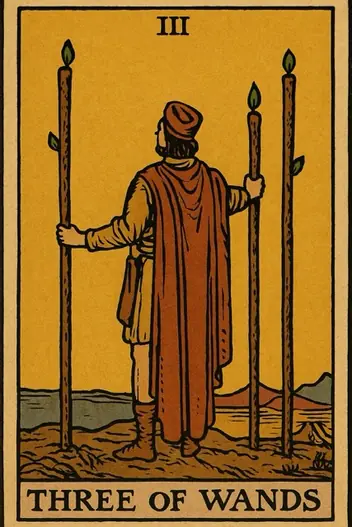
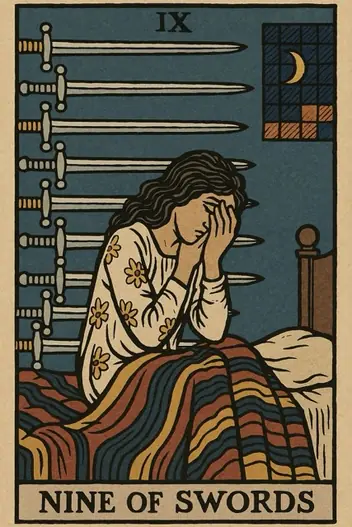
When the expansive, forward-looking energy of the Three of Wands meets the paralyzing, nocturnal dread of the Nine of Swords, you face a classic psychological paradox: the tension between ambition and anxiety. The Three of Wands represents the moment of strategic planning, of looking out from the cliff to see the ships on the horizon, ready to launch a new venture. The Nine of Swords, however, is the mind that keeps you awake at 3 AM, replaying every possible failure. This combination describes a person who has a clear vision but is tormented by the internal noise of worst-case scenarios.
In real life, this manifests as the entrepreneur who has a brilliant business plan but cannot sleep the night before the pitch. It’s the person in a relationship who sees a future together but is haunted by fears of betrayal or inadequacy. The clash is not between action and inaction, but between bold intention and cognitive distortion. The key insight here is that the anxiety is not a signal to stop—it is a signal that you are stepping outside your comfort zone. The challenge is to harness the strategic vision of the Wands without letting the Swords’ nightmares dictate your direction.
What Do Three of Wands and Nine of Swords Mean Together?
The psychological core of this pairing lies in the conflict between the conscious ego (Wands) and the unconscious shadow (Swords). The Three of Wands is an extroverted, assertive archetype that wants to expand, explore, and conquer new territory. It represents healthy ambition and the ability to see the big picture. The Nine of Swords, however, is an introverted, obsessive archetype that feeds on catastrophic thinking and rumination. When these two collide, the seeker is caught in a loop: they know what they want to do, but their mind generates so much fear that they freeze.
The practical implication is that this combination often signals a decision-making paralysis rooted in perfectionism. The seeker may be waiting for a guarantee of success before moving forward, which is a cognitive error. The Nine of Swords is not a prophecy of failure; it is a warning about the psychological cost of inaction. The most important takeaway is that the anxiety is a byproduct of the ambition. If you had no vision (Three of Wands), you would have nothing to worry about (Nine of Swords). Therefore, the solution is not to eliminate the fear, but to compartmentalize it and act despite it.
This dynamic also reveals a specific cognitive bias: the availability heuristic. The seeker is overestimating the probability of negative outcomes because those scenarios are more vivid and memorable in their mind. The Three of Wands asks you to look at the data—the ships are sailing, the plan is solid—while the Nine of Swords asks you to look at the nightmares. The Jungian path is to integrate the shadow: acknowledge the fear, write it down, and then ask yourself, “What is the rational probability of this worst-case scenario actually happening?” Often, the answer is far lower than the Nine of Swords suggests.
Your pair is already on the table. Ask your question and draw the clarifying card
or simply focus on it
Love and Relationships
If you are single:
This combination suggests you have a clear idea of the partner you want (Three of Wands), but you are paralyzed by fears of rejection, inadequacy, or past trauma (Nine of Swords). Your next step is to lower the stakes. Focus on low-risk, high-reward interactions rather than waiting for the “perfect” connection.
If you are in a relationship:
The dynamic here is that one partner is pushing for growth or a future plan (Three of Wands), while the other is consumed by anxiety or guilt (Nine of Swords). This is a call for structured communication. Set a specific time to discuss fears without letting them derail the shared vision.
In relationship readings, the Three of Wands and Nine of Swords often point to a gap between aspiration and emotional security. One partner may be eager to move to a new city, get married, or start a family, while the other is lying awake at night worrying about finances, compatibility, or past betrayals. The critical psychological insight is that the anxiety is not necessarily about the relationship itself, but about the loss of control that comes with commitment. The most effective strategy is to break the future plan into smaller, concrete steps. Instead of focusing on the “big move,” focus on the next month’s budget, the next therapy session, or the next honest conversation. This reduces the cognitive load on the anxious partner and allows the visionary partner to feel heard.
Bold relationship advice:
Do not let the Nine of Swords’ fear become a self-fulfilling prophecy. If you avoid the conversation because you are scared of the outcome, you are already choosing the worst-case scenario by default. Instead, use the Three of Wands’ strategic energy to schedule a “fear audit” where both partners list their specific worries and assign a probability to each. This objectifies the anxiety and makes it manageable.
Deepen your understanding
Find out exactly what this reading means for your current life situation with our oracle.
What Do Three of Wands and Nine of Swords Indicate for Your Career?
Strategic Opportunities:
Leverage your long-term vision to create a risk-mitigation plan. The Three of Wands gives you the big picture; use the Nine of Swords’ hyper-vigilance to identify specific weak points and address them proactively.
Strategic Opportunities:
Turn your anxiety into a competitive advantage. If you are worried about a competitor or a market shift, use that energy to conduct a thorough SWOT analysis. The fear is data—use it to refine your strategy.
Calculated Risks:
Avoid over-analysis paralysis. The Nine of Swords can trick you into believing you need 100% certainty before acting. In reality, the cost of waiting is often higher than the cost of a small failure.
In a career context, this combination is common for entrepreneurs, project managers, and creatives who are on the verge of a major launch. The Three of Wands represents the strategic foresight to see the opportunity, while the Nine of Swords represents the imposter syndrome and fear of public failure. The pragmatic interpretation is that you have done the work—the plan is solid, the resources are in place—but your mind is still replaying every possible mistake. The most important financial warning here is to avoid “sunk cost” thinking. Do not throw more money or time into perfecting the plan because you are afraid to execute. The best move is to set a hard deadline for the launch and stick to it.
For financial planning, this pairing suggests a need for balanced risk management. The Three of Wands wants to invest and expand, while the Nine of Swords wants to hoard cash and avoid loss. The Jungian solution is to create a “fear budget” —allocate a specific amount of capital or time for experimentation, and accept that some of it may be lost. This externalizes the anxiety and allows you to move forward with a clear head. Key strategic tip: If you are negotiating a contract or a salary, the Nine of Swords may make you undervalue yourself. Prepare your talking points in advance and rehearse them until the fear becomes routine.
What Are the Risks of Three of Wands and Nine of Swords?
The shadow manifestation of this combination is paralyzing perfectionism disguised as “prudent planning.” The seeker may convince themselves they are being thorough when, in reality, they are avoiding the discomfort of uncertainty. This is a form of cognitive avoidance —the mind prefers the familiar pain of worry over the unfamiliar risk of action. The Nine of Swords’ shadow can also manifest as projection: the seeker may attribute their own fears to external factors (e.g., “My partner is untrustworthy” when really they are afraid of intimacy). Meanwhile, the Three of Wands’ shadow can become hubris —a blind push for expansion without considering the emotional cost, leading to burnout or relational damage.
Another common pitfall is misreading the Nine of Swords as a warning to stop. In traditional Tarot, this card is often misinterpreted as a sign of impending doom. In reality, it is a sign of psychological distress that needs to be addressed, not a prophecy of failure. If the seeker cancels the project, ends the relationship, or abandons the goal because of this card, they are falling into the confirmation bias trap—they are seeing the fear as proof that they should retreat. The shadow lesson is that the fear is not the enemy; the refusal to act despite the fear is.
Reversed Three of Wands and Nine of Swords Explained
When cards appear in a reversed position, the dynamic shifts, but not always for the better.
If the Three of Wands is reversed:
This points to blocked potential or recklessness. You are either abandoning plans out of fear (the Nine of Swords wins), or conversely, acting impulsively while ignoring very real risks. Advice: seek the golden mean between paralysis and adventure.
If the Nine of Swords is reversed:
This can be a sign of internal resistance or "repression" of the problem. You don't feel anxiety, but that doesn't mean the risk isn't there. Sublimated anxiety can manifest as psychosomatic symptoms. Warning: do not ignore your instincts, even if you feel calm.
If BOTH are reversed:
Complete imbalance. You may become stuck in a state of "toxic optimism," denying obvious threats, or conversely, fall into deep apathy. The logical way to correct this: return to the basics. Cease all forward movement. Take a step back and re-evaluate the foundation of your plan.
Three of Wands and Nine of Swords Combined Message
Constructive use of this energy requires mental discipline. The Three of Wands grants you foresight and ambition, while the Nine of Swords provides acute sensitivity to danger. Your task is to transform anxiety from an enemy into an ally. Use the Nine of Swords as an early warning system, not as a verdict.
Strategic advice: Apply the "5/25 Rule." Write down 25 fears related to your project (Three). Then select the 5 most realistic ones. Develop an action plan for each of these 5 points. The remaining 20 fears are simply noise to be ignored. This method translates irrational anxiety into concrete tasks.
Your primary task is not to let fear steal your future. The Three of Wands symbolizes ships that have already set sail. You cannot call them back. The only choice is either to gaze at the horizon in terror or to take the helm into your own hands. Embrace uncertainty as the price of growth. Control what you can control (your actions, analysis, resources) and release what you cannot (others' opinions, the perfect outcome).
Where to Go From Here
The core message of Three of Wands and Nine of Swords is that clarity and fear can coexist. You have a valid vision, but your mind is generating noise. The goal is not to silence the noise, but to act in spite of it. This combination asks you to be a pragmatic architect: design your plan, acknowledge the risks, and take one concrete step forward. The ships on the horizon will not sail themselves; you must raise the anchor, even if your hands are shaking.
However, this general interpretation is just the archetype. The true power of Tarot lies in how these energies apply to your specific question, your unique history, and your current emotional state. To get a deep, personalized reading of this exact combination for your situation, use the Fortune Cards app. Whether you access it on the web or download it, the app will help you map these archetypes onto your specific love, career, or personal growth challenge. Stop guessing and start navigating—get your personalized interpretation now.
Interpretation by the Fortune Cards editorial team, based on the Rider–Waite tradition and Jungian archetypes. About our methodology · Updated: 2026-08-26
Other Combinations with Three of Wands
Other Combinations with Nine of Swords
Explore Individual Card Meanings
Table of Contents
- What Do Three of Wands and Nine of Swords Mean Together?
- Love and Relationships
- What Do Three of Wands and Nine of Swords Indicate for Your Career?
- What Are the Risks of Three of Wands and Nine of Swords?
- Reversed Three of Wands and Nine of Swords Explained
- Three of Wands and Nine of Swords Combined Message
- Where to Go From Here
Ready to find answers to your questions?
Start your first reading now and look at your situation with fresh clarity. The cards are ready to reveal deeper meaning.