Three of Wands and Three of Swords Tarot as Feelings
- Arcana
- Three of Wands — Minor Arcana, Wands; Three of Swords — Minor Arcana, Swords
- Elements
- Three of Wands — Fire; Three of Swords — Air
- Elemental interaction
- Friendly elements — energies support each other
- Numerology
- 3 + 3 = 6
When the ambitious, forward-looking energy of the Three of Wands collides with the piercing, painful clarity of the Three of Swords, we encounter a profound psychological tension. You are standing at the edge of a new horizon, eager to expand your reach, yet you are simultaneously being forced to confront a painful reality or a piece of information you have been avoiding. This is not a card of simple optimism; it is the card of calculated expansion through necessary heartbreak.
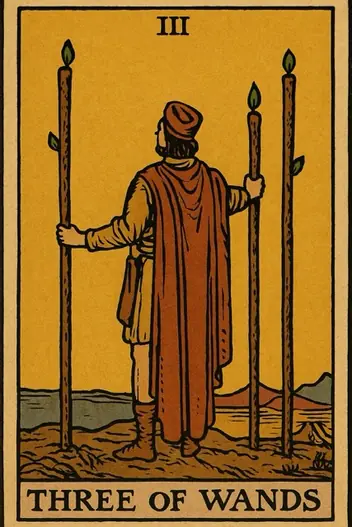
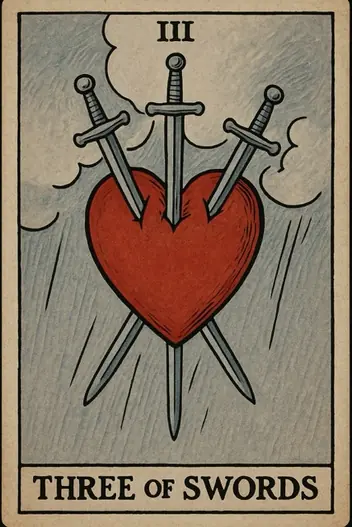
This combination suggests that your next major step forward requires you to first undergo a difficult emotional surgery. The Three of Wands represents the ship leaving the harbor—your plans, your vision, your long-term strategy. The Three of Swords represents the storm cloud on the horizon—the betrayal, the disappointment, or the hard truth that must be integrated before the journey can truly begin. The key insight here is that pain is not the enemy of progress; it is often the price of admission.
What Do Three of Wands and Three of Swords Mean Together?
The psychological state created by the Three of Wands and Three of Swords is one of strategic disillusionment. You are being asked to hold two opposing truths simultaneously: your excitement for the future and your grief over what must be sacrificed to get there. This is a hallmark of cognitive dissonance—the mental discomfort experienced when your beliefs (that everything is going according to plan) clash with reality (that something has gone wrong or been lost). The healthy response is to use this dissonance as fuel for recalibration, not as a reason to abandon the entire vision.
In practical terms, this pairing often appears when a person is on the cusp of a significant expansion—a new job, a move, a major investment—only to discover a hidden cost. This could be a betrayal of trust from a partner or colleague, a financial setback that was not anticipated, or the realization that a core assumption about the future was wrong. The mind, seeking to protect itself, may want to deny the pain and push forward blindly. However, the Three of Swords demands emotional honesty as a prerequisite for success.
The real-world implication is clear: you cannot build a future on a foundation of denial. The Three of Wands gives you the courage to look outward; the Three of Swords gives you the clarity to look inward. Together, they create a powerful, if uncomfortable, moment of truth. The most effective action is to pause, acknowledge the pain or disappointment without judgment, and then ask yourself: "What is this loss teaching me about how to proceed more wisely?" This is not a time for reckless optimism, but for sober, calculated action.
Love and Relationships
If you are single:
This combination warns you against idealizing a new connection. You may feel a strong pull toward someone, but the Three of Swords suggests you need to examine your own past wounds or the other person's credibility before committing. Look for red flags, not just green lights.
If you are in a relationship:
A difficult truth is surfacing. This could be an infidelity, a fundamental incompatibility, or a long-suppressed resentment. The Three of Wands energy wants to fix things and move forward, but the Three of Swords insists that healing must precede expansion.
In relationships, this pairing is a powerful call for emotional intelligence and boundary enforcement. The Three of Wands represents the desire to grow together, to plan a shared future, and to expand the relationship's horizons. However, the Three of Swords indicates that this growth cannot happen until a current wound is addressed. This is not a card of doom, but of necessary confrontation. If you are in a partnership, you must be willing to have the hard conversation about what has been broken. Avoiding the pain will only delay the growth.
For singles, this card combination often signals a "lesson in love." You may be attracted to someone who represents your next chapter, but the relationship dynamic may involve a betrayal of trust—either from them or from your own past. The key relationship advice is to practice radical honesty with yourself. Ask: "Am I projecting a future onto this person to avoid dealing with my own loneliness or fear?" The Three of Swords demands that you heal your heart before you ask it to travel.
Your pair is already on the table. Ask your question and draw the clarifying card
or simply focus on it
What Do Three of Wands and Three of Swords Indicate for Your Career?
Strategic Opportunities:
A major expansion is on the table—a promotion, a new business partnership, or a global market entry. The potential for growth is real and significant.
Strategic Opportunities:
The pain you are feeling (e.g., a client loss, a project failure) provides clear data on what needs to change. Use the disappointment as a diagnostic tool.
Calculated Risks:
Be wary of signing contracts or making large investments before resolving a lingering dispute. The "cost" of this opportunity may be higher than it appears.
In the professional realm, the Three of Wands and Three of Swords combination demands a pragmatic approach to risk management. You are being presented with a significant opportunity for expansion—perhaps a new market, a leadership role, or a major project. However, the Three of Swords warns that there is a hidden cost. This could be a betrayal from a colleague, a financial misrepresentation, or a strategic flaw in your plan. The most intelligent move is to conduct due diligence with extreme rigor.
Financially, this is a warning against speculative moves. The Three of Wands encourages long-term vision, but the Three of Swords says, "Check the fine print." If you are negotiating a deal, expect a painful concession. If you are launching a product, anticipate a harsh critique. The key to success here is emotional detachment from the outcome. Do not let your desire for the future blind you to the costs in the present. A strategic tip: write down the worst-case scenario and how you would handle it. This mental exercise turns anxiety into a contingency plan.
Three of Wands and Three of Swords: Warning Signs
The shadow manifestation of this pairing is masochistic optimism—the tendency to chase a painful situation because you believe the reward will justify the suffering. This is a classic cognitive bias known as the "sunk cost fallacy," where you continue investing in a failing plan because you have already invested so much. The Three of Swords brings pain, and the Three of Wands offers a way out, but if you are not careful, you will simply trade one form of suffering for another.
Another common pitfall is emotional bypassing. The seeker may use the visionary energy of the Three of Wands to ignore the cries of the Three of Swords. They might say, "I'm just going to focus on the future," while secretly avoiding a necessary confrontation. This leads to self-sabotage down the line, as the unaddressed pain will eventually surface and derail the entire plan. Poor judgment arises when you mistake emotional numbness for strategic patience.
Uncover hidden insights
Let our advanced Tarot system interpret these archetypes specifically for your personal path.
What If Three of Wands or Three of Swords Appears Reversed?
When cards are reversed, the dynamic becomes less acute but more insidious.
If the Three of Wands is reversed:
This indicates blocked potential and fear of the future. The person is not merely suffering (Swords); they are refusing to attempt moving forward. This is a state of learned helplessness. Advice: you need not to plan, but to take micro-steps. Your task is to restore faith in your ability to influence events, not to analyze the scale of the problem.
If the Three of Swords is reversed:
This is classic sabotage through pain avoidance. The person is not processing the trauma but suppressing it. They continue to actively make plans (Wands), but internally, unexpressed resentment is eating away at them. Warning: this state leads to emotional burnout. Your psyche expends colossal resources on suppressing feelings, which diminishes the effectiveness of your actions.
If BOTH are reversed:
Complete imbalance. You simultaneously have no faith in the future and cannot cope with the past. This is psychological paralysis. The logical way to correct this is a complete change of context. You need a radical pause: a vacation, a change of activity, or work with a therapist. Any "planning" in this state will be self-destructive.
Three of Wands and Three of Swords Combined Message
How can the energy of the Three of Wands be used constructively to balance the Three of Swords? The key lies in transforming pain into a filter, not a brake. The psychologically healthy way to integrate these archetypes is to acknowledge: "I have suffered, but I continue to move forward. My experience makes me not weaker, but more aware."
Your strategy should be built on the principle of "Protected Expansion." Do not try to ignore the pain—create a container for it. For example, keep a journal where you record all your fears and grievances related to past experiences. Then, during planning (Wands), use this list as a "mine map." You are not fleeing from the mines; you are navigating around them. The synthesis gives you a unique advantage: you see not only the horizon but also the traps at your feet.
Your task is not to choose between ambition and healing. Your task is to use ambition as a tool for healing. When you make plans, ask yourself: "Does this step bring me closer to who I want to be, or is it merely an escape from who I was?" An honest answer to this question is the true wisdom of this combination.
Your Next Step: Personal Context Matters
The core message of the Three of Wands and Three of Swords is that true progress requires emotional integrity. You cannot build a new future while ignoring the pain of the present. The path forward is clear, but it is paved with uncomfortable truths. Your task is to face those truths with the same courage you would use to explore a new horizon. The pain is not a detour; it is the road.
This analysis provides the general archetype, but the real power of Tarot lies in its application to your unique situation. To get a deep, personalized interpretation of this exact combination for your specific question—whether about a relationship, a career move, or a personal dilemma—use the Fortune Cards app. Available on the web or as a download, it offers a custom reading that integrates your context, your question, and your energy. Do not settle for generic advice. Get the clarity you need to act with wisdom right now.
Interpretation by the Fortune Cards editorial team, based on the Rider–Waite tradition and Jungian archetypes. About our methodology · Updated: 2026-08-26
Other Combinations with Three of Wands
Other Combinations with Three of Swords
Explore Individual Card Meanings
Table of Contents
- What Do Three of Wands and Three of Swords Mean Together?
- Love and Relationships
- What Do Three of Wands and Three of Swords Indicate for Your Career?
- Three of Wands and Three of Swords: Warning Signs
- What If Three of Wands or Three of Swords Appears Reversed?
- Three of Wands and Three of Swords Combined Message
- Your Next Step: Personal Context Matters
Ready to find answers to your questions?
Start your first reading now and look at your situation with fresh clarity. The cards are ready to reveal deeper meaning.