The Tower and Two of Swords Tarot Combination
- Arcana
- The Tower — Major Arcana; Two of Swords — Minor Arcana, Swords
- Elements
- The Tower — Fire; Two of Swords — Air
- Elemental interaction
- Friendly elements — energies support each other
- Numerology
- 16 + 2 = 18 → 9
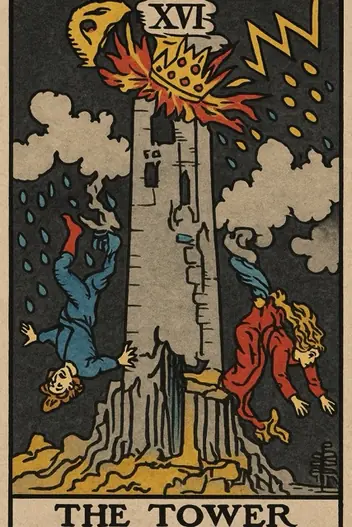
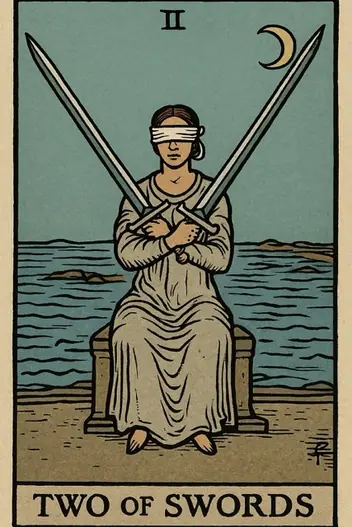
The Tower represents a sudden, disruptive collapse of a structure you believed was stable—a job loss, a betrayal, a health crisis, or an unexpected revelation that tears down your worldview. The Two of Swords, in contrast, depicts a deliberate state of emotional paralysis and willful blindness—the person sits blindfolded, balancing two crossed swords, refusing to see the truth in order to avoid a painful decision. When these two cards collide, the universe is forcing you to drop the blindfold. The Tower is the crash; the Two of Swords is the moment of decision you can no longer postpone. This combination is a psychological pressure test: it reveals whether you will retreat into denial or use the crisis to make a clear, hard choice.
The Tower and Two of Swords: How These Energies Interact
The core dynamic here is the confrontation between illusion and reality. The Two of Swords represents a cognitive dissonance—you have been holding two opposing truths in your mind (e.g., “I want this relationship to work” vs. “I know it’s toxic”) and refusing to choose. The Tower smashes that mental stalemate by removing your ability to ignore the situation. The psychological state is one of acute stress mixed with a strange clarity. You can no longer pretend. The blindfold is ripped off, and you must now see the facts as they are.
This pairing demands ruthless honesty with yourself. The Tower’s destruction is not random; it targets the very thing you were most invested in ignoring. Your next step is not to rebuild the old structure—that is a trap. Instead, you must use the crisis as a forced opportunity to make the decision you have been avoiding. The Two of Swords asks: “Which path will you choose now that you can see clearly?” The answer requires strategic detachment from emotional attachments to past outcomes. The most dangerous move is to refuse to decide, because the Tower’s aftershocks will only intensify if you freeze.
The Tower and Two of Swords as Feelings
If you are single:
This combination suggests a sudden disillusionment with a person or pattern you idealized. A secret may be revealed, or a situation will force you to see someone’s true character. Do not cling to the fantasy. Use the clarity to walk away cleanly.
If you are in a relationship:
A major conflict or betrayal is forcing a decision you have been avoiding. The relationship’s foundation is cracking, and you must choose: commit to the hard work of rebuilding with radical honesty, or end it. Staying neutral is no longer an option.
In relationships, this pairing often points to a power struggle masked as indecision. One partner may have been suppressing their true feelings or hiding a critical fact. The Tower represents the explosive truth that shatters the peace. The Two of Swords warns that continuing to avoid the conversation will only lead to more damage. The key relationship advice here is to lead with vulnerability—admit what you have been refusing to see. If both partners can drop their defenses and choose to see the situation objectively, the relationship can be rebuilt on a more honest foundation. However, if the blindfold stays on, the Tower will eventually bring the entire house down.
Your pair is already on the table. Ask your question and draw the clarifying card
or simply focus on it
The Tower and Two of Swords for Career and Money
Strategic Opportunities:
A sudden industry disruption or company restructuring is forcing you to reassess your career path. Use the crisis to pivot toward a role that aligns with your true skills, not your comfort zone.
Strategic Opportunities:
A financial loss or failed project reveals a flaw in your business model or investment strategy. This is the moment to cut losses and reallocate resources to a more viable option.
Calculated Risks:
Do not make impulsive decisions based on panic. The Two of Swords warns against freezing, but also against rash action. Take 48 hours to gather data before committing to a new direction.
Professionally, this combination signals a crisis of decision-making. You may have been stuck between two job offers, two business strategies, or two investment paths, avoiding a final call. The Tower forces the issue—perhaps through a layoff, a market crash, or a contract falling through. The financial warning is clear: denial is expensive. Ignoring a red flag in a partnership, a declining market, or a toxic work environment will eventually cost you more than facing it now. Strategically, this is a time for defensive positioning—cut unnecessary expenses, renegotiate contracts, and avoid new ventures until you have a clear picture. The smartest move is to choose the option that offers the most flexibility, not the one that promises the highest return. This is a moment for risk management, not risk-taking.
Negative Meaning of The Tower and Two of Swords
The shadow side of The Tower and Two of Swords is willful self-destruction through cognitive rigidity. The seeker may, after the Tower’s blow, double down on denial—blaming others, rationalizing the crisis as bad luck, or refusing to accept the evidence. This is psychological splitting: seeing the situation as either entirely their fault or entirely external, when the truth is more nuanced. Another pitfall is paralytic analysis—obsessing over the “right” choice to the point of inaction, which only prolongs the pain. The cognitive bias at play is loss aversion: the fear of making a wrong decision outweighs the cost of doing nothing. Self-sabotage manifests as choosing the familiar pain (staying in a broken relationship or job) over the unknown pain of change. To avoid this, you must externalize the decision: write down pros and cons, seek a neutral third party’s perspective, and set a hard deadline for your choice.
Get a personalized interpretation
Unlock the combined meaning of your cards in the context of your unique question — for free.
The Tower and Two of Swords Reversed: What Changes?
When cards appear in a reversed position, the dynamic shifts from an external crisis to internal sabotage. This is not a cancellation of the event, but a change in your reaction to it.
If The Tower is Reversed:
This indicates a blocked potential for destruction. You have avoided fate's blow, but you have not learned the lesson. You have postponed an inevitable crisis, but the tension remains. Warning: this is not a victory, but a delay. Your task is to voluntarily destroy what is already cracking at the seams, before life does it for you. The recklessness here lies in trying to return to the old order.
If the Two of Swords is Reversed:
This is internal resistance escalating into hysteria. You can no longer remain silent, but your truth bursts forth chaotically and destructively. Advice: find a safe channel for emotional release (sports, therapy, creative work) before you speak. The weakness here is in the inability to structure your anger or fear.
If BOTH are Reversed:
Complete imbalance. You are experiencing a "silent crisis" — destruction is occurring, but you are unaware of it. This is a state of deep depression or apathy, where energy drains into the sand. The logical path to correction: seek external help. You need a mentor, coach, or therapist to act as your "eyes" while you cannot face reality.
Overall Meaning of The Tower and Two of Swords
How to constructively use the energy of the Tower to balance the Two of Swords? The key lies in shifting focus from "why did this happen" to "what do I do next". The Two of Swords gets stuck in analyzing the past and fearing the future. The Tower offers a unique gift — complete freedom from old obligations. Use the crisis as fuel for action.
The first strategic step is acknowledging your powerlessness over the past. You cannot undo the collapse. But you can control your reaction to the wreckage. Psychologically, this is a moment of catharsis: allow yourself to experience anger and grief, but strictly limit the time for it (e.g., 24 hours). After that — switch into "sapper mode": methodically clear the debris, without trying to rebuild the old foundation.
The second step is using the energy of the Two of Swords for focus. Its blindness is a metaphor for cutting away the excess. In a state of crisis, your resources are limited. Create a "list of three": the three most important actions that will save the situation or minimize losses. Ignore everything else. Do not try to grasp the ungraspable.
A deep strategic piece of advice: perceive the Tower as a surgical operation, and the Two of Swords as anesthesia. The crisis has removed a cancerous tumor (old, dysfunctional patterns). Your task is not to interfere with the wound's healing, but to ensure cleanliness and rest. Do not flinch, do not try to speed up the process, do not seek the guilty. Your only decision right now is the decision to survive and grow stronger. Accept it, remove the blindfold, and take the first step.
Applying This to Your Situation
The Tower and Two of Swords is not a prediction of doom—it is a psychological call to action. The core message is: stop avoiding the truth, and make the hard choice. The crisis has already happened; the only question is whether you will use it to grow or to hide. The clarity you gain now is a gift, even if it hurts. The path forward requires courage, not certainty.
This analysis provides the general archetype, but the true power of Tarot lies in applying it to your unique situation. Every Tower is built on a different foundation, and every Two of Swords holds a different decision. To get a deep, personalized interpretation of this exact combination for your specific question—whether about love, career, or personal growth—use the Fortune Cards app. You can access it on the web or download it now to receive a tailored reading that respects your exact context and guides your next step with precision.
Interpretation by the Fortune Cards editorial team, based on the Rider–Waite tradition and Jungian archetypes. About our methodology · Updated: 2026-08-26
Other Combinations with The Tower
Other Combinations with Two of Swords
Explore Individual Card Meanings
Table of Contents
- The Tower and Two of Swords: How These Energies Interact
- The Tower and Two of Swords as Feelings
- The Tower and Two of Swords for Career and Money
- Negative Meaning of The Tower and Two of Swords
- The Tower and Two of Swords Reversed: What Changes?
- Overall Meaning of The Tower and Two of Swords
- Applying This to Your Situation
Ready to find answers to your questions?
Start your first reading now and look at your situation with fresh clarity. The cards are ready to reveal deeper meaning.