Two of Wands and Six of Swords Together in Tarot
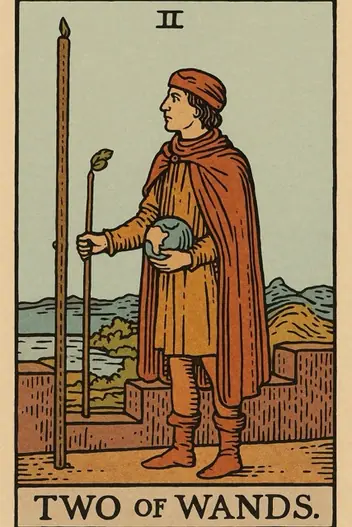

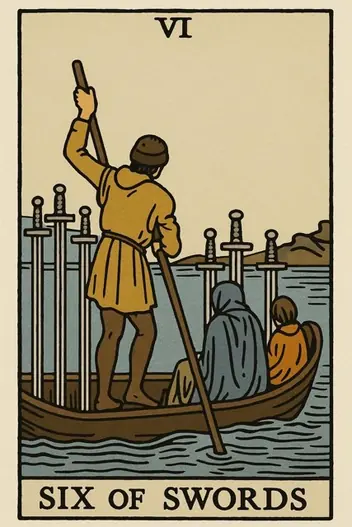
- Arcana
- Two of Wands — Minor Arcana, Wands; Six of Swords — Minor Arcana, Swords
- Elements
- Two of Wands — Fire; Six of Swords — Air
- Elemental interaction
- Friendly elements — energies support each other
- Numerology
- 2 + 6 = 8
The intersection of the Two of Wands and the Six of Swords represents a pivotal psychological moment: the decision to leave a familiar situation in pursuit of a more ambitious, yet uncertain, horizon. The Two of Wands embodies the archetype of the Visionary Planner—the part of you that surveys the world, maps out possibilities, and feels the restless pull of expansion. The Six of Swords, conversely, is the Rite of Passage—the actual, often uncomfortable, journey away from what is known toward what is not yet built.
In pragmatic terms, this combination signals that your ambition has outgrown your current environment. You are not merely daydreaming about change; you are actively preparing to execute a strategic retreat or relocation. The core conflict here is between the desire for control (Two of Wands) and the necessity of surrender (Six of Swords). You must plan meticulously, but also accept that the journey will require leaving some things behind—people, places, or identities—that no longer serve your long-term vision.
Two of Wands and Six of Swords Combination Meaning
When these two cards merge, the psychological state is one of calculated departure. The Two of Wands provides the strategic framework—the map, the timeline, the risk assessment. The Six of Swords provides the emotional logistics—the quiet packing, the farewells, the acceptance of temporary discomfort. Together, they create a mindset where ambition is tempered by realism. You are not impulsively burning bridges; you are methodically building new ones while quietly disengaging from the old.
The key dynamic is tension between expansion and release. The Two of Wands wants to conquer new territory, but the Six of Swords reminds you that every conquest requires a departure. This is not a card of spontaneous adventure, but of structured transition. You may feel a sense of loneliness or isolation during this phase, as the Six of Swords often indicates a journey taken alone or with minimal support. However, this solitude is a strategic asset—it allows for clearer thinking and less emotional interference.
The most important psychological insight here is that you cannot hold the map and steer the boat at the same time. The Two of Wands represents the planning stage; the Six of Swords represents the execution. If you try to re-plan mid-journey, you risk paralysis or missed opportunities. Trust the decisions you made before you set sail. This combination rewards decisiveness and follow-through over endless deliberation.
What Do Two of Wands and Six of Swords Say About Love?
If you are single:
This pair suggests you are evaluating a potential partner through a practical, long-term lens. You may be deciding whether to invest emotional energy in someone who comes from a different background or life stage. Beware of over-analyzing the connection; you may be so focused on the "map" of your future that you miss the person sitting in front of you.
If you are in a relationship:
The combination often indicates a planned separation or significant transition within the partnership. This could be a move for work, a decision to take space for personal growth, or a conscious choice to end the relationship if it no longer aligns with your shared vision.
In a relationship context, the Two of Wands and Six of Swords together highlight the psychological challenge of balancing ambition with intimacy. One partner may feel they are being left behind, while the other feels their growth is being stifled. The key relationship advice is to communicate the "why" behind your departure, not just the "what." Explain that your vision for the future includes them, or doesn't—and be honest about which it is. Emotional intelligence here means acknowledging the grief of leaving a familiar relational dynamic, even if the change is positive. Avoid the pitfall of intellectualizing your partner's feelings; the Six of Swords demands empathy for the emotional cost of transition.
Your pair is already on the table. Ask your question and draw the clarifying card
or simply focus on it
Career Meaning of Two of Wands and Six of Swords
Strategic Opportunities:
Relocating for a career pivot—this combination strongly favors a job offer in a new city, industry, or company structure. The Two of Wands gives you the foresight to choose the right opportunity; the Six of Swords gives you the discipline to execute the move.
Strategic Opportunities:
Launching a long-term project that requires an initial investment of time or resources away from your current base. This could be a startup, a research project, or an overseas assignment.
Calculated Risks:
Avoid burning bridges during your departure. The Six of Swords suggests a quiet exit, not a dramatic confrontation. Overconfidence in your planning (Two of Wands shadow) could lead you to underestimate the actual costs, timeline, or emotional toll of the transition.
From a career perspective, this combination is a green light for strategic mobility, but with a clear caveat: do not act on impulse. The Two of Wands represents the CEO mindset—global vision, resource allocation, and risk management. The Six of Swords represents the project manager—execution, logistics, and timeline management. Together, they suggest that your next career move should be calculated, not reactive. Financially, this is a time to consolidate resources before the move. Avoid major new investments until you are settled in your new location or role. The most important financial warning is to have a six-month contingency fund before making any major transition. The Six of Swords indicates a journey, but not necessarily a smooth one; prepare for unexpected costs.
What Are the Risks of Two of Wands and Six of Swords?
The shadow of this combination manifests as paralysis by analysis (over-identifying with the Two of Wands) or escapism disguised as growth (over-identifying with the Six of Swords). When blocked, you may find yourself endlessly mapping out futures without ever taking the first step. The cognitive bias at play is the planning fallacy—the tendency to underestimate how long a transition will take and how much it will cost emotionally.
Conversely, the shadow can also appear as premature departure—leaving a situation that could have been improved, simply because the "new" looks shinier. The Six of Swords, in its shadow form, can be a rationalization for avoidance. You may tell yourself you are making a strategic move when you are actually running from unresolved conflict or discomfort. Self-sabotage occurs when you use the Two of Wands' vision to justify a decision that your gut knows is wrong. The core pitfall is confusing ambition with restlessness. True ambition builds; restlessness merely moves.
Get a personalized interpretation
Unlock the combined meaning of your cards in the context of your unique question — for free.
Reversed Two of Wands and Six of Swords Explained
If the Two of Wands is Reversed:
Blocked Potential and Recklessness. You are either unable to make a choice (fear of the horizon) or you are grabbing at everything at once. Paired with the upright Six of Swords, this creates a dangerous situation: you are adrift, but you don't know where you are going. Advice: stop. Cease all movement until you have defined at least one priority goal.
If the Six of Swords is Reversed:
Inner Resistance and Weakness. You know you need to leave (the Two of Wands is upright), but you are sabotaging the process. You are stalling for time, hoping the problem will resolve itself. Warning: this is a path to crisis. Your delay turns a planned transition into a chaotic flight when resources are already depleted.
If BOTH are Reversed:
Complete Dynamic Imbalance — you are stuck between the fear of the future and the terror of the past. This is a state of paralysis of the will. The logical way to correct this: tactical minimum. Forget about global plans (reversed Two) and distant journeys (reversed Six). Take one small, concrete action that will break the cycle. Remove one thing, write one letter, make one phone call. Restore a sense of control over your micro-reality.
Synthesis: Strategic Conclusion
How to constructively use this dynamic? See yourself as the CEO of your own life, conducting a restructuring of assets. The Two of Wands is your board of directors approving a new strategy. The Six of Swords is the logistics department ensuring the office relocation. Your task is to synchronize these two departments so they don't work at cross-purposes.
A deep strategic piece of advice: create a "Plan B" for your "Plan A." The Two of Wands often fixates on a single ideal scenario. The Six of Swords teaches that the path is rarely smooth. Therefore, when planning a transition, immediately build in a 20% buffer for unforeseen circumstances. This is not pessimism; it is risk management. Ask yourself: "What will I do if the boat springs a leak halfway across?" The answer to this question will transform anxiety into readiness.
This combination arms you with clarity: you are not losing control; you are changing the battlefield. Your vision of the future (Two of Wands) remains unchanged. Only the tactics for achieving it (Six of Swords) are shifting. Accept the fact that movement is not a betrayal of your ambitions, but their only realistic form. As long as you are sailing, you are still steering the ship.
Where to Go From Here
The core message of the Two of Wands and Six of Swords is clear: your vision demands a journey, and the journey demands a plan. You are standing at the edge of a significant transition—one that requires both strategic foresight and emotional resilience. The general archetype tells you what is happening, but only your specific situation reveals how to navigate it.
To apply this insight directly to your life right now, use the Fortune Cards app. While this article provides the universal meaning of this card combination, the true power of Tarot lies in its personal application. The app allows you to pull these cards for your exact question—whether about a relationship, a career move, or a personal dilemma—and receive a deep, AI-enhanced interpretation tailored to your unique context. Download Fortune Cards on the web or your preferred app store and get the clarity you need to take your next step with confidence.
Interpretation by the Fortune Cards editorial team, based on the Rider–Waite tradition and Jungian archetypes. About our methodology · Updated: 2026-08-26
Other Combinations with Two of Wands
Other Combinations with Six of Swords
Explore Individual Card Meanings
Table of Contents
- Two of Wands and Six of Swords Combination Meaning
- What Do Two of Wands and Six of Swords Say About Love?
- Career Meaning of Two of Wands and Six of Swords
- What Are the Risks of Two of Wands and Six of Swords?
- Reversed Two of Wands and Six of Swords Explained
- Synthesis: Strategic Conclusion
- Where to Go From Here
Ready to find answers to your questions?
Start your first reading now and look at your situation with fresh clarity. The cards are ready to reveal deeper meaning.