Wheel of Fortune and Six of Swords Tarot Combination
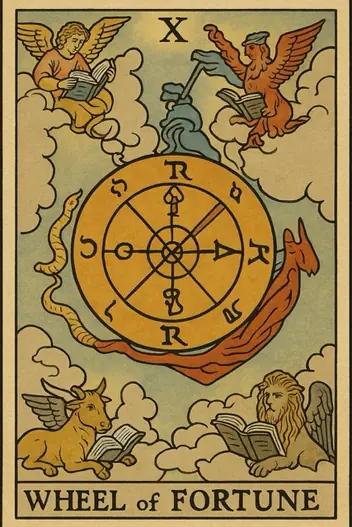
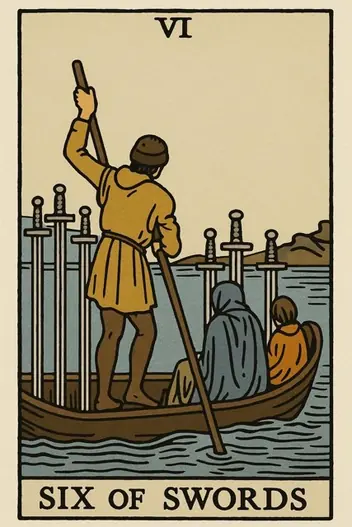
- Arcana
- Wheel of Fortune — Major Arcana; Six of Swords — Minor Arcana, Swords
- Elements
- Wheel of Fortune — Fire; Six of Swords — Air
- Elemental interaction
- Friendly elements — energies support each other
- Numerology
- 10 + 6 = 16 → 7
When the Wheel of Fortune—the archetype of cyclical change, fate, and turning points—meets the Six of Swords—the card of deliberate transition, emotional departure, and moving toward calmer waters—we encounter a powerful psychological intersection. This combination suggests that a significant, often unavoidable, shift is underway, but it is not a chaotic storm. Instead, it is a structured passage where the seeker must consciously choose to ride the momentum of change rather than resist it.
From a Jungian perspective, this pairing signals a rite of passage. The Wheel represents the impersonal, collective forces of time and circumstance (the axis mundi), while the Six of Swords represents the ego’s conscious decision to navigate that current toward a new psychological shore. The key insight is that fate provides the opportunity, but you must steer the boat. This is not passive surrender; it is active adaptation to a changing reality.
Wheel of Fortune and Six of Swords: How These Energies Interact
The core dynamic here is the tension between external inevitability and internal agency. The Wheel of Fortune turns regardless of your preferences—it governs economic cycles, relationship seasons, and life phases. The Six of Swords, however, is the psychological response to that turn. It asks: How will you move through this transition? With resistance and regret, or with clear-eyed acceptance and a strategic plan?
This combination often appears when a major life chapter is closing—a job ends, a relationship shifts, or a long-held belief system dissolves. The seeker may feel a mix of relief and grief. The Wheel ensures the old structure cannot remain; the Six of Swords provides the emotional distance to see the situation objectively. The most important psychological insight is that this is not a time for impulsive decisions or desperate clinging to the past. Instead, it calls for deliberate, measured steps toward a new horizon.
The mindset required is one of detached engagement. You are not the victim of fate, nor its master. You are a passenger with a map. The cards urge you to acknowledge the loss (the boat carries swords—painful truths), but also to trust the direction of the current. Practically, this means creating a transition plan that allows for emotional processing while executing necessary logistical moves. Bold action is not required; consistent, forward movement is.
Wheel of Fortune and Six of Swords Love Outcome
If you are single:
This combination suggests you are emerging from a painful or stagnant period. Do not rush into a new relationship to escape the past. Instead, focus on emotional closure and self-reclamation first. The right connection will appear when you are truly moving forward, not just running away.
If you are in a relationship:
A significant transition is underway—a move, a career change, or a shift in values. The relationship will be tested by external pressures. Prioritize honest communication about fears and expectations. Avoid blaming your partner for the changes; the Wheel is turning for you both.
In relationships, the Wheel of Fortune and Six of Swords indicate a period of necessary distance or redefinition. This is not necessarily a breakup, but a fundamental recalibration. One or both partners may feel the need for space to process recent upheavals. The danger is emotional withdrawal without explanation. The key relationship advice is to maintain a shared narrative: acknowledge that you are in a boat together, even if you are both rowing toward different internal destinations. Do not make permanent decisions based on temporary feelings. The Wheel will turn again, and the emotional fog of the Six of Swords will clear. Focus on respect, clarity, and mutual support during the transition, rather than forcing premature resolution.
Your pair is already on the table. Ask your question and draw the clarifying card
or simply focus on it
Wheel of Fortune and Six of Swords in Career Readings
Strategic Opportunities:
Restructuring and repositioning. This is an ideal time to accept a transfer, a role change, or a lateral move that positions you for future growth. The stability you seek is in the movement, not the destination.
Strategic Opportunities:
Letting go of sunk costs. The Six of Swords asks you to objectively cut ties with projects, clients, or investments that are draining resources. The Wheel rewards those who prune dead branches.
Calculated Risks:
Avoid doubling down on a failing strategy. The Wheel’s downturn is real; do not try to force a reversal with more money or effort. The risk is emotional stubbornness masking as persistence. Accept the loss and move on.
In your career, this combination signals a structural pivot rather than a crisis. The Wheel of Fortune indicates that market forces, company culture, or industry trends are shifting—this is not personal. The Six of Swords advises strategic retreat or relocation. If you are job hunting, focus on industries with growth momentum, not struggling ones you hope to revive. If you are negotiating a raise or contract, emphasize your ability to navigate change and bring stability to chaos. Financially, this is a time for consolidation, not expansion. Pay down debt, build an emergency fund, and avoid speculative investments. The most important financial warning is this: do not mistake a temporary uptick for a permanent recovery. The Wheel is still turning; prepare for the next phase, don’t celebrate the current one.
Wheel of Fortune and Six of Swords Reversed: How to Read It
When the "Wheel of Fortune" is reversed, external changes are blocked or become chaotic. You may feel stuck in a cycle of misfortune. Strategic advice: stop waiting for a "sign from above." The reversed "Wheel" often indicates that you are sabotaging your own escape by clinging to control in a situation where it is impossible. Your task is to artificially create micro-changes (change your daily routine, start a new project) to set the mechanism in motion.
If the "Six of Swords" is reversed, it points to internal resistance to movement. You know you need to leave, but you cannot. This is fear of the unknown or false loyalty to the past. Warning: the reversed "Six" is a direct path to depression and stagnation. You need to literally "force yourself" to take the first step, even if it seems illogical. Consult a psychologist or coach to identify blocking beliefs.
When both cards are reversed, a complete imbalance arises: chaos on the outside and paralysis on the inside. This is a state of "learned helplessness." A logical way to correct it: act contrary to your feelings. Focus on one micro-goal (e.g., clear your desk, write one letter). This will restore a sense of control and show the "Wheel" that you are ready for change. Do not try to solve everything at once—start with a small movement.
Uncover hidden insights
Let our advanced Tarot system interpret these archetypes specifically for your personal path.
The Shadow Side of Wheel of Fortune and Six of Swords
The shadow of this combination manifests as learned helplessness or reckless fatalism. When the Wheel of Fortune’s energy is blocked, the seeker may blame external circumstances for their stagnation, refusing to take the conscious step of the Six of Swords. They wait for a “sign” or a “miracle” instead of accepting the responsibility to move. Alternatively, the Six of Swords’ shadow appears as emotional avoidance—using the transition as an excuse to cut off relationships, abandon commitments, or escape difficult emotions without processing them.
Cognitive biases at play include the “sunk cost fallacy” (staying too long in a bad situation because you’ve already invested so much) and “hindsight bias” (believing you should have seen the change coming, leading to self-blame). The most dangerous pitfall is compartmentalizing grief—packing away the pain of the past without truly healing. This creates a “haunted boat” where the unresolved emotions resurface later, often in a new relationship or job. The shadow path is one of false closure: leaving physically but staying emotionally anchored to the past.
Overall Meaning of Wheel of Fortune and Six of Swords
Constructive use of this energy requires dual vision from you. On one hand, you must accept the "Wheel of Fortune" as a given: cycles are inevitable, markets fall, relationships end, opportunities come and go. On the other hand, you must activate the "Six of Swords" as your primary tool: not waiting for the wave to carry you ashore, but rowing yourself in a chosen direction.
Your strategic move is to turn uncertainty into a plan. Do not ask "Why is this happening to me?" Ask "Where should I move next, based on this new fact?" Make a list of three things you leave in the past (projects, habits, relationships) and three you take with you (skills, resources, values). This will be your "boat." It will not protect you from the storm, but it will give you direction.
The deep wisdom of this union is that transition is not a destination, but a new state of being. You will not arrive at a "harbor" where everything becomes perfect. You will learn to live in motion, finding stability not in stasis, but in your capacity to adapt. This is true maturity: accepting chaos as the norm and learning to navigate within it. Your task is not to stop the "Wheel," but to synchronize your steps with it.
Applying This to Your Situation
The Wheel of Fortune and Six of Swords together deliver a clear, pragmatic message: accept the change, plan your departure, and move with intention. The external circumstances are shifting, but your internal compass must remain steady. This is not a time for dramatic resistance or passive waiting—it is a time for strategic, emotionally intelligent navigation. The journey ahead may be quiet, but it is profoundly transformative.
However, general archetypes can only take you so far. The true power of Tarot lies in applying these insights to your specific life situation—your unique relationship dynamics, career crossroads, and psychological patterns. That is where the Fortune Cards app becomes an indispensable tool. Whether you use it on the web or download it, the app allows you to input your exact question and receive a deep, personalized interpretation of this exact card combination for your unique context. Stop guessing how this applies to you—get the clarity you need right now.
Interpretation by the Fortune Cards editorial team, based on the Rider–Waite tradition and Jungian archetypes. About our methodology · Updated: 2026-08-26
Other Combinations with Wheel of Fortune
Other Combinations with Six of Swords
Explore Individual Card Meanings
Table of Contents
- Wheel of Fortune and Six of Swords: How These Energies Interact
- Wheel of Fortune and Six of Swords Love Outcome
- Wheel of Fortune and Six of Swords in Career Readings
- Wheel of Fortune and Six of Swords Reversed: How to Read It
- The Shadow Side of Wheel of Fortune and Six of Swords
- Overall Meaning of Wheel of Fortune and Six of Swords
- Applying This to Your Situation
Ready to find answers to your questions?
Start your first reading now and look at your situation with fresh clarity. The cards are ready to reveal deeper meaning.