The World and Five of Swords Tarot as Feelings
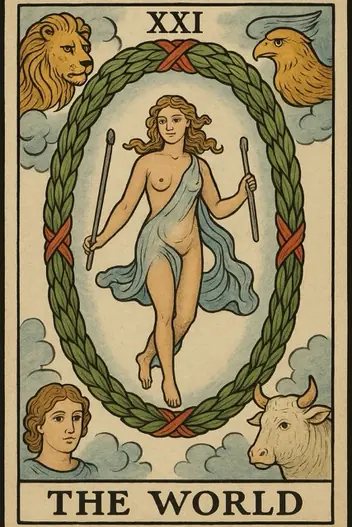

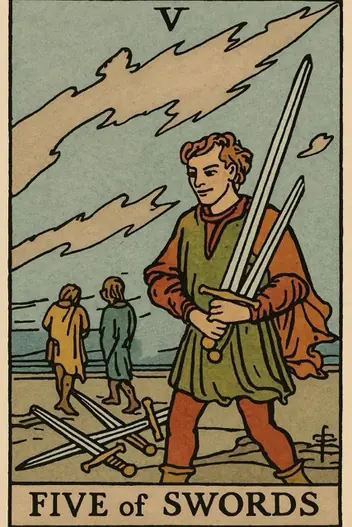
- Arcana
- The World — Major Arcana; Five of Swords — Minor Arcana, Swords
- Elements
- The World — Earth; Five of Swords — Air
- Elemental interaction
- Opposing elements — energies create tension
- Numerology
- 21 + 5 = 26 → 8
When the archetype of wholeness (The World) collides with the archetype of conflict (Five of Swords), we are presented with a sophisticated psychological paradox: achieving a goal at the cost of your integrity. The World represents the end of a cycle, mastery, and the integration of opposites. The Five of Swords represents a win born from a battle of wills, often leaving behind a trail of resentment or isolation. In practice, this combination signals a moment where you stand at the finish line, but the victory feels hollow. You have the trophy, but you may have lost the respect of your team, your partner, or even your own self-respect. This is not a time for celebration, but for cold, hard assessment of the true cost of your success.
The World and Five of Swords Combination Meaning
The psychological state created by The World and Five of Swords is one of strategic exhaustion. You have navigated a long, complex cycle (The World) and have emerged with a clear result. However, the method of arrival (Five of Swords) suggests that this result was achieved through a zero-sum game—you won, and someone else lost. The key dynamic here is the cognitive dissonance between the feeling of accomplishment and the feeling of social or relational defeat. You may be asking yourself: "If I finally got what I wanted, why do I feel so empty?"
This combination forces a pragmatic reckoning with the shadow of ambition. The World energy provides the clarity of seeing the big picture, while the Five of Swords energy provides the sharp, tactical edge to cut through obstacles. Together, they create a mindset that is highly effective at closing deals and ending chapters, but dangerously blind to the collateral damage left behind. The most important insight here is that a win that isolates you from your support system is not a win at all. The cards advise you to audit your victory: Did you use your intelligence to solve a problem, or to defeat a person? The answer determines whether this is a true completion or a lonely summit.
Your pair is already on the table. Ask your question and draw the clarifying card
or simply focus on it
What Do The World and Five of Swords Indicate for Your Career?
Strategic Opportunities:
Leveraging a hard-fought skill to close a major project or contract. You have the expertise to finish what you started.
Strategic Opportunities:
Cutting dead weight. This is an excellent time to terminate a toxic partnership, a failing business line, or an underperforming employee. The World gives you the permission to end it cleanly.
Calculated Risks:
Avoid burning bridges. The Five of Swords warns that your aggressive tactics may make you enemies in the industry. A win today can become a reputation liability tomorrow.
In a professional context, this is a high-stakes, low-empathy energy. You are in a position to finalize a major milestone—perhaps a product launch, a merger, or a long-term project. The World card gives you the strategic overview to see the finish line. The Five of Swords gives you the ruthless pragmatism to step on toes to get there. The financial warning here is critical: do not confuse short-term revenue with long-term value. If you are negotiating a deal, you may be tempted to push for every last concession. This combination suggests you will get what you demand, but you may lose a valuable future collaborator. The best strategic move is to secure your victory, then immediately pivot to damage control. Send a conciliatory email, acknowledge the other party's perspective, and frame the outcome as a necessary step for the organization, not a personal defeat.
Get a personalized interpretation
Unlock the combined meaning of your cards in the context of your unique question — for free.
The World and Five of Swords in Love Tarot
If you are single:
This combination warns against using a "winning" argument or a competitive dynamic to assess a potential partner. Avoid treating dating like a battlefield. You may successfully prove you are right, but you will lose the chance for a genuine connection.
If you are in a relationship:
You or your partner may be "keeping score." This pair suggests a recent conflict where one person felt they won at the expense of the other's feelings. The relationship has completed a cycle, but the method of closure has created a rift.
In a relationship context, The World and Five of Swords points to a power struggle that has reached a final, decisive point. One partner may have used logic or manipulation to force a resolution, believing they have achieved a necessary closure (The World). However, the emotional residue is that of a hollow victory. The key relationship advice here is to distinguish between being effective and being right. If you have "won" an argument, but your partner feels defeated or resentful, the relationship itself has lost. The pragmatic path forward requires a difficult conversation about boundaries and respect. You must acknowledge the cost of the conflict and decide if the relationship can survive the damage. If you are the one who feels defeated, this card asks you to reclaim your power not by fighting back, but by setting a non-negotiable standard for mutual respect.
Shadow Side & Pitfalls
The shadow side of this pairing is the Pyrrhic Victory—a success that costs so much it is equivalent to a defeat. The primary pitfall is confirmation bias: you will be so focused on the evidence that you have "won" or "completed" something that you will ignore the signs of relational decay. You may rationalize your behavior by telling yourself that the end justifies the means. This is a cognitive distortion that can lead to isolation and a brittle sense of self-worth. Another shadow manifestation is maladaptive perfectionism: the need to have the "final word" or to control the narrative so completely that you damage your own support system. If you find yourself alone after a victory, feeling a mix of pride and emptiness, you are in the shadow of The World and Five of Swords. The antidote is radical honesty about your motives. Ask yourself: Did I do this to achieve a goal, or did I do this to prove I was right?
Reversed Positions: What Changes?
If The World is Reversed:
The completion of the cycle is delayed or falls apart. You have already won the conflict (upright Five of Swords), but you cannot enjoy the result. This is a state of a "stalled finale," where you stand on the threshold of a new life but cannot bring yourself to enter. Advice: stop looking back at the "battlefield" and start building a new world.
If the Five of Swords is Reversed:
You are losing the conflict or giving up the fight. In combination with the upright World, this can mean you are sacrificing your own interests to preserve an illusory harmony. You are surrendering victory to keep the peace, but this peace is built on your self-respect. Risk: deep internal frustration.
If BOTH are Reversed:
Complete imbalance. This is a situation of "neither war nor peace." You are stuck in an endless, meaningless conflict that yields no result. The logical way to correct this: acknowledge that the current strategy (aggression or concessions) has failed, and radically change your tactics. You need an arbiter or a complete exit from the situation.
Synthesis: Strategic Conclusion
Constructive use of this combination requires hyper-awareness from you, along with the ability to separate tactics from strategy. The energy of the Five of Swords is your "surgical scalpel": it is needed to cut away the excess, defend your boundaries, and end what no longer works. The energy of The World is the goal: a harmonious system where you feel comfortable. Your task is not to let the scalpel turn into an axe.
How to balance these cards? Use the principle of "controlled conflict." Do not engage in chaotic quarrels. Identify 1-2 points where you need to set a firm condition. Win on those points using logic and facts (Five of Swords), and immediately offer a constructive solution to bring the situation to completion (The World). Do not fixate on destroying your opponent—focus on achieving your own result.
A deep strategic piece of advice: abandon the role of "triumphator" in favor of the role of "architect." The triumphator seeks enemies; the architect builds a system. Your victory will be complete only when, looking back, you see not ruins, but a cleared space for new construction. Clarity comes when you understand: true victory is not the destruction of another, but the creation of a space where your values can flourish without constant struggle.
Where to Go From Here
The core message of The World and Five of Swords is that you have the power to finish what you start, but you must be honest about the price of your methods. You are standing at a threshold of completion. The question is not whether you can cross it, but whether you will like who you become on the other side. Success without integrity is a hollow trophy. This archetype demands you audit your victory for its true cost.
While this article provides the general archetype, the true magic happens when Tarot is applied to your unique situation. Your specific question, your current relationship, or your financial goal will change how these cards manifest. Don't guess—get clarity. Use the Fortune Cards app on the web or download it today to receive a deep, personalized interpretation of this exact combination for your specific question. Get the insight you need to make your next move a true victory.
Interpretation by the Fortune Cards editorial team, based on the Rider–Waite tradition and Jungian archetypes. About our methodology · Updated: 2026-08-26
Other Combinations with The World
Other Combinations with Five of Swords
Explore Individual Card Meanings
Ready to find answers to your questions?
Start your first reading now and look at your situation with fresh clarity. The cards are ready to reveal deeper meaning.