Ace of Swords and Five of Swords Tarot as Feelings

- Arcana
- Ace of Swords — Minor Arcana, Swords; Five of Swords — Minor Arcana, Swords
- Elements
- Ace of Swords — Air; Five of Swords — Air
- Elemental interaction
- Same element — energies intensify each other
- Numerology
- 1 + 5 = 6
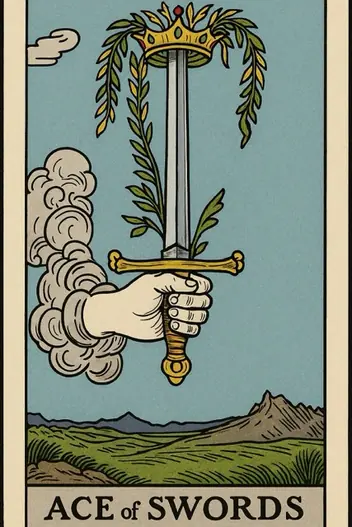
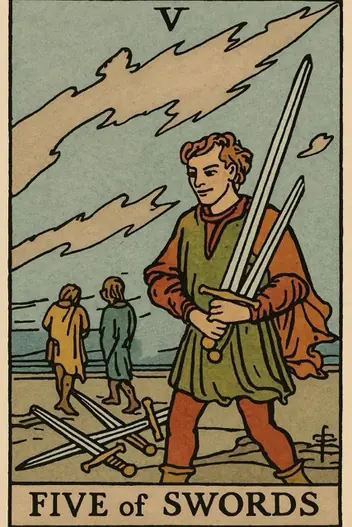
The Ace of Swords represents a breakthrough in mental clarity—a piercing insight, a new truth, or a decisive idea that cuts through confusion. The Five of Swords, by contrast, depicts the aftermath of a battle: a hollow victory, a broken alliance, or a conflict won at a high cost. When these two cards appear together, they signal a moment where intellectual clarity is weaponized, where a powerful truth becomes the center of a struggle for status, ego, or survival.
Psychologically, this combination forces the seeker to ask: Is my insight serving my growth, or is it feeding my need to be right? The Ace offers the sword of truth; the Five shows how that sword can wound both the bearer and those around them. The core dynamic is a tension between objective wisdom and subjective ego-defense. You may have a correct assessment of a situation, but the way you deliver it—or the battle you choose to fight—determines whether you emerge with integrity or isolation.
Core Dynamics & Interpretation
When the Ace of Swords and Five of Swords merge, the psychological state is one of sharpened vigilance mixed with defensive aggression. The seeker has likely identified a core problem—a lie, a flaw, or an unfairness—and feels compelled to act on it. The Ace provides the clarity, but the Five introduces the shadow of competition: the insight is now a weapon in a zero-sum game. The risk is that you become so attached to being “right” that you ignore the relational damage you cause.
This pairing often appears when you are on the verge of a truth that will disrupt a power structure. In a team, it might mean exposing a colleague’s mistake. In a personal relationship, it might mean finally articulating a long-held grievance. The challenge is to wield the Ace’s clarity without falling into the Five’s trap of needing to humiliate or defeat the other person. The key is to ask: “Do I want to be effective, or do I want to win?” Effectiveness requires strategy, timing, and empathy. Winning, in the Five of Swords sense, often leaves you standing alone over a field of broken trust.
The practical implication is that you must separate the truth from the ego. The truth itself is neutral; your attachment to it is where the conflict arises. If you can hold the insight with detachment—using it to solve a problem rather than to prove a point—you can navigate this energy without the collateral damage the Five of Swords warns about. This is a time for precision, not aggression.
Ace of Swords and Five of Swords in Love Tarot
If you are single:
This combination suggests you may be overly analytical about a new connection. You see a flaw or a red flag clearly, but you risk turning that observation into a battle. Ask yourself: is this a dealbreaker, or am I afraid of vulnerability?
If you are in a relationship:
There is a high likelihood of a “truth bomb” being dropped or a conflict where one partner tries to prove they are right at the expense of the other. The goal is not to win the argument, but to understand the pattern beneath it.
In relationships, the Ace of Swords and Five of Swords point to a communication crisis that is actually a power struggle. You may have a perfectly valid point—your partner forgot a commitment, broke a boundary, or was dishonest. The Ace gives you the words to articulate this clearly. But the Five warns that if you present this truth as a verdict or a victory, you will damage the emotional safety in the relationship. The highest use of this energy is to speak your truth without needing to defeat the other person.
If you are single, this pairing can indicate a tendency to judge potential partners harshly. You spot inconsistencies or flaws quickly, but you may use this insight to push people away rather than to assess compatibility realistically. The shadow move is to reject someone before they can reject you. Instead, use the Ace’s clarity to define your non-negotiables, and the Five’s lesson to recognize that not every conflict needs a winner. Sometimes, letting go of being right is the smarter strategy for finding connection.
Your pair is already on the table. Ask your question and draw the clarifying card
or simply focus on it
Career Meaning of Ace of Swords and Five of Swords
Strategic Opportunities:
Use the Ace’s clarity to identify a systemic inefficiency or a hidden problem in your workplace. This is a powerful moment for proposing a solution, but only if you frame it as a win for the team, not a critique of a person.
Strategic Opportunities:
Negotiate from a position of knowledge. If you have data or a clear argument, you can win a raise, a contract, or a promotion—but do so with diplomacy. The Five of Swords warns against burning bridges.
Calculated Risks:
Avoid public confrontations or office politics. If you expose a colleague’s error, you may win the argument but lose their cooperation. Objectively assess the long-term cost of “winning” this battle.
In career and finances, this combination is a double-edged sword for decision-making. The Ace gives you the mental clarity to see a strategic advantage—perhaps a competitor’s weakness, a market gap, or a budget error. The Five, however, warns that how you act on this insight matters more than the insight itself. If you rush to claim credit, humiliate a rival, or force a win at any cost, you may achieve short-term gains but create long-term enemies.
Financially, this pairing suggests a moment of truth about a shared resource—a partnership, a loan, or a joint investment. You may need to have a difficult conversation about fairness or transparency. The key is to approach it as a problem to solve together, not a fight to win. If you feel the urge to “teach someone a lesson” or “prove them wrong,” pause. Ask yourself: “What outcome actually serves my financial stability?” Often, the answer is compromise, not conquest.
Ask your specific question
Don't rely on generic meanings. Get a customized reading tailored specifically to your energies.
Shadow Side & Pitfalls
The shadow of the Ace of Swords and Five of Swords is intellectual arrogance combined with emotional detachment. The seeker may become so convinced of their own rightness that they fail to see the human cost of their actions. This is the classic “truth without tact” trap. You have the insight, but you lack the emotional intelligence to deliver it effectively. The result is a hollow victory: you were “right,” but now you are alone, or you have damaged a relationship that was worth preserving.
Cognitive biases at play include confirmation bias (you only see evidence that supports your position) and the Dunning-Kruger effect (overestimating your own expertise in a complex situation). The Five of Swords often appears when the seeker has misjudged the stakes—they thought they were fighting for a principle, but they were actually fighting for their ego. Self-sabotage occurs when you prioritize being right over being effective. If you feel a rush of adrenaline when you think about “winning” this argument, pause. That feeling is a red flag that you are in the shadow.
What If Ace of Swords or Five of Swords Appears Reversed?
If the Ace of Swords is Reversed:
Clarity turns into delusion or impulsiveness. You attack (Five), confident in your rightness, but in reality, you don't see the full picture. Warning: do not start a conflict until you have checked the facts several times. Your anger may be based on a false premise.
If the Five of Swords is Reversed:
Aggression decreases, but passive capitulation appears. You see the problem (Ace), but find no strength or desire to fight for it. This is a state of inner defeat, where the truth exists, but the will to act is suppressed. Advice: you need not to surrender, but to seek allies, transforming a solitary strike into a collective project.
If BOTH are Reversed:
Complete imbalance. A combination of cognitive chaos (reversed Ace) and self-sabotage (reversed Five). The person does not understand what they want, yet feels like a victim of aggression. Logical way to correct: a full STOP. Do not make decisions, do not engage in arguments. Focus on basic resource restoration and fact-finding.
Ace of Swords and Five of Swords Combined Message
Constructive use of this dynamic requires a redefinition of the goal. The energy of the Ace of Swords is not a hammer for driving nails, but a surgeon's scalpel. Your task is not to "defeat" another person (the Five), but to cut away the problem while preserving the relationship.
The strategic algorithm for action: upon receiving the insight (Ace), pause. Ask yourself: "What price am I willing to pay for this victory?" If the price is the relationship, trust, or respect, seek another path. Use the clarity of the Ace to propose a third option that satisfies everyone, rather than to insist on your own. Your strength lies not in making others lose, but in creating a solution where there are no losers. The main conclusion: true victory is not the triumph of one over another, but a synthesis where truth serves development, not destruction.
Your Next Step: Personal Context Matters
The Ace of Swords and Five of Swords together deliver a powerful message: you have the truth, but you must choose how to wield it. The core lesson is that clarity without compassion is a weapon, and victory without integrity is a loss. Your next step is to examine your motivation. Are you seeking resolution, or are you seeking vindication? The answer determines whether this combination brings growth or grief.
While this article provides a deep archetypal analysis, the true power of Tarot lies in its application to your specific situation. The Fortune Cards app allows you to input your exact question—whether about a relationship, a career move, or a personal conflict—and receive a personalized interpretation of this card combination tailored to your context. You can use it on the web or download the app to get an immediate, nuanced reading that reflects your unique life circumstances. Don't just understand the cards; apply them to your life right now.
Interpretation by the Fortune Cards editorial team, based on the Rider–Waite tradition and Jungian archetypes. About our methodology · Updated: 2026-08-26
Other Combinations with Ace of Swords
Other Combinations with Five of Swords
Explore Individual Card Meanings
Table of Contents
- Core Dynamics & Interpretation
- Ace of Swords and Five of Swords in Love Tarot
- Career Meaning of Ace of Swords and Five of Swords
- Shadow Side & Pitfalls
- What If Ace of Swords or Five of Swords Appears Reversed?
- Ace of Swords and Five of Swords Combined Message
- Your Next Step: Personal Context Matters
Ready to find answers to your questions?
Start your first reading now and look at your situation with fresh clarity. The cards are ready to reveal deeper meaning.