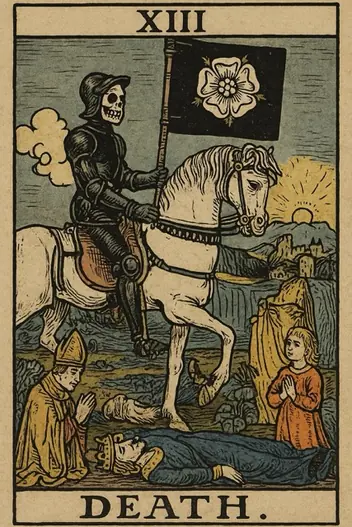
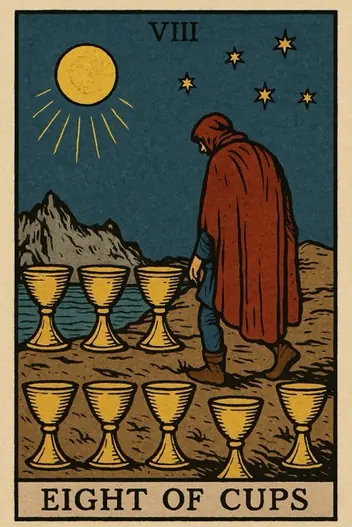
Death and Eight of Cups Together in Tarot
- Arcana
- Death — Major Arcana; Eight of Cups — Minor Arcana, Cups
- Elements
- Death — Water; Eight of Cups — Water
- Elemental interaction
- Same element — energies intensify each other
- Numerology
- 13 + 8 = 21 → 3
The intersection of Death and Eight Of Cups in a Tarot reading signals a profound psychological crossroads. Death, as an archetype, is not about literal demise but about inevitable transformation—the dismantling of structures, identities, or attachments that no longer serve growth. The Eight Of Cups, meanwhile, represents conscious withdrawal—the decision to walk away from emotional investments, dead-end situations, or comfort zones to seek deeper meaning elsewhere.
When these energies collide, the message is clear: you are not just experiencing change; you are being called to initiate a deliberate departure from a situation that has reached its natural conclusion. This is not passive fate, but an active psychological choice. The combination demands that you confront the cognitive dissonance between what you know you should release and what you still cling to out of habit or fear. The strategic question becomes: are you leaving because the path is blocked, or because you have outgrown the destination?
What Do Death and Eight of Cups Mean Together?
The psychological state created by Death and Eight Of Cups is one of calculated grief and purposeful detachment. You are likely aware that a major chapter—be it a relationship, career path, or identity—is ending. Unlike the chaotic energy of The Tower, this combination suggests a slow, deliberate dismantling. You are not being forced out; you are choosing to walk, even if the decision feels heavy and lonely. The core dynamic here is integration of loss with agency: you accept the ending while actively shaping the next move.
This merger often manifests as a test of emotional resilience. The Death card strips away superficial hopes, while the Eight Of Cups asks you to turn your back on what you have built. The real-world implication is a need for ruthless self-honesty. Are you leaving because you have exhausted all options, or because you are avoiding discomfort? The key insight is that this combination rewards those who can distinguish between a necessary ending and a premature escape. If you can sit with the grief of the Death card without rushing into the Eight Of Cups’ exit, you gain the clarity to make a decision that aligns with your long-term psychological health, not just your short-term relief.
Your pair is already on the table. Ask your question and draw the clarifying card
or simply focus on it
Career Meaning of Death and Eight of Cups
Strategic Opportunities:
Identify and exit a role or project that has plateaued. This combination is a green light to resign from a dead-end job or dissolve a partnership that no longer aligns with your long-term vision. The Eight Of Cups gives you the permission to leave gracefully, while Death ensures you do not look back.
Strategic Opportunities:
Invest in retraining or pivoting to a field with higher growth potential. The Death card clears old skill sets, and the Eight Of Cups supports the emotional discipline to start from scratch. Use this period to map out a 12-month exit strategy from your current career path.
Calculated Risks:
Avoid burning bridges or making impulsive resignations without a safety net. The Eight Of Cups can tempt you to leave in a dramatic, avoidant manner. The key warning is to not let emotional exhaustion drive financial decisions. Ensure you have at least three months of savings or a new role lined up before you act.
In the professional realm, this combination is a powerful signal for strategic disinvestment. You are being asked to objectively audit your career: which roles, clients, or projects are "dead" in terms of growth, satisfaction, or financial return? The financial wisdom here is to treat the Eight Of Cups as a calculated withdrawal, not an escape. If you are in a negotiation, this combination suggests you have the upper hand if you are willing to walk away. Boldly state your terms, but be prepared to leave the table if they are not met. The Death card ensures that what you leave behind will be replaced by something more aligned, but only if you plan your exit with the same rigor you would use for a new investment.
Uncover hidden insights
Let our advanced Tarot system interpret these archetypes specifically for your personal path.
What Do Death and Eight of Cups Say About Love?
If you are single:
This pair suggests you are evaluating a potential partner or situation through a lens of emotional maturity. You are likely to recognize early signs of incompatibility and choose to walk away before deep attachment forms. Trust your intuition that a clean exit now prevents a painful transformation later.
If you are in a relationship:
The focus is on boundaries and the courage to end what is no longer nourishing. If you are the partner considering leaving, this combination asks you to examine whether you are abandoning a salvageable connection or honoring a necessary end. If you are the one being left, it signals that the other person is processing a major internal shift that may not involve you.
In relationship dynamics, this combination highlights the tension between loyalty and self-preservation. The Death card forces you to confront the reality that the relationship’s original form is dying. The Eight Of Cups then asks: will you stay to rebuild, or will you leave to find a more authentic connection? The most important relationship advice here is to avoid the trap of emotional blackmail or guilt. If you stay out of obligation, you will breed resentment. If you leave out of fear, you may miss a chance for growth. Use this energy to have honest, direct conversations about what is truly dead and what can be revived. The healthiest outcome is either a mutual, respectful ending or a deliberate, transparent effort to co-create a new foundation.
Shadow Side & Pitfalls
When the energy of Death and Eight Of Cups is blocked or acted upon irrationally, it manifests as chronic avoidance or self-sabotage. The most common shadow is the "ghosting" pattern—leaving relationships, jobs, or commitments without closure, driven by a fear of confrontation. This combination can also trigger a cognitive bias known as the "sunk cost fallacy", where you stay in a dead situation because you have already invested so much time or emotion. Conversely, it can fuel an impulsive exit where you mistake temporary discomfort for a terminal problem.
Another pitfall is grandiose victimhood: you may frame your departure as a heroic escape, ignoring your own role in the stagnation. The shadow of the Eight Of Cups is emotional detachment used as a defense mechanism, while Death’s shadow is nihilism—believing nothing matters, so you might as well leave. The key to avoiding these pitfalls is to practice radical accountability. Ask yourself: Am I leaving to grow, or to avoid growth? If you feel a rush of relief at the thought of leaving, pause. True transformation often feels like grief, not liberation. Use journaling or therapy to differentiate between a strategic exit and an emotional flight response.
What If Death or Eight of Cups Appears Reversed?
When cards appear in a reversed position, the dynamic becomes distorted, turning constructive withdrawal into destructive stagnation.
If Death is reversed:
You are stuck in a cycle of dying that cannot reach completion. This is blocked potential — you are aware that something needs to change, but you fear the pain of transformation. Or, conversely, you exhibit recklessness, destroying everything around you without a plan. Advice: start small — close one "unfinished gestalt story" within a week.
If the Eight of Cups is reversed:
You are experiencing internal resistance to leaving. You know you need to walk away, but you cling to the illusion that the situation will change. This is a manifestation of weak will. Warning: this is a direct path to emotional burnout and depression. You need external pressure (a coach, a mentor) to take the first step.
If BOTH are reversed:
Complete imbalance. You simultaneously fear change (Death reversed) and cannot leave a toxic environment (Eight of Cups reversed). This creates a paralysis of will. The only logical way to correct this is to artificially create a crisis: for example, submit a resignation letter or set a deadline for making a decision.
What Is the Overall Message of Death and Eight of Cups?
Constructive use of this combination requires you to assume the role of an "architect of endings." The energy of Death grants you permission to conclude — you can acknowledge that something has died without feeling guilt. The energy of the Eight of Cups provides you with the tool to do so — the ability to walk away without scandal and without looking back. Your task is to synthesize these forces into a cold yet noble act of liberation.
A deep strategic counsel: do not attempt to "remake" or "save" what is already dead. Instead, channel this energy into creating a "closure ritual." This could be a letter you never send, or a conversation where you clearly articulate: "I am grateful for the experience, but I choose to move on." This is not mysticism — it is a psychological technique that fixes a point of no return in your consciousness.
Your primary resource right now is time and clarity. Do not waste them on attempts to revive the past. Death and the Eight of Cups together are not a verdict, but a license for a new life that you begin from a blank slate. Accept this mandate and act without delay. Only then can you transform loss into gain, and departure into the start of a journey.
Where to Go From Here
The core message of Death and Eight Of Cups is that you are at a pivotal juncture where endings and departures are not just inevitable, but necessary for your psychological evolution. This is a time to honor what has died, grieve its loss, and then deliberately choose your next path with clear eyes and a steady hand. The combination rewards those who can sit with the discomfort of transition without rushing to escape it. Your next step is to ask yourself a specific, contextual question: What am I truly leaving behind, and what am I moving toward?
While this article provides a deep archetypal analysis, the true power of Tarot lies in its application to your unique story. The meaning of Death and Eight Of Cups shifts based on your specific relationship, career, or personal question. To get a deep, personalized interpretation of this exact combination for your exact situation, use the Fortune Cards app. You can access it on the web or download it to receive a tailored reading that integrates your context, your timing, and your psychological patterns. Don’t rely on generalities—let the cards speak directly to your life.
Interpretation by the Fortune Cards editorial team, based on the Rider–Waite tradition and Jungian archetypes. About our methodology · Updated: 2026-08-26
Other Combinations with Death
Other Combinations with Eight of Cups
Explore Individual Card Meanings
Table of Contents
Ready to find answers to your questions?
Start your first reading now and look at your situation with fresh clarity. The cards are ready to reveal deeper meaning.