Love Tarot: Death and Four of Swords
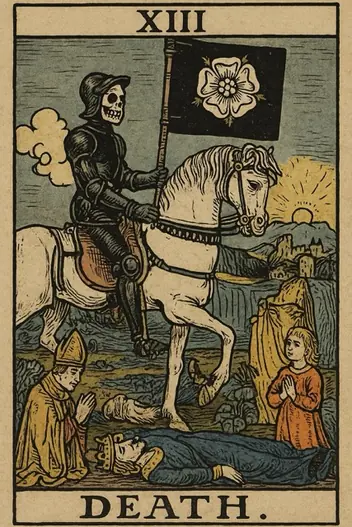
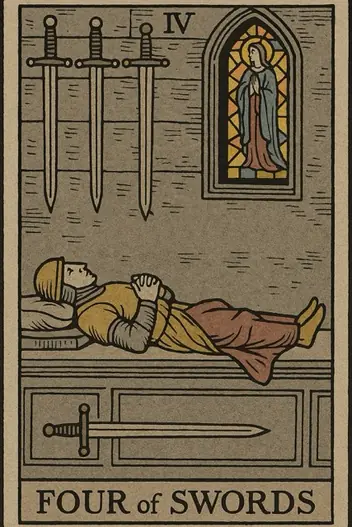
- Arcana
- Death — Major Arcana; Four of Swords — Minor Arcana, Swords
- Elements
- Death — Water; Four of Swords — Air
- Elemental interaction
- Neutral elements — energies coexist without conflict
- Numerology
- 13 + 4 = 17 → 8
When the Death card—the archetype of radical endings and unavoidable transformation—collides with the Four of Swords—the archetype of mental retreat, recovery, and strategic withdrawal—a powerful psychological paradox emerges. This combination represents the tension between the need to let go and the compulsion to stop and think. It is not a card of sudden catastrophe, but rather a signal that the mind must first surrender before the life can change.
In practical terms, this pair suggests that a major transition is imminent, but it requires conscious preparation. You are not being asked to leap blindly into the unknown; you are being asked to rest, reflect, and mentally disengage from what no longer serves you before the transformation can complete itself. This is a time for calculated stillness, not impulsive action.
Core Dynamics & Interpretation
The psychological state created by Death and Four of Swords is one of controlled surrender. The Death card demands the end of a phase—a job, a relationship, a belief system—while the Four of Swords insists on a period of cognitive disengagement before that end can be fully processed. This is a classic Jungian moment: the ego must temporarily step back to allow the unconscious to integrate the loss.
The key insight here is that forced rest is not failure; it is a strategic necessity. If you resist the Four of Swords’ call to withdraw, the Death card’s transformation will feel chaotic and overwhelming. If you embrace the pause, you gain clarity on what must die and what can be reborn. This combination rewards mental discipline and emotional detachment from the outcome.
From a behavioral perspective, this pair warns against rumination and analysis paralysis. The Four of Swords is not about endlessly thinking through a problem; it is about setting the problem aside so that the subconscious can work on it. The Death card then provides the energy for a clean break when you return to action. The practical takeaway: stop trying to force the change. Create space, and let the natural end occur.
Career and Finances
Strategic Opportunities:
Use this time to reassess your career trajectory without pressure to act immediately. The Death card clears the path for a new role or industry, but the Four of Swords says you need mental clarity first. This is ideal for updating your resume, networking quietly, or researching new fields without making any public moves.
Strategic Opportunities:
Delegate or postpone non-urgent decisions. If you are in a leadership position, this combination suggests that a major restructuring or project phase is ending. The best strategy is to pause before announcing changes—let your team or stakeholders adjust to the idea of an ending before you present the new plan.
Calculated Risks:
Avoid making financial commitments during this phase. The Death card can indicate a loss of income or a shift in financial stability, but the Four of Swords warns against impulsive spending or investment decisions driven by anxiety. Do not use money to distract yourself from the emotional work of letting go.
The most important financial warning is to avoid the "sunk cost fallacy." The Death card represents a clean break, but the Four of Swords can tempt you to over-analyze past decisions or hold onto a failing project because you have already invested so much. Objectively assess whether the resource drain is worth the emotional cost. If a job, client, or investment is causing chronic stress, the combination suggests that the wisest financial move is to cut losses now and use the recovery period to plan a more sustainable path. Bold action here means strategic withdrawal, not aggressive pursuit.
Your pair is already on the table. Ask your question and draw the clarifying card
or simply focus on it
Death and Four of Swords in Love Tarot
If you are single:
This combination suggests you need a period of deliberate solitude before pursuing a new connection. Trying to date while still mentally attached to a past relationship or fear of change will only attract unstable dynamics. Use this time to redefine what you truly want without external influence.
If you are in a relationship:
The relationship is likely at a critical turning point that requires a temporary emotional timeout. This is not a breakup necessarily, but a structured pause to assess whether the partnership can evolve past a current impasse. Avoid making permanent decisions during this reflective phase.
The core relationship advice here is to prioritize emotional intelligence over reaction. If you are in a partnership, this combination often appears when one or both partners are holding onto resentment or fear of change. The Death card demands that you let go of the relationship’s old form—perhaps an outdated dynamic, a recurring argument pattern, or a shared fantasy about the future. The Four of Swords advises that you discuss this need for change in a calm, structured setting, perhaps with a therapist or after a few days of separate reflection. Do not force a conversation when you are emotionally flooded. Instead, agree on a specific time to revisit the topic after a period of rest. This approach transforms a potential breakup into a conscious evolution of the bond.
Deepen your understanding
Find out exactly what this reading means for your current life situation with our oracle.
What Are the Risks of Death and Four of Swords?
When the energy of Death and Four of Swords is blocked or expressed poorly, the seeker may fall into chronic avoidance or passive-aggressive resistance. The shadow of the Four of Swords is procrastination disguised as "needing more time to think." You may convince yourself that you are being strategic, when in reality you are terrified of the Death card’s finality. This leads to a state of emotional paralysis where you neither fully engage with the present nor commit to change.
Another common pitfall is cognitive dissonance—holding two contradictory beliefs simultaneously (e.g., "I know this relationship is over" and "Maybe it will get better if I just rest"). The Death card’s shadow is brutal denial of the need for change, while the Four of Swords’ shadow is excessive mental detachment that numbs you to genuine feelings. Beware of using "self-care" or "taking a break" as a way to avoid necessary confrontation. The combination demands that you use the rest period to gather courage, not to build more walls. If you find yourself feeling more anxious the longer you wait, it is a sign that you are avoiding, not preparing.
Reversed Death and Four of Swords Explained
When cards appear in a reversed position, the dynamic becomes less fatal but more unsettling.
If Death is reversed:
The process of transformation is blocked. You are desperately clinging to a dead structure, refusing to let it go. This is a state of reckless struggle against the inevitable. Risk: you will expend all your energy maintaining a facade that will collapse with even greater losses. Advice: acknowledge your defeat. This is not weakness, but the only way to minimize the damage.
If the Four of Swords is reversed:
This indicates an internal resistance to rest. You do not allow yourself to stop, even though you are exhausted to the limit. Insomnia, anxiety, obsessive thoughts. Warning: your nervous system is on the verge of a breakdown. Ignoring your body's signals will lead to psychosomatic issues or serious illness. Advice: forcibly implement a "digital detox" routine and go to sleep on a schedule.
If BOTH are reversed:
Complete imbalance. This is a chaotic oscillation between the desire to destroy everything and the inability to find peace. A person may begin impulsive actions (quitting a job, ending a relationship) without awareness of the consequences, and then fall into hysterics. A logical way to correct this: reduce stimulation to zero. Turn off your phone, isolate yourself in a quiet place for 3 days. Only complete sensory deprivation can break this destructive cycle.
Death and Four of Swords Combined Message
How can one constructively use the energy of Death to balance the Four of Swords? The answer is paradoxical: you must consciously and disciplinedly die to the outer world. Do not wait for life to finish you off; take control of the process. Organize your retreat. Set clear timeframes for "lying low" (for example, exactly 7 days). During this period — no attempts to make plans, search for meaning, or analyze mistakes. Your only task is physical recovery: sleep, food, walks.
The strategic advice that will arm you with clarity is: perceive the Four of Swords as an operating room, and Death as the surgery itself. After surgery, you cannot immediately run a marathon. Rehabilitation is needed. Do not try to "transcend" the crisis or "become stronger" right now. First, let the wound heal. When you emerge from this state (and you will, if you do not resist), you will discover that all old problems have vanished. They died on their own while you were in isolation. Your only task now is to preserve yourself as a person, by allowing the old personality to die.
Your Next Step: Personal Context Matters
The Death and Four of Swords combination is a powerful reminder that true transformation requires both the courage to end and the wisdom to pause. The message is not to rush through grief or change, but to use stillness as a tool for clarity. When you stop fighting the inevitable and instead create space for it to unfold, you move from surviving change to orchestrating it. This is a time for strategic patience—not passivity, but active waiting.
While this article provides a deep analysis of the archetype, the real power of Tarot comes from applying it to your unique life. The meaning of Death and Four of Swords shifts dramatically depending on whether you are ending a 20-year marriage, leaving a toxic job, or simply releasing a limiting belief. To get a personalized interpretation of this exact combination for your specific situation, use the Fortune Cards app today. You can access it on the web or download it to receive a deep, context-aware reading that tells you exactly what this pair means for your life right now. Your transformation is waiting—but only you can decide when to act.
Interpretation by the Fortune Cards editorial team, based on the Rider–Waite tradition and Jungian archetypes. About our methodology · Updated: 2026-08-26
Other Combinations with Death
Other Combinations with Four of Swords
Explore Individual Card Meanings
Ready to find answers to your questions?
Start your first reading now and look at your situation with fresh clarity. The cards are ready to reveal deeper meaning.