Death and Seven of Pentacles Together in Tarot
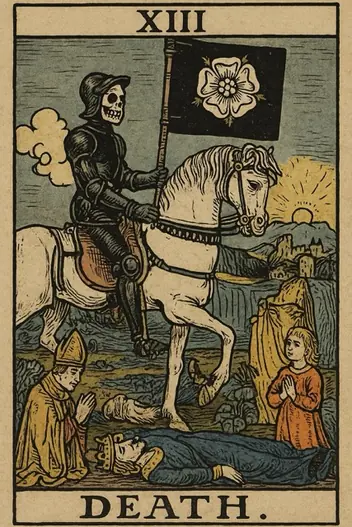
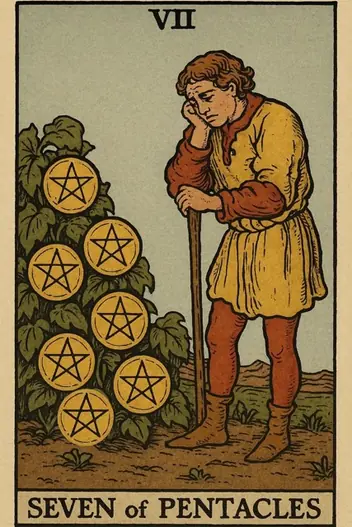
- Arcana
- Death — Major Arcana; Seven of Pentacles — Minor Arcana, Pentacles
- Elements
- Death — Water; Seven of Pentacles — Earth
- Elemental interaction
- Friendly elements — energies support each other
- Numerology
- 13 + 7 = 20 → 2
When the Death card meets the Seven of Pentacles, we are not dealing with a sudden catastrophe but with a calculated, necessary termination of something that no longer yields value. The Death card represents the archetype of transformation—the psychological process of letting go of an outdated identity, project, or pattern to make room for renewal. The Seven of Pentacles, in contrast, is the card of patience, evaluation, and long-term investment. Together, they create a tension: you have been working hard, planting seeds, and waiting for results. Now, the Death card demands an honest audit. If the harvest is not coming, you must have the courage to cut your losses and redirect your energy.
This combination is not about destruction for its own sake. It is about strategic pruning. In Jungian terms, it represents the confrontation with the Shadow of inertia—the part of you that clings to familiar but unproductive routines out of fear of the unknown. The psychological challenge here is to distinguish between true patience (Seven of Pentacles) and stubborn avoidance of necessary change (Death). The core message: do not waste another season tending to a field that will never bear fruit.
Core Dynamics & Interpretation
The fusion of Death and Seven of Pentacles creates a high-stakes decision-making environment where emotional detachment is required for survival. The Death card strips away sentimentality, forcing you to look at your projects, relationships, or career path with cold, pragmatic clarity. The Seven of Pentacles then asks: What has the return on your investment actually been? If the answer is "low" or "none," the path forward is clear—stop pouring resources into a dead end. This is not a time for wishful thinking or "sunk cost" fallacies. You must be willing to walk away from something you have built, even if it feels like a loss.
Psychologically, this combination activates the Evaluator archetype—the part of you that can step back and assess progress without ego attachment. The key insight is that patience without periodic review becomes stagnation. The Death card provides the necessary shock to break the hypnotic cycle of "just one more effort." In real-world terms, this might mean: canceling a failing business initiative, ending a relationship that has plateaued, or abandoning a creative project that drains more than it inspires. The pain of letting go is temporary; the pain of staying in a dead-end situation is chronic.
The strategic implication is clear: you must treat your time and energy as finite capital. The Seven of Pentacles reminds you that growth takes time, but the Death card insists that time alone does not guarantee results. You need a termination threshold—a clear point at which you will objectively say, "This is no longer viable." This combination is a call to reallocate your efforts toward something that actually has potential for long-term yield.
What Do Death and Seven of Pentacles Indicate for Your Career?
Strategic Opportunities:
Cut unprofitable projects or side hustles that drain time without measurable return. This frees up capital for higher-yield ventures.
Strategic Opportunities:
Use this period for a professional "audit." Review your resume, skills, and network. Identify what no longer serves your long-term goals and pivot to a more promising niche.
Calculated Risks:
Avoid doubling down on a failing strategy out of pride or fear of admitting error. The sunk cost fallacy is your biggest enemy here. Do not take on new debt to prop up an old, dying venture.
In the professional realm, this combination is a powerful signal for strategic disinvestment. The Seven of Pentacles represents the patient cultivation of a career or business, but the Death card reveals that some seeds simply do not grow in your current soil. This is not a failure of effort—it is a failure of alignment. You may have been working hard in the wrong field, for the wrong boss, or on the wrong product. Bold: The most productive action you can take now is to stop watering a dead plant.
Financially, this pair warns against emotional spending or investing to avoid the pain of loss. You might be tempted to throw money at a sinking project to "save" it, but the Death card says: let it die. The Seven of Pentacles then asks you to reinvest your remaining capital into something with a longer growth horizon. Bold: A loss taken now is a lesson learned; a loss prolonged is a pattern of self-sabotage. Use this time to build a financial buffer and diversify your income streams rather than concentrating risk in one unstable area.
Your pair is already on the table. Ask your question and draw the clarifying card
or simply focus on it
Death and Seven of Pentacles in Love Tarot
If you are single:
This combination suggests you are evaluating a potential partner or a past connection through a pragmatic lens. You may need to let go of an idealized version of love and accept that a certain relationship has run its course before it even began. Do not invest emotional energy in someone who shows no reciprocal commitment.
If you are in a relationship:
You and your partner are at a critical evaluation point. The question is not whether you love each other, but whether the relationship is sustainable and mutually nourishing. Be prepared to have an honest conversation about what is not working.
In relationships, Death and Seven of Pentacles points to a necessary period of emotional accounting. You may feel that you have invested months or years into a partnership that now feels stagnant or one-sided. The Death card demands that you stop pretending that more time will fix fundamental incompatibilities. Bold: The most dangerous belief here is that "if we just wait longer, things will improve." This combination warns that waiting without active change is a form of avoidance.
If you are single, this pair suggests you are emerging from a period of emotional burnout from previous investments. You may be overly cautious now, which is healthy up to a point. The key is to use the Seven of Pentacles' patience to evaluate new connections slowly, but not to let the Death card's fear of loss close you off entirely. Bold: The goal is not to avoid pain, but to invest only in relationships that show clear signs of mutual growth.
Your unique Tarot reading
See how these cards interact with your destiny. Start a free personal reading now.
What If Death or Seven of Pentacles Appears Reversed?
If Death is reversed:
Blocked potential. You are clinging to the past, preventing yourself from moving forward. The Seven of Pentacles in its upright position here emphasizes the futility of waiting. Your "harvest" will never ripen until you allow the old to pass away. Advice: Take the first step toward change, even if it feels destructive. It is better than endless agony.
If the Seven of Pentacles is reversed:
Inner resistance and laziness. You know you need to change (Death upright), but you lack the strength or will. The reversed Seven represents procrastination and fear of the outcome. You are afraid your efforts will be in vain. Advice: Lower the bar. Do not demand immediate success from yourself. Just start doing something new to break the vicious cycle of inaction.
If BOTH are reversed:
Complete imbalance. This is a state of "frozen chaos". You can neither change anything (Death blocks transformation) nor preserve anything (the Seven points to a loss of resources). Advice: This is a signal for radical simplification. Remove everything superfluous. Focus on basic needs—food, sleep, health. Do not make important decisions until you regain a sense of grounding.
What Are the Risks of Death and Seven of Pentacles?
The shadow manifestation of Death and Seven of Pentacles is paralysis disguised as patience. The seeker may rationalize inaction by saying they are "waiting for the right moment" when, in reality, they are terrified of making a decision. This is the cognitive bias of loss aversion—the fear of losing what you have (even if it is not working) outweighs the potential gain of something new. The result is stagnation: you keep tending to a garden that has already died, hoping for a miracle.
Another pitfall is premature termination. The Death card can be interpreted too literally, leading to impulsive cuts without proper evaluation. The Seven of Pentacles warns that not all slow growth is failure—some things simply take longer to mature. The shadow side here is impatience disguised as decisiveness: you may quit a project or relationship just before it was about to bear fruit. Bold: The key is to distinguish between a dying enterprise and a slow-growing one. If the core structure is healthy but needs more time, the Death card is misapplied. If the core is rotten, the Seven of Pentacles' patience becomes a trap.
Finally, watch for the martyr complex: using the Death card as an excuse to sacrifice yourself for a cause that does not value you. This might look like staying in a job you hate because you've "invested too much time," or clinging to a relationship because of shared history. Bold: True transformation requires you to honor your own time and energy as finite resources. Do not let the fear of starting over keep you trapped in a cycle of diminishing returns.
What Is the Overall Message of Death and Seven of Pentacles?
How to constructively use the energy of Death to balance the Seven of Pentacles? The answer is through strategic patience and conscious completion. Death grants you permission for a "cleansing," while the Seven of Pentacles is a card of cyclicality. It reminds you that spring always follows winter, but you must wait for winter to end first.
Your task is not to fight the inevitable, but to skillfully manage resources during a crisis. Understand this: what you perceive as loss is actually a redistribution of capital (emotional, temporal, financial). Do not try to harvest from a dead field. Instead, plow it and prepare the soil for a new sowing.
A deep strategic piece of advice: Use the energy of Death to "reset" your expectations of the Seven of Pentacles. Stop waiting for immediate returns. Accept the pause. This period is not meant for you to achieve a result, but for you to recognize the value of what you have and understand what you truly need. Only by passing through this acceptance can you take a conscious step into a new life.
Where to Go From Here
The Death and Seven of Pentacles combination is a strategic wake-up call: it asks you to audit your investments—emotional, financial, and professional—and have the courage to walk away from what is not working. The core message is that true patience is not passive waiting, but active evaluation and redirection. You are not being asked to destroy everything; you are being asked to prune what is dead so that what is alive can grow.
While this article provides a deep archetypal analysis, the real power of Tarot comes from applying it to your specific situation. Your unique question, timing, and emotional state will shift the interpretation. That is why I recommend using the Fortune Cards app. It allows you to input your exact query—whether about a relationship, career decision, or personal crossroads—and receive a personalized, AI-powered reading of this exact combination. The app is available on the web and for download, giving you instant access to a deep, context-aware interpretation that goes beyond generic meanings. Stop guessing. Get your tailored reading now.
Interpretation by the Fortune Cards editorial team, based on the Rider–Waite tradition and Jungian archetypes. About our methodology · Updated: 2026-08-26
Other Combinations with Death
Other Combinations with Seven of Pentacles
Explore Individual Card Meanings
Table of Contents
- Core Dynamics & Interpretation
- What Do Death and Seven of Pentacles Indicate for Your Career?
- Death and Seven of Pentacles in Love Tarot
- What If Death or Seven of Pentacles Appears Reversed?
- What Are the Risks of Death and Seven of Pentacles?
- What Is the Overall Message of Death and Seven of Pentacles?
- Where to Go From Here
Ready to find answers to your questions?
Start your first reading now and look at your situation with fresh clarity. The cards are ready to reveal deeper meaning.