The Devil and Five of Wands Reversed in Tarot
- Arcana
- The Devil — Major Arcana; Five of Wands — Minor Arcana, Wands
- Elements
- The Devil — Earth; Five of Wands — Fire
- Elemental interaction
- Neutral elements — energies coexist without conflict
- Numerology
- 15 + 5 = 20 → 2
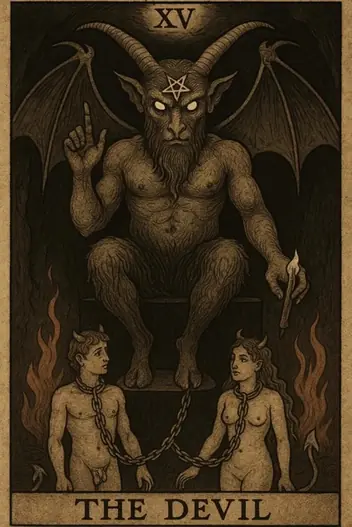
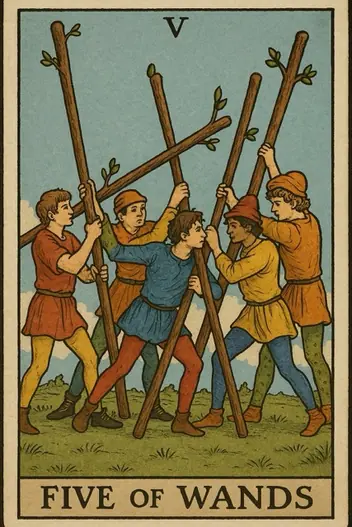
When The Devil meets the Five of Wands, you are looking at a psychological pressure cooker. The Devil represents attachment, compulsion, and the illusion of powerlessness—the chains we forge through fear or desire. The Five of Wands introduces raw, competitive friction, conflict, and the need to prove oneself. Together, they describe a situation where your own shadow material (insecurity, obsession, or rigid control) is fueling a cycle of unnecessary struggle. The core question here is: Are you fighting to free yourself, or are you fighting to defend your cage? This combination demands a pragmatic audit of where your energy is going and whether the battle you’re in is actually worth winning.
The Devil and Five of Wands: How These Energies Interact
The psychological state created by The Devil and Five of Wands is one of entrenched defensiveness. You feel trapped—by a person, a habit, or a situation—and your response is to fight harder, often against the wrong targets. The Devil’s energy is about addiction to a pattern (e.g., needing to be right, needing control, fearing loss), while the Five of Wands represents the externalization of that inner conflict into petty arguments, competition, or power struggles. The result is a high-stakes, low-reward game where you exhaust yourself fighting symptoms instead of causes.
In real-world terms, this is the classic “sunk cost fallacy” in action. You stay in a toxic job, relationship, or habit because you’ve invested so much, and you argue with anyone who suggests you leave. The tension feels productive, but it’s actually numbing your ability to see the exit. The key insight is that the conflict is not the problem—it’s the symptom of a deeper attachment you haven’t examined. To break the loop, you must first name what you are afraid to lose. Only then can you decide if that thing is worth the fight.
Your pair is already on the table. Ask your question and draw the clarifying card
or simply focus on it
The Devil and Five of Wands in Career Readings
Strategic Opportunities:
Use the competitive energy to sharpen your skills or differentiate yourself in a crowded market. Channel the friction into productive rivalry, like a sales contest or a creative brief.
Strategic Opportunities:
This can signal a necessary confrontation with a toxic boss or unethical practice. The Devil demands you face the truth about a situation you’ve been avoiding.
Calculated Risks:
Do not get drawn into office politics or petty turf wars. The Five of Wands can quickly drain your time and reputation with no tangible payoff. Avoid making financial decisions out of fear or spite.
In your professional life, this combination often appears when you are over-invested in a project or position that is no longer serving you. The Devil’s energy can manifest as golden handcuffs—a high salary that keeps you in a soul-crushing role, or a partnership where you sacrifice ethics for stability. The Five of Wands warns that the conflict you are facing (a difficult client, a rival colleague, a stalled project) is a distraction from a bigger strategic error. The pragmatic move is to run a cost-benefit analysis on your current situation. What is the actual ROI of staying versus leaving? If you are fighting for a promotion, ask yourself: Am I fighting for the title, or for the work I want to do? Bold financial warning: Avoid making large investments or signing contracts under pressure. The Devil can create a false sense of urgency. Take 72 hours to review any decision made during a conflict.
The Devil and Five of Wands Love Outcome
If you are single:
This combination warns against pursuing a connection that feels thrilling but is built on power imbalances, jealousy, or intense competition for attention. The attraction may be strong, but the foundation is unstable.
If you are in a relationship:
You are likely locked in a cycle of repetitive arguments where both partners are more focused on “winning” than understanding. The Devil’s chains here are often shared resentments or codependent patterns.
The relationship dynamics here are volatile and require high emotional intelligence to navigate. The Devil often points to a partner who triggers your insecurities, or a dynamic where sex, money, or control is used as leverage. The Five of Wands adds a layer of constant friction—bickering over trivial matters, competing for status, or feeling like you have to fight for your needs to be heard. The most pragmatic advice is to stop trying to “fix” the other person. Instead, examine what you are getting out of the struggle. Are you avoiding loneliness? Are you addicted to the drama? Set a clear boundary: no conversations when either of you is triggered. Use a cooling-off period to separate the person from the pattern. If the fights are about the same three issues, consider if the attachment is to the idea of the relationship, not the reality.
Ask your specific question
Don't rely on generic meanings. Get a customized reading tailored specifically to your energies.
When The Devil and Five of Wands Signal Trouble
The shadow side of this pairing is self-sabotage disguised as ambition. You may believe you are fighting for a cause, but you are actually feeding a compulsion for control or validation. Common cognitive biases include confirmation bias (only seeing evidence that justifies your struggle) and the illusion of transparency (assuming others know your motives, leading to miscommunication). When blocked, this energy can turn into paranoia—seeing enemies everywhere and treating neutral situations as personal attacks. The greatest pitfall is burnout from misdirected effort. You may win the battle but lose the war, exhausting resources on a fight that was never yours to win. If you feel a rush of righteous anger, pause. Ask: Is this anger protecting me, or is it keeping me stuck?
The Devil and Five of Wands Reversed: How to Read It
When cards appear reversed, the dynamic becomes distorted, but does not disappear. It retreats into the shadow or becomes passive-aggressive.
If The Devil is reversed:
The addiction to conflict remains, but control is lost. The person becomes a victim of circumstances, rather than an active player. They provoke arguments but cannot resolve them. Advice: stop blaming others. Take back responsibility for your own reactions.
If the Five of Wands is reversed:
The energy of struggle is suppressed. Instead of open conflict — passive aggression, intrigue, and sabotage. Here, The Devil manifests as manipulation from the shadows. Warning: such a "quiet war" destroys trust faster than an open quarrel.
If BOTH are reversed:
This is complete imbalance. The person simultaneously craves power but fears the fight. They become stuck in a victim state, blaming the entire world. Advice: the only way out is to honestly admit that you are creating your own hell. Start with a small action unrelated to control or competition.
The Devil and Five of Wands: The Combined Message
How to use the Devil's energy to balance the Five of Wands? The answer is paradoxical: you must direct the will to power toward suppressing your own aggressive impulsiveness. The Devil is the archetype of discipline and concentration. Use it to take control of the Five of Wands, rather than fueling it.
Your strategic task is to transform chaotic struggle into structured competition. Instead of fighting for every resource, create the rules of the game where your strength lies in discipline and strategy. For example, in business—this means not undercutting, but creating a unique product. In relationships—not domination, but establishing clear and honest boundaries.
A deep piece of advice: separate your self-worth from the outcome of every battle. The Devil binds you to the result. The Five of Wands compels you to fight for it. Realize that your value does not depend on whether you win this argument or not. Once you do this, you will cease to be addicted to the adrenaline of conflict and will be able to choose which battles to enter. Clarity comes when you stop confusing survival with living.
Applying This to Your Situation
The core message of The Devil and Five of Wands is a call to stop fighting the wrong war. The chains are real, but they are often self-forged. Your next step is to identify the attachment—fear of failure, need for approval, comfort in chaos—and decide if it’s worth the energy you’re spending. The conflict is not your enemy; it is a signal. Listen to it, then act with precision, not reaction.
Your situation is unique. While this article gives you the archetypal map, the real power lies in applying these insights to your specific question. To get a deep, personalized interpretation of The Devil and Five of Wands for your exact situation—whether about love, career, or inner growth—use the Fortune Cards app. Available on the web or as a download, it delivers a tailored reading that accounts for your context, not just generic card meanings. Stop guessing. Get clarity. Download Fortune Cards now.
Interpretation by the Fortune Cards editorial team, based on the Rider–Waite tradition and Jungian archetypes. About our methodology · Updated: 2026-08-26
Other Combinations with The Devil
Other Combinations with Five of Wands
Explore Individual Card Meanings
Table of Contents
- The Devil and Five of Wands: How These Energies Interact
- The Devil and Five of Wands in Career Readings
- The Devil and Five of Wands Love Outcome
- When The Devil and Five of Wands Signal Trouble
- The Devil and Five of Wands Reversed: How to Read It
- The Devil and Five of Wands: The Combined Message
- Applying This to Your Situation
Ready to find answers to your questions?
Start your first reading now and look at your situation with fresh clarity. The cards are ready to reveal deeper meaning.