Eight of Cups and Ten of Swords Tarot as Feelings
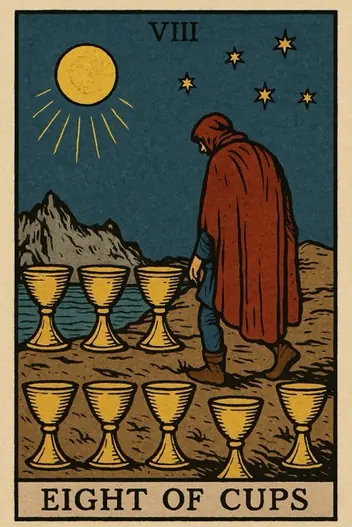

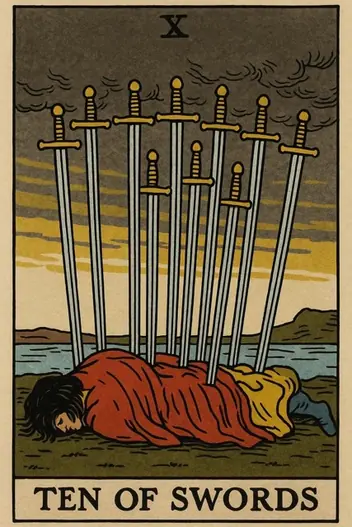
- Arcana
- Eight of Cups — Minor Arcana, Cups; Ten of Swords — Minor Arcana, Swords
- Elements
- Eight of Cups — Water; Ten of Swords — Air
- Elemental interaction
- Neutral elements — energies coexist without conflict
- Numerology
- 8 + 10 = 18 → 9
This combination represents a critical psychological turning point. The Eight of Cups embodies the archetype of the Wanderer—the conscious decision to walk away from emotional investments that no longer serve your growth. The Ten of Swords embodies the Martyr archetype—the painful, often dramatic conclusion of a mental battle. When these cards collide, they depict a scenario where you have hit rock bottom mentally or emotionally, and the only sane response is to leave the battlefield entirely. This isn't a random event; it’s the logical outcome of prolonged denial or misplaced loyalty. The key insight here is that the pain is a signal, not a punishment. Ignoring it would be a failure of strategic judgment.
Core Dynamics & Interpretation
The core dynamic of this pairing is a decisive break following a period of intense mental suffering. The Ten of Swords represents the final, sharp realization that a situation—be it a relationship, job, or belief system—is not just flawed but toxic to your psyche. The Eight of Cups is the behavioral response: the deliberate, often solitary, act of walking away without looking back. Psychologically, this mirrors the Jungian process of individuation, where you must shed a false persona or an outdated attachment to reclaim your authentic self.
This is not a card of passive victimhood. The Ten of Swords may show a figure pinned down, but the Eight of Cups shows a figure in motion. The psychological state here is one of post-traumatic clarity. You have absorbed the worst blow, and the adrenaline of survival is now fueling a strategic retreat. The real-world implication is that you must treat this as a non-negotiable exit strategy. Any attempt to "fix" the situation or "go back" will only repeat the cycle of self-sabotage. The mindset required is that of a cold-eyed realist: accept the loss, take the lesson, and move your resources—time, energy, focus—to higher ground.
What Do Eight of Cups and Ten of Swords Indicate for Your Career?
Strategic Opportunities:
Quitting a dead-end job or toxic work environment is the primary opportunity here. This frees up mental bandwidth for a career pivot aligned with your true values.
Strategic Opportunities:
Liquidating underperforming assets or cutting ties with a failing business partner. This clears the deck for a fresh, more sustainable financial strategy.
Calculated Risks:
Avoid burning bridges publicly. While you must leave, do so professionally. The Ten of Swords warns against dramatic resignations that could damage your reputation.
In a career context, this combination is a strategic retreat, not a failure. The Eight of Cups shows you are walking away from a situation that has become emotionally and intellectually bankrupt. The Ten of Swords suggests that the final blow—a layoff, a major project failure, or a public conflict—has already occurred or is imminent. Your task is to accept the loss of sunk costs. Do not pour more energy into salvaging a reputation or a role that is fundamentally compromised. Bold financial warning: Do not take on debt to "prove" you can fix a broken venture. Instead, redirect capital into a low-risk, high-liquidity position while you regroup. This is a time for conservative resource management and strategic patience.
Your pair is already on the table. Ask your question and draw the clarifying card
or simply focus on it
Eight of Cups and Ten of Swords in Love Tarot
If you are single:
This combination suggests you are emerging from a period of heartbreak or disillusionment. Do not rush into a new romance. Instead, use this time for emotional detox and recalibration. Your next connection should be built on a foundation of mutual respect, not a reaction to past pain.
If you are in a relationship:
This pairing signals a critical breaking point. A pattern of betrayal, constant criticism, or emotional neglect has reached its logical conclusion. The healthiest action is to initiate a clear, final separation rather than prolonging a cycle of resentment.
In relationships, this combination demands radical honesty about the cost of staying. The Ten of Swords often points to a partner who has been "defeated" by the dynamic—perhaps through words spoken in anger, infidelity, or a fundamental incompatibility that cannot be resolved. The Eight of Cups advises that the most loving act is to walk away with dignity. Bold relationship advice: Do not confuse "closure" with "reconciliation." Closure is an internal process; you do not need the other person's permission to end a harmful chapter. If you stay, you risk internalizing the victim role of the Ten of Swords permanently. Set a firm boundary: leave the corpse of the old relationship behind to focus on your own healing.
Your unique Tarot reading
See how these cards interact with your destiny. Start a free personal reading now.
Reversed Eight of Cups and Ten of Swords Explained
When cards appear reversed, the dynamic shifts from external drama to internal struggle.
If the Eight of Cups is reversed:
This indicates a blocked potential for departure. You understand that you need to leave, but you are afraid or unable to take the step. You are stuck in a state of "wanting to, but cannot." This leads to an accumulation of frustration, making the final blow of the Ten of Swords even more devastating. Advice: find the resource to make a decision. Your hesitation is your greatest enemy.
If the Ten of Swords is reversed:
The crisis is prolonged. Instead of a swift and painful blow, you experience a lingering agony. The blow has already been struck, but you refuse to admit defeat and continue clinging to an illusion. Warning: this is a state of self-deception. You are not recovering; you are merely postponing the inevitable fall.
If BOTH are reversed:
Complete imbalance and paralysis of the will. You can neither leave nor stay, nor accept the blow. This is a state of profound depression and denial of reality. The only way to rectify the situation is to seek external help (psychologist, mentor), as there are no longer any internal resources left to break this cycle. Advice: acknowledge your powerlessness and delegate decision-making to someone you trust.
Shadow Side & Pitfalls
The shadow of this combination manifests as martyrdom without agency. The seeker may become stuck in the Ten of Swords position, replaying the "final blow" in their mind and identifying as a victim. This leads to a cognitive bias called "learned helplessness" —believing that no action can change the outcome. Alternatively, the shadow of the Eight of Cups emerges as escapism disguised as growth. The seeker might walk away from a situation that was actually salvageable, driven by a fear of conflict or a need for emotional drama. This is self-sabotage through avoidance. The worst-case scenario is a cycle: you hit a painful ending, run away, and then repeat the same pattern in a new context because you never addressed the underlying psychological wound. The key pitfall is confusing "moving on" with "running away." True movement requires you to take the lesson from the Ten of Swords—what specific belief or behavior led to this low point?—before you set out with the Eight of Cups.
Synthesis: Strategic Conclusion
Constructive use of the energy of this card pair requires the courage to admit defeat in a battle in order to win the war. The Eight of Cups grants you the existential right to walk away. The Ten of Swords gives you clarity: the past is dead. Your task is not to try to resurrect it, but to conduct a dignified funeral.
Strategically, this is the ideal moment for a "strategic retreat". In military science, this is one of the most complex maneuvers. It demands discipline and cold calculation. Do not waste energy on anger or resentment—that is fuel for the past. Redirect it toward planning the next step. The Eight of Cups says: "Go." The Ten of Swords says: "Do not look back."
Deep strategic advice:
Use the pain of the Ten of Swords as a calibration tool. Memorize this feeling as clearly as possible. It will become your internal barometer, helping you in the future to recognize the recurrence of this scenario in its early stages. Right now, you are learning to identify "red flags" not with your mind, but with your body. Having gone through this once, you will gain immunity against its repetition. Your strength lies not in avoiding pain, but in making it your teacher.
Where to Go From Here
The core message of the Eight of Cups and Ten of Swords is clear: a painful ending demands a deliberate departure. You cannot heal in the same environment that broke you. The psychology here is about accepting loss as a prerequisite for growth. Your next step is to identify one concrete attachment—a job, a relationship, a belief—that you must release today. This isn’t about vague hope; it’s about executing a clear exit strategy.
While this article outlines the general archetype, your specific situation requires a personalized lens. Use the Fortune Cards app to get a deep, tailored interpretation of this exact combination for your unique question. Whether you access it on the web or download it, the app applies these psychological principles directly to your life—turning abstract insight into actionable steps right now.
Interpretation by the Fortune Cards editorial team, based on the Rider–Waite tradition and Jungian archetypes. About our methodology · Updated: 2026-08-26
Other Combinations with Eight of Cups
Other Combinations with Ten of Swords
Explore Individual Card Meanings
Table of Contents
Ready to find answers to your questions?
Start your first reading now and look at your situation with fresh clarity. The cards are ready to reveal deeper meaning.