Love Tarot: Five of Wands and Page of Cups
- Arcana
- Five of Wands — Minor Arcana, Wands; Page of Cups — Minor Arcana, Cups
- Elements
- Five of Wands — Fire; Page of Cups — Water
- Elemental interaction
- Opposing elements — energies create tension
- Numerology
- 5 + 11 = 16 → 7
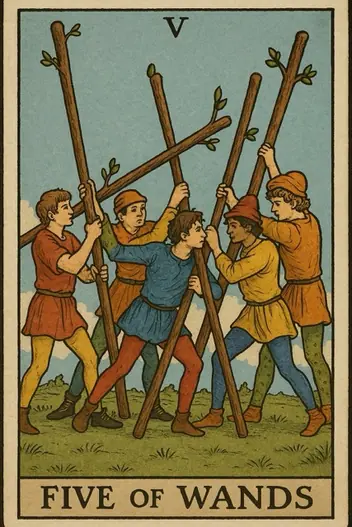
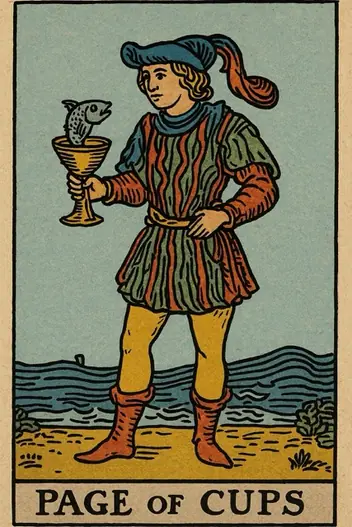
When the Five of Wands—a card of competition, conflict, and scattered energy—collides with the Page of Cups—a card of emotional curiosity, creative idealism, and vulnerability—the result is a psychological tension between assertive drive and tender receptivity. This pairing often signals a situation where raw ambition meets untested feelings, creating a crucible for growth or confusion. From a Jungian perspective, the Five of Wands represents the shadow of the warrior (unchecked ego striving), while the Page of Cups embodies the anima in its nascent form (emotional openness seeking integration). The key challenge here is learning to channel competitive energy without crushing the fragile, intuitive spark the Page represents.
In real-world terms, this combination frequently appears when you are pushing for a win—in a debate, project, or relationship—while simultaneously being flooded with new, unprocessed emotions. It’s the tension between wanting to fight for your position and wanting to explore a tender feeling. The pragmatic advice is to resist the urge to overreact; the Five of Wands can turn the Page’s gentle curiosity into defensiveness. Instead, treat this as a strategic pause: observe your emotional reactions before engaging in the fray.
Five of Wands and Page of Cups Combination Meaning
The core dynamic of the Five of Wands and Page of Cups is a conflict between external friction and internal sensitivity. The Five of Wands creates a battlefield—whether literal arguments, workplace rivalry, or internal self-doubt—while the Page of Cups floats in with a naive, creative, or emotionally vulnerable perspective. This combination forces you to ask: “Am I fighting for a cause, or am I fighting my own feelings?” The Page of Cups often signals a new emotional insight or creative idea that feels fragile. The Five of Wands threatens to trample it under the noise of competition.
Psychologically, this pairing activates the Puer Aeternus archetype (the eternal child) in the Page, clashing with the Hero archetype in the Five. The result is a cognitive dissonance: you may feel compelled to prove yourself (Five) while secretly wanting to retreat into a safe, imaginative space (Page). The most important insight is that this is not a zero-sum game. You can integrate both energies by using the Five of Wands’ assertive focus to protect and champion the Page’s creative or emotional insights. For example, instead of arguing to win, argue to clarify your emotional truth. The strategic move is to channel competitive energy into self-expression—turn the conflict into a workshop for your emotions.
On a practical level, expect mixed signals from yourself or others. Someone may act combative while feeling deeply vulnerable underneath. The key is to avoid taking the bait of the Five’s provocation. Instead, ask: “What is the emotional need beneath this conflict?” The Page of Cups suggests that the answer is often a desire for recognition or connection—not victory. Bold insight: This card pair warns against using emotional openness as a weapon or shield. Be honest about your feelings, but don’t expect everyone to handle them gently.
Career and Finances
Strategic Opportunities:
Use the Page of Cups’ creative intuition to generate fresh ideas that can differentiate you in a competitive market. The Five of Wands gives you the drive to pitch and defend those ideas in meetings or negotiations.
Strategic Opportunities:
This is an ideal time to collaborate with a rival or competitor. The Page’s openness can help you see their perspective, while the Five’s energy can turn the interaction into a productive brainstorming session rather than a fight.
Calculated Risks:
Avoid starting a project based purely on emotion or ego. The Page of Cups can lead to over-idealizing a venture, while the Five of Wands can push you into unnecessary competition that drains resources. Objectively assess whether the conflict is worth your time.
In your career, this combination signals a tension between innovation and office politics. You may have a brilliant, creative idea (Page of Cups) but face resistance, skepticism, or outright competition from colleagues (Five of Wands). Bold strategic tip: Don’t try to out-shout the competition. Instead, use the Page’s charm and emotional intelligence to build alliances before you go to battle. The Five of Wands can be channeled into healthy debate—present your idea as a solution to a shared problem, not a personal victory.
Financially, this pair warns against impulsive spending driven by emotional highs (Page) or risky investments fueled by competitive pressure (Five). Bold financial warning: Do not make a major financial decision while feeling either overly defensive or overly optimistic. The Page of Cups can lead to naive optimism (“This will definitely work out!”), while the Five of Wands can trigger reactive risk-taking (“I need to beat them to it!”). The prudent move is to sleep on it for at least two days, then review the numbers with a detached, analytical eye.
Key career takeaway:
This is a learning opportunity, not a battle. The Page of Cups encourages you to stay curious about feedback, even if it’s delivered harshly. The Five of Wands teaches you to stand your ground without becoming rigid. Bold insight: The most successful outcome comes from treating criticism as data, not as a personal attack.
Your pair is already on the table. Ask your question and draw the clarifying card
or simply focus on it
Love and Relationships
If you are single:
This combination suggests a potential new connection that feels exciting but also confusing. You may meet someone who triggers both intellectual rivalry (Five) and emotional curiosity (Page). Proceed with caution: the chemistry is real, but the dynamic could become a power struggle if you don’t manage your ego. Focus on listening to your intuition rather than trying to “win” the person over.
If you are in a relationship:
Expect arguments that are really about unexpressed feelings. The Five of Wands can manifest as petty disagreements, while the Page of Cups reveals that one partner is harboring a new emotional need or creative idea they’re afraid to share. The core issue is not the conflict itself, but the fear of vulnerability.
In relationships, the Five of Wands and Page of Cups creates a push-pull dynamic where one partner may be more assertive or competitive, while the other is more emotionally sensitive or idealistic. Bold advice: Do not dismiss your partner’s feelings as “dramatic” or “childish.” The Page of Cups represents a genuine emotional truth, even if it’s expressed clumsily. Instead, use the Five of Wands’ energy to actively engage in a constructive dialogue—ask clarifying questions, acknowledge the emotional undercurrent, and set boundaries around how you argue. The risk is that this dynamic can spiral into emotional withdrawal (Page retreats) or escalated conflict (Five dominates). The mature path is to treat the relationship as a creative project: collaborate on a solution rather than compete for the “right” answer.
Key relationship advice in bold:
Practice emotional transparency without blame. Say, “I feel hurt when we argue like this,” instead of “You always start fights.” The Page of Cups thrives on safe emotional expression, while the Five of Wands needs structured conflict to feel productive.
What Are the Risks of Five of Wands and Page of Cups?
The shadow side of this combination emerges when the Five of Wands’ aggression suppresses the Page of Cups’ vulnerability, or when the Page’s naivety escalates the Five’s conflict into a pointless war. Psychologically, this can manifest as reactive defensiveness—you feel attacked, so you lash out, even when the real issue is your own unprocessed emotions. Alternatively, the Page of Cups can become passive-aggressive, using emotional manipulation (“I’m just being honest”) to win the Five’s argument.
Common cognitive biases here:
The confirmation bias (only seeing evidence that supports your side of the fight) and the emotional reasoning fallacy (“I feel threatened, so they must be threatening me”). Self-sabotage occurs when you reject a genuine emotional insight because it doesn’t fit your competitive narrative. For example, you might ignore a creative idea because it feels “too soft” for the current conflict.
The biggest pitfall is burnout. The Five of Wands demands constant energy for battle, while the Page of Cups drains you with emotional highs and lows. If you don’t ground yourself, you may end up exhausted, resentful, and disconnected from your original motivation. Bold warning: Do not confuse intensity with intimacy. Just because you’re arguing passionately doesn’t mean you’re connecting meaningfully. The shadow here is drama addiction—using conflict to feel alive, while avoiding the quiet, vulnerable work of true emotional growth.
Uncover hidden insights
Let our advanced Tarot system interpret these archetypes specifically for your personal path.
What If Five of Wands or Page of Cups Appears Reversed?
When cards appear in a reversed position, constructive tension shifts into dysfunctional scenarios.
If the Five of Wands is reversed:
The conflict goes underground. Instead of an open argument, you get passive aggression, sabotage, and unspoken grievances. Creative energy is blocked by the fear of competition. Advice: you need to create a safe space for direct, yet respectful dialogue. Otherwise, the emotional potential of the Page of Cups will be poisoned by a toxic environment.
If the Page of Cups is reversed:
This points to emotional immaturity or manipulation of feelings. Instead of a sincere offer, you get tantrums, hysterics, or attempts to evoke pity to achieve one's goals in the conflict. Advice: do not give in to emotional blackmail. Demand concrete actions and facts, not just feelings.
If BOTH are reversed:
Complete imbalance. You are dealing with cynical and destructive behavior. The conflict is fought with dirty tactics, and emotional expressions are used as weapons. This is a scenario of "toxic relationships" or "workplace burnout." The logical way to correct this: temporary isolation from the triggering environment. Take a pause to analyze where your vulnerability was used against you, and rebuild your personal boundaries from scratch.
Five of Wands and Page of Cups Combined Message
How to constructively use this dynamic? The key strategy is "conscious confrontation." You need to learn to enter an argument not to destroy an opponent, but to hone and defend your emotional truth. Imagine the Five of Wands as a sculptor and the Page of Cups as the clay. Without the resistance of the material, no form can be born. Your task is to allow the conflict to "sculpt" something stable and beautiful from your raw feeling (idea, project, relationship).
Practical algorithm of action: 1) Recognize your emotional impulse (Page of Cups). 2) Formulate it as a thesis for discussion. 3) Invite criticism, but establish a rule: criticism must be directed at the idea, not the person (Five of Wands). 4) Use the feedback received for refinement, not for defense. Deep strategic advice: become the "conductor" of your inner orchestra. Do not allow one instrument (aggression or sensitivity) to drown out another. Only in their harmonious, albeit tense, interaction is genuine creativity and deep connection born.
Applying This to Your Situation
The core message of the Five of Wands and Page of Cups is that conflict can be a container for creativity, and vulnerability can be a strategic asset. You are being asked to fight for your feelings, not against them. This means pausing before reacting, asking what emotional need is driving the conflict, and channeling your competitive energy into protecting your inner vision. The most successful outcome comes from treating disagreements as collaborations—you and your “opponent” are both trying to solve a problem, even if you disagree on the solution.
But here’s the truth:
This article gives you the general archetype, but your specific situation is unique. The Five of Wands and Page of Cups may mean something different for your relationship question versus your career dilemma. That’s where the Fortune Cards app comes in. It’s built to apply these psychological insights to your exact context—your question, your emotions, your timing. Whether you’re on the web or using the app, you can get a deep, personalized interpretation of this combination for your specific question right now. Don’t guess—get clarity. Download Fortune Cards and let the Tarot meet your real life.
Interpretation by the Fortune Cards editorial team, based on the Rider–Waite tradition and Jungian archetypes. About our methodology · Updated: 2026-08-26
Other Combinations with Five of Wands
Other Combinations with Page of Cups
Explore Individual Card Meanings
Table of Contents
Ready to find answers to your questions?
Start your first reading now and look at your situation with fresh clarity. The cards are ready to reveal deeper meaning.