Five of Wands and Page of Pentacles Together in Tarot

- Arcana
- Five of Wands — Minor Arcana, Wands; Page of Pentacles — Minor Arcana, Pentacles
- Elements
- Five of Wands — Fire; Page of Pentacles — Earth
- Elemental interaction
- Neutral elements — energies coexist without conflict
- Numerology
- 5 + 11 = 16 → 7
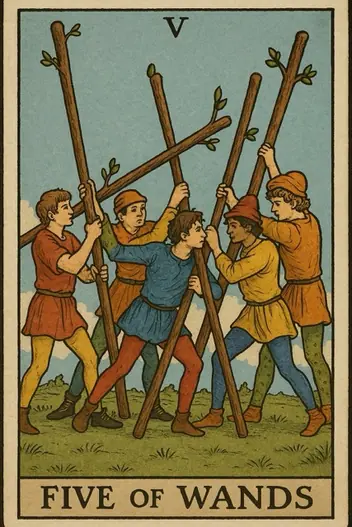
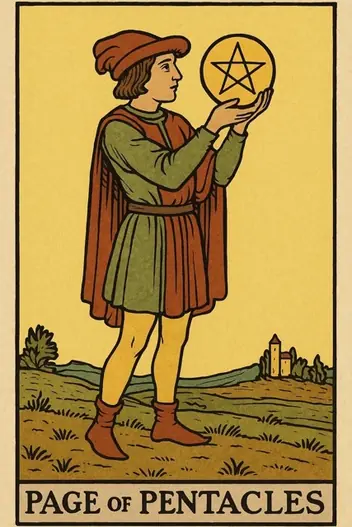
When the competitive friction of the Five of Wands collides with the methodical curiosity of the Page of Pentacles, you get a peculiar psychological cocktail. This pairing represents a moment where you are being asked to learn in the middle of a conflict, or to compete for the right to master a skill. The Five of Wands brings tension, rivalry, and scattered energy; the Page of Pentacles brings focus, study, and a grounded approach. Together, they describe a situation where your patience is tested by external chaos, and your best strategy is to treat the conflict as a classroom.
Core Dynamics & Interpretation
The core dynamic here is the tension between rapid reaction and deliberate action. The Five of Wands is a card of immediate, often unproductive struggle—multiple voices, competing agendas, and a lack of clear hierarchy. The Page of Pentacles, by contrast, is a student archetype: humble, observant, and willing to do the repetitive work. When these energies combine, the psychological state is one of frustrated ambition. You want to move forward, but you are stuck in a scrum of opinions or logistical hurdles.
The key insight is that this conflict is not a threat to your progress—it is the curriculum. The Page of Pentacles energy asks you to step back from the emotional heat and treat the disagreement as data. Instead of trying to win every argument, focus on what you can learn from the friction. The Five of Wands often points to a lack of coordination, but the Page suggests that systematic note-taking and incremental improvement will eventually dissolve the chaos. Your competitive energy must be channeled into skill acquisition, not ego battles.
Your pair is already on the table. Ask your question and draw the clarifying card
or simply focus on it
Career Meaning of Five of Wands and Page of Pentacles
Strategic Opportunities:
The friction in your workplace is revealing a skill gap you need to fill. Use the competition as motivation to upskill or get certified.
Strategic Opportunities:
You are in a position to become the calm, methodical problem-solver in a chaotic team. This will earn you long-term credibility.
Calculated Risks:
Avoid getting drawn into office politics or turf wars that have no clear learning outcome. Do not invest time in arguments that do not teach you something valuable.
In a career context, this combination is a powerful signal for professional development through adversity. You may be facing a situation where multiple colleagues are vying for the same promotion, or where a project is mired in conflicting opinions. The Page of Pentacles advises you to stay in your lane of competence and focus on building tangible skills. Your financial strategy should be conservative: save, budget, and avoid speculative investments during this period of instability. The Five of Wands warns that money made through rivalry is often lost through poor planning. Instead, invest in education, tools, or certifications that make you indispensable. The long-term payoff here comes from mastering a craft, not from winning a single argument.
Deepen your understanding
Find out exactly what this reading means for your current life situation with our oracle.
Love and Relationships
If you are single:
This combination suggests you may be drawn to someone who challenges you intellectually or socially, but the connection feels like a contest. Focus on whether the competition is inspiring growth or just draining your energy.
If you are in a relationship:
You and your partner may be stuck in a cycle of petty disagreements or power struggles. The solution is to shift from “winning” the argument to understanding the underlying need.
In relationships, the Five of Wands and Page of Pentacles often point to a dynamic where one partner feels they are constantly defending their position. This can manifest as bickering over household responsibilities, financial decisions, or differing life goals. The Page of Pentacles energy here is a call to become a student of your partner’s perspective. Instead of reacting defensively, ask questions. Treat the relationship conflict as a shared problem to solve, not a battle to win. The emotional intelligence required is the ability to pause the fight and ask: “What are we actually trying to build here?” This card pair warns against letting ego-driven competition erode intimacy. Practical compromise and a willingness to learn from each other is the path forward.
What If Five of Wands or Page of Pentacles Appears Reversed?
If the Five of Wands is reversed, internal struggle becomes blocked. Instead of active competition, you encounter passive aggression, envy, or sabotage. The energy of conflict does not manifest outwardly but corrodes from within. Advice: stop avoiding confrontation. Let off steam constructively — through sports, debates, or open discussion of the problem.
If the Page of Pentacles is reversed, this points to an unwillingness to learn or ignoring foundational knowledge. You are trying to compete without the necessary tools. This is a path to burnout and defeat. Warning: do not try to win by "brute force." Return to the basics, retrain, or find a mentor.
If BOTH cards are reversed, a complete imbalance arises — chaotic struggle without purpose and without skills. This is a state of total self-sabotage, where you waste energy on meaningless arguments, ignoring obvious opportunities for growth. Remedies: a full stop. Take a week-long timeout to stop reacting to triggers and begin systematically analyzing your failures.
Shadow Side & Pitfalls
The shadow manifestation of this pairing is the “angry student” archetype—someone who learns only to prove others wrong, or who uses knowledge as a weapon. You may fall into the cognitive bias of competitive overconfidence, believing that because you are “studying” the situation, you are automatically right. This can lead to pedantic arguments where you focus on minor details to win a point, while losing sight of the bigger picture. Another pitfall is analysis paralysis: the Page of Pentacles can become overly cautious, while the Five of Wands pushes for action. The result is a stuck state where you are neither fighting effectively nor learning efficiently. Self-sabotage occurs when you mistake busywork for progress, or when you use the chaos as an excuse to avoid committing to a clear path.
What Is the Overall Message of Five of Wands and Page of Pentacles?
Constructive use of this combination requires disciplined aggression. Your task is not to suppress your opponent, but to use them as a training tool. The energy of the Five of Wands (excitement, drive, desire to be first) must be channeled into activating the Page of Pentacles (diligence, attention to detail, learning). Imagine you are preparing for important negotiations: instead of simply being angry at your opponent, you study their strategy, learn new debate techniques, and rehearse your arguments.
Strategic advice: divide the process into two phases. The first phase — "Battle": you actively defend your boundaries and engage in competition. The second phase — "Study": you analyze the result, note your mistakes, and master new tools. The cyclical repetition of these phases is the key to mastery. Do not try to be both a warrior and a student at the same moment — this leads to a scattering of attention.
Deep insight: this combination teaches that true strength lies not in victory over others, but in overcoming one's own inertia through an external challenge. Competition is not a goal, but a method. Your main opponent is your yesterday's self, and the Five of Wands and the Page of Pentacles are the tools that will help you become better.
Applying This to Your Situation
The Five of Wands and Page of Pentacles together tell you that your next breakthrough requires you to be both a warrior and a scholar. You must engage with the conflict, but not as a brawler—as a strategist. Your best move is to identify one concrete skill you can develop right now that will make the current struggle irrelevant. The friction is temporary; the competence you build is permanent.
While this article provides the general archetype, the true magic happens when Tarot is applied to your unique situation. The Fortune Cards app can give you a deep, personalized interpretation of this exact combination for your specific question—whether it’s about a relationship, a career move, or a personal dilemma. Use the app on the web or download it now to get the clarity you need to turn chaos into mastery.
Interpretation by the Fortune Cards editorial team, based on the Rider–Waite tradition and Jungian archetypes. About our methodology · Updated: 2026-08-26
Other Combinations with Five of Wands
Other Combinations with Page of Pentacles
Explore Individual Card Meanings
Table of Contents
Ready to find answers to your questions?
Start your first reading now and look at your situation with fresh clarity. The cards are ready to reveal deeper meaning.