Love Tarot: The Fool and Two of Swords

- Arcana
- The Fool — Major Arcana; Two of Swords — Minor Arcana, Swords
- Elements
- The Fool — Air; Two of Swords — Air
- Elemental interaction
- Same element — energies intensify each other
- Numerology
- 0 + 2 = 2
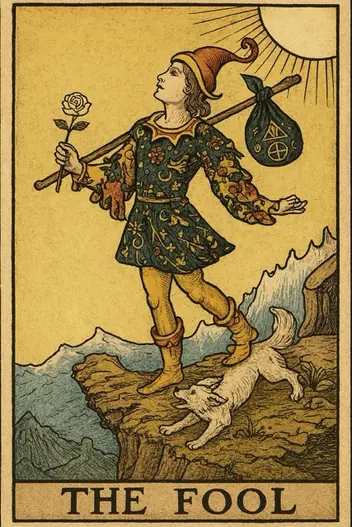
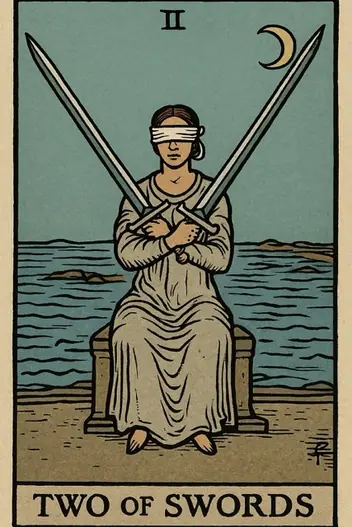
When the unbridled optimism of The Fool meets the defensive paralysis of the Two of Swords, we witness a psychological collision between impulsive action and rational avoidance. The Fool represents a clean slate—a willingness to step off a cliff without knowing the outcome. The Two of Swords represents a person blindfolded, holding two crossed blades, refusing to see the truth or make a choice. Together, they create a tension between starting something new and being stuck in a stalemate.
This combination often appears when you are on the verge of a major life change but are actively avoiding the decision required to move forward. You may feel the pull of adventure (The Fool) but are trapped by your own over-analysis or fear of making the wrong move (Two of Swords). The core dynamic is a battle between instinct and intellect, where your gut says "go" but your mind says "wait—and maybe never."
Core Dynamics & Interpretation
The psychological state described by The Fool and Two of Swords is one of cognitive dissonance. You know you need to take a risk, but you are using mental gymnastics to justify inaction. The Fool’s energy is raw, unfiltered potential—it doesn't care about consequences. The Two of Swords is the ego’s defense mechanism, creating a false sense of control by refusing to see the full picture. This pairing suggests you are stuck between a leap of faith and a fortress of denial.
In practical terms, this combination often points to a situation where you have all the information you need to decide, but you are choosing to remain blindfolded. The Two of Swords wants to keep the status quo safe, while The Fool wants to burn the bridge and jump. The key insight here is that indecision is itself a decision—and it often leads to stagnation. You are not being asked to be reckless, but you must confront the fear that keeps you from moving.
This energy manifests in real life as a procrastination loop: you start a new project, feel excited (The Fool), then hit a wall of uncertainty and stop (Two of Swords). The solution is not to force action, but to remove the blindfold and analyze the situation with clarity. Once you see the choices objectively, the leap becomes a calculated step, not a blind jump.
Your pair is already on the table. Ask your question and draw the clarifying card
or simply focus on it
Love and Relationships
If you are single:
This pairing warns you against romanticizing potential while ignoring red flags. You may meet someone exciting (The Fool) but refuse to see they are emotionally unavailable or inconsistent (Two of Swords). Ask direct questions before investing further.
If you are in a relationship:
You and your partner may be avoiding a critical conversation about the future. One of you wants to take a risk (moving in, commitment, or change), while the other is blocking the discussion to avoid conflict. This stalemate will erode trust over time.
In relationships, The Fool and Two of Swords often indicate a power struggle between spontaneity and control. One partner feels the urge to explore, experiment, or take the relationship to the next level, while the other is emotionally armored, refusing to engage with the uncertainty. The core issue is not the decision itself, but the lack of communication about it. You must remove the blindfold together and face the truth, even if it’s uncomfortable. Bold advice: Schedule a neutral, timed conversation to discuss the future without pressure. If you cannot talk about the leap, the relationship will remain stuck in a holding pattern.
What Do The Fool and Two of Swords Indicate for Your Career?
Strategic Opportunities:
This is a prime moment to launch a new project if you can first resolve a lingering indecision. The Fool’s energy is best used after you clear the mental blockage.
Strategic Opportunities:
Use this time to audit your current commitments. The Two of Swords may be hiding a bad investment or a toxic work dynamic that you are ignoring. Identify the blind spot and act on it.
Calculated Risks:
Do not quit your job or make a major financial leap without first gathering objective data. The Fool’s impulsiveness can lead to financial loss if the Two of Swords’ caution is dismissed entirely.
Professionally, this combination signals a decision fork in the road where you must choose between safety and growth. You may be offered a new role, a side project, or a career pivot, but you are stuck weighing pros and cons indefinitely. The pragmatic approach is to set a deadline for your decision—for example, 48 hours to research, then act. Bold financial warning: Avoid taking on new debt or signing long-term contracts until you have clarity. The Two of Swords can mask hidden costs or obligations. Instead, make a small, reversible bet (e.g., a freelance gig or a trial course) to test the waters without full commitment.
Ask your specific question
Don't rely on generic meanings. Get a customized reading tailored specifically to your energies.
Reversed The Fool and Two of Swords Explained
When cards appear in a reversed position, the dynamic becomes distorted, but it does not disappear.
If The Fool is Reversed:
This indicates blocked potential and a fear of novelty. You are not just afraid to jump — you deny the very possibility of a leap. This is a state of learned helplessness, where you have convinced yourself that change is impossible. Advice: Start small — do something you have been putting off that does not require global decisions. Unlock the energy of action through routine.
If the Two of Swords is Reversed:
This is internal resistance that has entered an active phase. You can no longer ignore the problem. The blindfold has been torn off, and you see reality in all its unflattering detail. It is painful, but this is an opportunity. Warning: Do not panic from the abundance of information. Focus on one, the most important fact.
If BOTH are Reversed:
This is complete imbalance and chaos. You are simultaneously afraid to act and can no longer tolerate stagnation. This is a state of extreme frustration that can lead to an impulsive, destructive act. Method of Correction: You need an external anchor — a mentor, a psychologist, or simply a friend who will say: "Stop. Let's sort this out step by step." Your task is to lower your anxiety level before you make any decision.
What Are the Risks of The Fool and Two of Swords?
The shadow manifestation of The Fool and Two of Swords is delusional optimism combined with willful ignorance. You may convince yourself that "everything will work out" (The Fool) while refusing to look at evidence to the contrary (Two of Swords). This leads to self-sabotage through avoidance: you miss deadlines, ignore feedback, or let opportunities pass because you are too afraid to admit you are stuck.
Cognitive biases to watch for: Optimism bias (underestimating risks) and Ostrich effect (ignoring negative information). You may also experience analysis paralysis where you research endlessly but never act. The shadow side of this pairing is a vicious cycle: you take a small risk, face a setback, then retreat into indecision for months. The antidote is radical honesty with yourself—ask: "What am I afraid to see? What would I decide if I had to choose right now?"
Synthesis: Strategic Conclusion
How can this explosive mixture be used constructively? The key lies in the conscious paradox. You need to embrace the Fool's energy (spontaneity, trust in the world, readiness for risk) and use it to break through the defensive barrier of the Two of Swords. But do this not through recklessness, but through a structured experiment.
Your strategy is "controlled chaos." Choose one area of life (career or relationships) where you will act on the Fool's principle: take one unpredictable, illogical step. But do so within clear temporal and resource boundaries (the energy of the Two of Swords, transformed into discipline). For example: "I will call this client/person and propose an unconventional idea. If I don't receive approval within 10 minutes of conversation, I will end this experiment."
This combination teaches us that clarity comes not through thinking, but through action. You cannot "think up" the right solution. You can only "act it into being." Remove the blindfold by seeing that the abyss is merely an illusion of your mind. Take the step, and you will discover solid ground beneath your feet. The Two of Swords is the fear of ghosts. The Fool is the courage to see that there are no ghosts. Use the Fool's naivety to dispel the fears of the Two of Swords.
Applying This to Your Situation
The Fool and Two of Swords is a call to break the stalemate by facing the truth. You have the courage to start something new, but you must first remove the blindfold and see the situation clearly. The core message is: indecision is not safety; it is a slow form of self-sabotage. Take one small, honest step today—whether that’s a conversation, a decision, or simply admitting you are stuck.
While this article provides the general archetype of The Fool and Two of Swords, the true magic happens when Tarot is applied to your unique situation. Your specific question, relationship dynamics, and timing can shift the meaning dramatically. Get a deep, personalized interpretation of this exact combination for your specific question right now using the Fortune Cards app. Whether on the web or through the app, you’ll receive tailored insights that cut through the noise and guide your next move.
Interpretation by the Fortune Cards editorial team, based on the Rider–Waite tradition and Jungian archetypes. About our methodology · Updated: 2026-08-26
Other Combinations with The Fool
Other Combinations with Two of Swords
Explore Individual Card Meanings
Table of Contents
Ready to find answers to your questions?
Start your first reading now and look at your situation with fresh clarity. The cards are ready to reveal deeper meaning.