Four of Pentacles & Knight of Pentacles in Tarot: Combined Meaning and Advice
- Arcana
- Four of Pentacles — Minor Arcana, Pentacles; Knight of Pentacles — Minor Arcana, Pentacles
- Elements
- Four of Pentacles — Earth; Knight of Pentacles — Earth
- Elemental interaction
- Same element — energies intensify each other
- Numerology
- 4 + 12 = 16 → 7
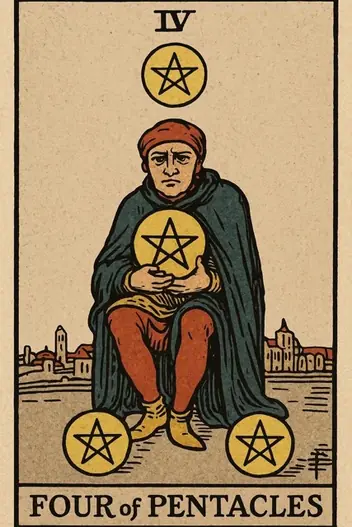
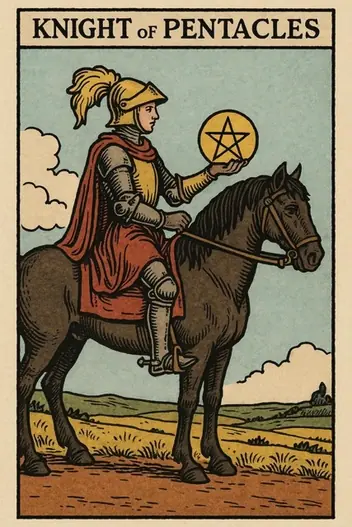
When the Four of Pentacles meets the Knight of Pentacles, we encounter a psychological state of extreme, controlled preservation. The Four of Pentacles represents the fear of loss—clinging to resources, status, or emotional security with a tight grip. The Knight of Pentacles embodies slow, methodical, duty-bound action. Together, they create a mindset where safety is prioritized over growth, and every move is calculated to avoid any perceived risk. This combination suggests a person who is building a fortress around their life, but may be unknowingly trapping themselves inside.
The collision of these two archetypes in a reading signals a period of intense focus on material stability and routine, but with a shadow of stagnation and possessiveness. The Knight’s diligence becomes a tool for the Four’s hoarding—work becomes a means to control, not to expand. Psychologically, this is a powerful defense mechanism against uncertainty, but it can also lead to missed opportunities, emotional isolation, and a rigid worldview that resists necessary change.
Four of Pentacles and Knight of Pentacles: How These Energies Interact
The core dynamic here is a feedback loop of caution and control. The Knight of Pentacles provides the discipline and patience to execute a plan, while the Four of Pentacles provides the motivation to protect what has been built. This can be highly effective for long-term projects, savings, or maintaining a stable home environment. However, the psychological cost is a narrowing of perspective. The seeker may become so focused on holding onto their current position that they fail to see new paths or adapt to changing circumstances.
This combination often manifests as a "resource hoarding" mindset. In practical terms, this means the seeker is likely overworking to maintain a sense of security, but is also reluctant to invest in new ventures, relationships, or personal growth that require a leap of faith. The Knight’s reliability is a strength, but when fused with the Four’s fear, it becomes stubbornness. The key insight is that security is not the absence of risk, but the capacity to manage it. The seeker must ask themselves: Is my fortress protecting me, or is it a prison?
Ask your question and flip the cards
or simply focus on it
What Do Four of Pentacles and Knight of Pentacles Say About Love?
If you are single:
This combination suggests you are evaluating potential partners through a lens of practicality and fear. You may be drawn to someone who seems stable and reliable, but you are also holding back emotionally, waiting for perfect guarantees that don't exist. The risk is mistaking comfort for connection.
If you are in a relationship:
The dynamic likely involves one partner controlling resources or emotional expression as a way to maintain power. There may be a stagnant routine where both parties feel safe but unfulfilled. Open communication about needs and fears is critical.
In relationships, this pairing signals a strong need for boundaries, but also a danger of emotional walls. The Four of Pentacles can indicate jealousy, possessiveness, or a fear of being vulnerable. The Knight of Pentacles, while loyal, can become boring or unresponsive if he only focuses on duties. The psychological work here is to differentiate between healthy boundaries and emotional hoarding. Advice: Schedule regular "check-in" conversations where both partners can express what they need to feel secure without controlling the other. True intimacy requires letting go of the illusion of total control. The Knight’s patience can be a gift if used to build trust, not walls.
Deepen your understanding
Find out exactly what this reading means for your current life situation with our AI oracle.
Career and Finances
Strategic Opportunities:
Consolidate and optimize existing assets. This is an excellent time to audit your finances, streamline workflows, or pay down debt. The Knight’s methodical nature supports detailed planning.
Strategic Opportunities:
Build a reputation for reliability. In a competitive environment, being the person who delivers consistently is a powerful advantage. Focus on client retention and long-term contracts.
Calculated Risks:
Avoid over-investing in a single strategy or asset. The Four of Pentacles can lead to "sunk cost" thinking—holding onto a bad investment or job out of fear of loss. Objectively assess if your current path is genuinely profitable or just comfortable.
Professionally, this combination is a double-edged sword. On one hand, it supports meticulous project management, savings, and steady career growth. On the other hand, it can indicate fear of delegation, micromanagement, and a refusal to innovate. A key financial warning: This energy can lead to "poverty mentality"—even when resources are adequate, the seeker feels they are not enough. Strategic tip: Use the Knight’s discipline to set aside a specific percentage of income for calculated risk-taking (e.g., education, networking, or a side project). This breaks the hoarding cycle while maintaining security.
Four of Pentacles and Knight of Pentacles Reversed: What Changes?
Reversed cards shatter the fragile balance between control and action, revealing hidden defects in the strategy.
If the Four of Pentacles is reversed:
The main pillar of defense collapses. This leads to impulsive spending or, conversely, to complete paralysis of the will. The fear of loss is replaced by a feeling that "all is lost," provoking reckless attempts to recoup losses. Advice: immediately impose a 72-hour moratorium on any financial decisions to restore clarity of thought.
If the Knight of Pentacles is reversed:
Internal resistance and procrastination. The person understands that action is needed but sabotages every step. This is the state of a "stuck truck"—the wheels are spinning, but the vehicle isn't moving. Warning: do not try to "force it" through willpower. Find an external controller (partner, coach) who will set the rhythm and deadlines.
If BOTH are reversed:
Complete imbalance—chaos and wastefulness. Resources slip through your fingers, and attempts to build something shatter against internal sabotage. A logical way to correct this: return to basics. Reduce everything to a minimum. Focus on one simple action per day (e.g., tracking expenses) to restore a sense of control.
What Are the Risks of Four of Pentacles and Knight of Pentacles?
The shadow side of this combination is pathological resistance to change. The seeker may suffer from cognitive biases like loss aversion (overvaluing what they have) and status quo bias (preferring the current state even when it is suboptimal). This can manifest as workaholism (the Knight’s diligence without purpose) or emotional miserliness (the Four’s hoarding applied to affection). Self-sabotage occurs when the seeker equates safety with inaction. They may refuse a promotion because it requires relocation, or stay in a dead-end relationship because it feels predictable. The greatest pitfall is mistaking routine for progress. The Knight of Pentacles must remember that his journey has a destination; the Four of Pentacles must learn that holding on too tightly can crush what it seeks to protect.
Synthesis: Strategic Conclusion
The constructive use of the Four of Pentacles' energy to balance the Knight of Pentacles is the "Smart Fortress" principle. Do not attempt to defend everything at once. Select 2-3 key resources (health, a core skill, a primary income source) and build maximum protection around them (insurance, a reserve fund, regular skill development). Everything else should remain open to change and risk. This allows the Knight to move forward without fear of losing the foundation.
Strategically, you need to learn to differentiate threats. The fear of loss (the Four) is often irrational and directed at what is not critical. Your task is to conduct an audit: what are you truly afraid of losing? Most likely, it is an illusion of control, not a real asset. Once you abandon the defense of illusions, the Knight of Pentacles will gain true speed, because it will stop dragging the burden of unnecessary "safes."
A deep strategic piece of advice: use the energy of the Four to create "rails" for the Knight. The Four should set the rules of the game (budget, deadlines, KPIs), and the Knight should methodically move along them. Do not let the Four dictate the goals—only the constraints. This way, you will build a sustainable system capable of growth without destructive crises. Clarity in this distinction is the key to success.
Applying This to Your Situation
The core message of the Four of Pentacles and Knight of Pentacles is this: Security is a foundation, not a ceiling. You have the discipline to build, but you must also have the courage to open the gates. The question is not whether you can protect what you have, but whether you can use it to create a life worth living. Your psychological work is to balance control with trust, and routine with growth.
While this article provides a deep archetypal analysis, the true meaning of this combination is deeply personal. Your specific question, your emotional state, and the other cards in your spread will change the interpretation. To get a custom, one-on-one reading that applies these insights directly to your unique situation, use the Fortune Cards app. Available on the web or as a download, it offers a deep, personalized interpretation of this exact combination for your specific question right now. Stop guessing. Start understanding.
Interpretation by the Fortune Cards editorial team, based on the Rider–Waite tradition and Jungian archetypes. About our methodology · Updated: 2026-08-01
Other Combinations with Four of Pentacles
Other Combinations with Knight of Pentacles
Explore Individual Card Meanings
Table of Contents
- Four of Pentacles and Knight of Pentacles: How These Energies Interact
- What Do Four of Pentacles and Knight of Pentacles Say About Love?
- Career and Finances
- Four of Pentacles and Knight of Pentacles Reversed: What Changes?
- What Are the Risks of Four of Pentacles and Knight of Pentacles?
- Synthesis: Strategic Conclusion
- Applying This to Your Situation
Ready to Discover Your Path?
Join thousands of seekers who have found clarity and guidance through our platform. Your cosmic journey awaits.