Four of Swords and Five of Swords Reversed in Tarot

- Arcana
- Four of Swords — Minor Arcana, Swords; Five of Swords — Minor Arcana, Swords
- Elements
- Four of Swords — Air; Five of Swords — Air
- Elemental interaction
- Same element — energies intensify each other
- Numerology
- 4 + 5 = 9
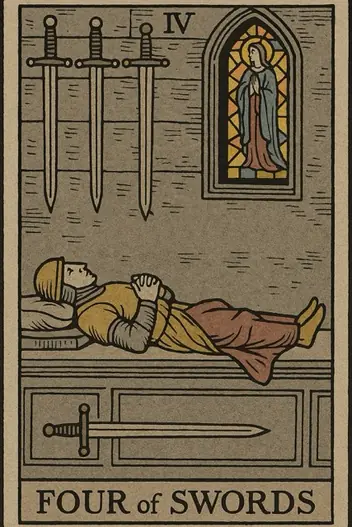
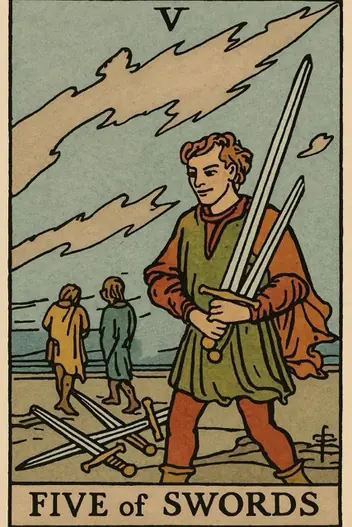
The intersection of the Four of Swords and Five of Swords creates a powerful psychological tension: the need for mental rest colliding with the sting of defeat or unresolved conflict. The Four of Swords represents strategic retreat, convalescence, and mental recovery—a deliberate pause to regain clarity. The Five of Swords embodies victory at a cost, hollow wins, and the toxic aftermath of a power struggle where no one truly benefits.
When these energies combine, you are likely facing a situation where you have either exhausted yourself in a fight that wasn’t worth winning, or you are considering withdrawing from a conflict to preserve your mental health. This is not a card of surrender, but of calculated self-preservation. The key question becomes: Are you resting to heal, or are you retreating to avoid facing a painful truth? The answer determines whether this combination signals wisdom or avoidance.
Four of Swords and Five of Swords Together: Meaning
The psychological state created by Four of Swords and Five of Swords is one of post-conflict exhaustion mixed with bitter clarity. You may have just won an argument or negotiation, but feel empty rather than triumphant. Alternatively, you may have lost a battle and now need to isolate yourself to process the humiliation or regret. This pair forces you to confront the cost of winning—did the price of victory outweigh the prize?
In real-world terms, this combination often appears when someone has been gaslit, manipulated, or outmaneuvered in a social or professional dynamic. The Five of Swords indicates that someone (possibly you) has used sharp intellect or ruthless tactics to gain an upper hand. The Four of Swords then demands a pause to assess whether that win was worth the damage to relationships or self-respect. The core insight here is that not all battles need to be fought, and not all wins are worth celebrating.
This energy is particularly relevant for high-stakes decision-making where pride and ego are involved. The cards urge you to step back and ask: Am I fighting for a principle, or just to feel superior? If the answer is the latter, the Four of Swords provides the exit strategy—a dignified withdrawal that protects your long-term mental health. The wisest move is often to let the other person have the last word, while you reclaim your peace.
Your pair is already on the table. Ask your question and draw the clarifying card
or simply focus on it
Four of Swords and Five of Swords in Love and Relationships
If you are single:
This combination suggests you may be recovering from a recent romantic disappointment or a situation where you felt outmaneuvered. Take time to process before pursuing new connections. The urge to prove yourself or get revenge is a trap.
If you are in a relationship:
There is a high risk of power struggles where one partner tries to "win" arguments at the expense of emotional intimacy. You may need a cooling-off period to prevent further damage.
In relationships, Four of Swords and Five of Swords points to a dynamic where communication has become adversarial. One partner may have used harsh words or manipulative logic to dominate a discussion, leaving the other feeling defeated and retreating into silence. This is not a healthy resolution—it is a temporary ceasefire where resentment builds. The Four of Swords offers a chance to break this cycle by agreeing to a structured pause: set a specific time to revisit the issue when both parties are calmer. The key relationship advice here is to prioritize understanding over being right. If you feel the need to "win" every disagreement, you are sacrificing connection for ego. True intimacy requires both partners to feel heard, not defeated.
Four of Swords and Five of Swords for Career and Money
Strategic Opportunities:
Use this time to reassess your career priorities after a difficult project or negotiation. The pause allows you to see which battles are worth your energy.
Strategic Opportunities:
Document lessons learned from a recent conflict or failed deal. The clarity you gain now will prevent repeating the same mistake.
Calculated Risks:
Avoid making retaliatory moves or engaging in office politics while you are still emotionally drained. Do not sign contracts or make major financial decisions until you have fully recovered your mental energy.
In your professional life, this combination often signals a post-merger or post-dispute period where you need to step back and evaluate the landscape. You may have been involved in a cutthroat negotiation where you either won a hollow victory or suffered a humiliating loss. The Four of Swords advises you to take sick leave, delegate tasks, or simply disengage from toxic team dynamics. Financially, be wary of settlements or deals that seem too good to be true—the Five of Swords warns of hidden costs or underhanded tactics. The smartest career move right now is to protect your reputation and mental bandwidth rather than chasing short-term gains. Use this retreat to strategize your next move with a clear head.
Ask your specific question
Don't rely on generic meanings. Get a customized reading tailored specifically to your energies.
When Four of Swords and Five of Swords Signal Trouble
The shadow of this combination manifests as passive-aggressive withdrawal or self-pitying isolation. You may convince yourself you are "taking a break" when you are actually avoiding accountability for your role in a conflict. The cognitive bias at play is the sour grapes fallacy—convincing yourself that winning wasn't important after you lost, rather than honestly assessing your performance. This can lead to chronic disengagement where you stop fighting for anything meaningful because you fear the emotional cost.
Another pitfall is rumination—using the Four of Swords' rest period to obsessively replay the Five of Swords' conflict in your mind, turning recovery into mental self-flagellation. This combination can also indicate gaslighting dynamics where one party uses silence as a weapon, pretending to be "at peace" while actually punishing the other person with withdrawal. Be honest with yourself: Are you resting to heal, or resting to punish? If the latter, you are prolonging the conflict, not resolving it.
Four of Swords and Five of Swords Reversed Meaning
If the Four of Swords is Reversed:
This indicates a pathological avoidance of rest. The person refuses to acknowledge their exhaustion, leading to reckless aggression. Instead of retreating and recovering, they charge into battle completely unprepared. Advice: a forced pause is inevitable — if you do not stop voluntarily, your body will do it for you (illness, nervous breakdown).
If the Five of Swords is Reversed:
The "winner" dynamic is weakened. This can signify an internal resistance to conflict. You want to surrender, but your pride won't allow it. Or, you have encountered an opponent who is themselves uncertain of their rightness. Advice: use this uncertainty. Do not attack; observe. An opponent who hesitates is already half-defeated.
If BOTH are Reversed:
Complete chaos and loss of control. The person refuses to rest, yet is incapable of fighting. This is the state of a "target": you are exhausted but do not pause, and at the same time, you cannot defend yourself. Advice: acknowledge your powerlessness. This is the one case where surrender is victory. You need to fully exit the game to avoid taking irreparable damage.
Four of Swords and Five of Swords: Tarot Advice
Constructive use of this combination requires iron discipline and honesty with yourself. Your task is to separate these two energies in time. You cannot rest and wage war simultaneously. Therefore, your first step is a resource diagnosis. Ask yourself: "Do I have real energy for this battle?" If the answer is "no"—the Four of Swords must become your absolute priority. Cancel all conflicts, retreat into the shadows, focus on your health. This is not cowardice, but rational asset management.
If the answer is "yes"—act swiftly and ruthlessly, as the Five of Swords demands. But remember: your goal is not to destroy the opponent, but to conclude the conflict with minimal losses. Use the energy of the Four of Swords for a cold, detached analysis of the opponent's weaknesses. Do not allow emotions (anger or fear) to dictate your decisions.
Strategic advice: apply the "one strike" principle. Choose one, most crucial action that will shift the balance of power in your favor. Deliver this strike using all your accumulated energy, and immediately withdraw to recover. Do not attempt to finish off the opponent—the Five of Swords will punish you for greed. Your victory is not annihilation, but achieving a state of parity that allows you to return to a state of rest.
Applying This to Your Situation
The core message of Four of Swords and Five of Swords is that not every fight is worth your energy, and not every victory is worth its price. You are being called to choose your battles wisely, and to value your mental peace over temporary wins in arguments or negotiations. This combination is a strategic retreat, not a surrender—a chance to regroup and re-enter the fray with clearer priorities.
While this article provides a powerful general interpretation, the true insight comes from applying it to your unique situation. Your specific question, relationship history, and career context will shift the meaning significantly. That is why I recommend using the Fortune Cards app for a deep, personalized reading. You can access it on the web or download it to get a tailored interpretation of this exact combination for your specific question right now. Don't guess—get clarity that fits your life.
Interpretation by the Fortune Cards editorial team, based on the Rider–Waite tradition and Jungian archetypes. About our methodology · Updated: 2026-08-26
Other Combinations with Four of Swords
Other Combinations with Five of Swords
Explore Individual Card Meanings
Table of Contents
- Four of Swords and Five of Swords Together: Meaning
- Four of Swords and Five of Swords in Love and Relationships
- Four of Swords and Five of Swords for Career and Money
- When Four of Swords and Five of Swords Signal Trouble
- Four of Swords and Five of Swords Reversed Meaning
- Four of Swords and Five of Swords: Tarot Advice
- Applying This to Your Situation
Ready to find answers to your questions?
Start your first reading now and look at your situation with fresh clarity. The cards are ready to reveal deeper meaning.