Love Tarot: Four of Swords and Ten of Swords
- Arcana
- Four of Swords — Minor Arcana, Swords; Ten of Swords — Minor Arcana, Swords
- Elements
- Four of Swords — Air; Ten of Swords — Air
- Elemental interaction
- Same element — energies intensify each other
- Numerology
- 4 + 10 = 14 → 5
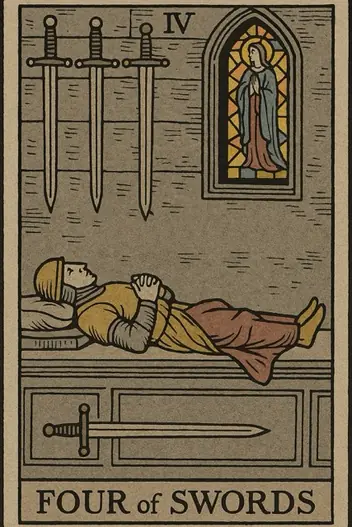
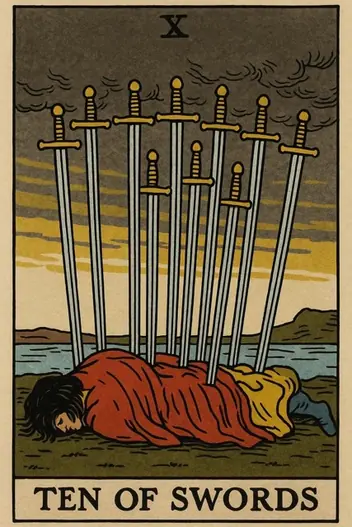
When the Four of Swords meets the Ten of Swords, we witness a psychological turning point: the aftermath of a painful defeat and the deliberate withdrawal that follows. The Ten of Swords represents a crisis—an ending that feels absolute, often involving betrayal, exhaustion, or a final blow to a situation or belief. The Four of Swords introduces a counter-move: a conscious choice to stop, retreat, and mentally regroup. This combination is not about denial; it is about survival through strategic rest. In Jungian terms, we see the collapse of a persona—an identity or role that no longer serves—followed by the ego’s necessary descent into the unconscious for healing. The key insight here is that the worst is over, but recovery requires you to stop fighting. The cards demand that you shift from reactive pain to calculated stillness.
Four of Swords and Ten of Swords Combination Meaning
The core dynamic of the Four of Swords and Ten of Swords is the immediate aftermath of a psychological or practical catastrophe. The Ten of Swords delivers the final blow—a job loss, a breakup, a betrayal, or a failed project. The mind is flooded with negative narratives: "I should have seen it coming," "This is the end," "I am ruined." The Four of Swords intervenes as the ego’s survival mechanism, forcing a retreat into isolation or meditation. This is not escapism; it is a necessary cognitive reset. In therapy terms, this resembles a crisis intervention: you cannot process trauma while still in the fight-or-flight state. The combination warns against the urge to immediately "fix" or "move on." Instead, it prescribes a period of low stimulation—sleep, quiet reflection, or even temporary disengagement from the problem.
The psychological state here is one of controlled surrender. You accept the loss, but you do not let it define you permanently. The Four of Swords provides the mental scaffolding for the Ten of Swords’ devastation. Practically, this means you should stop making major decisions for at least 48–72 hours. Let the initial shock subside. The real danger is compulsive rumination—replaying the event without new insight. Instead, use this time to distinguish between what you can control (your response) and what you cannot (the past). The cards suggest that the ending is genuine, but your interpretation of it is not yet complete. A deeper meaning will emerge only after you have rested.
Career Meaning of Four of Swords and Ten of Swords
Strategic Opportunities:
Use this downtime to audit your professional skills and identify what needs to be updated or abandoned. The Ten of Swords often ends a project or role; the Four of Swords gives you space to plan your next move without panic.
Strategic Opportunities:
Leverage the "reset period" to network quietly or research new industries. Your mind is sharp, but your emotions are raw—focus on data, not decisions.
Calculated Risks:
Avoid signing contracts, making large purchases, or quitting your job impulsively. The Ten of Swords suggests a loss, but the Four of Swords warns against a reactive second loss. The biggest financial risk right now is acting out of desperation.
In your career, this combination is a mandate for strategic withdrawal. You may have been fired, failed a major initiative, or realized a business partnership is toxic. The worst thing you can do is immediately apply for new jobs or pitch new ideas. Your psychological state is compromised; you will project insecurity. Instead, treat this as a two-week sabbatical. Update your resume, but do not send it. Analyze what went wrong, but do not blame yourself or others—focus on systems, not individuals. Bold financial warning: Do not use savings to "fix" a failing venture. The Ten of Swords is a sign to cut losses. The Four of Swords tells you to preserve your capital and energy for a fresh start. For entrepreneurs, this means pausing operations to reassess your business model rather than doubling down. For employees, it means taking sick leave or vacation time to decompress before a job search. The key is intentional inaction—not laziness, but a calculated pause to prevent further damage.
Your pair is already on the table. Ask your question and draw the clarifying card
or simply focus on it
What Do Four of Swords and Ten of Swords Say About Love?
If you are single:
This combination suggests you are recovering from a recent emotional wound—perhaps a rejection or a toxic cycle. Do not rush into a new connection to numb the pain. Instead, use this time to reflect on what you truly need. The right partner will emerge when you are no longer trying to escape your own thoughts.
If you are in a relationship:
You or your partner may be experiencing a significant rupture—a breach of trust, a painful argument, or the realization that the relationship has run its course. The priority is not resolution but de-escalation. Agree to a temporary pause in communication to allow emotions to settle.
In relationships, this pairing signals a critical turning point where silence is more powerful than words. The Ten of Swords often represents a betrayal or a harsh truth that cannot be unsaid. The Four of Swords advises withdrawing to process your feelings before confronting your partner. Bold key relationship advice: Do not seek closure from the other person; seek it within yourself. If you are the one who caused the hurt, this is not the time for apologies—it is the time for genuine self-examination. The dynamic here is about boundaries: knowing when to walk away to preserve your sanity, and when to stay quiet to avoid making things worse. For couples committed to healing, this combination can lead to a deeper understanding if both partners observe a respectful period of introspection. However, if the Ten of Swords represents a final break, the Four of Swords supports a dignified exit rather than a dramatic confrontation.
Uncover hidden insights
Let our advanced Tarot system interpret these archetypes specifically for your personal path.
Reversed Four of Swords and Ten of Swords Explained
If the Four of Swords is Reversed:
Blocked Recovery. The person cannot allow themselves to rest due to external pressure or internal perfectionism. They continue to work themselves to the bone, ignoring signals of exhaustion. Advice: forcibly introduce a "digital detox" regime and a minimum of 8 hours of sleep per night. Without this, you risk transitioning into the chronic phase of the Ten of Swords.
If the Ten of Swords is Reversed:
Resistance to the Inevitable. The person refuses to acknowledge that the project/relationship is over. They cling to the illusion of a "second chance" or hope for a miracle. Warning: this is the most dangerous position—it leads to prolonged stagnation. It is necessary to perform a "closing ritual": write down the reasons for the collapse and consciously let the situation go.
If BOTH are Reversed:
Complete Imbalance: "a storm in a teacup." The person neither rests (reversed 4) nor completes cycles (reversed 10). This is a state of chronic stress without results. Energy is wasted on fruitless worries and fuss. The logical way to correct this: strict daily planning with mandatory rest blocks and "killing" at least one unpromising task per week.
Shadow Side & Pitfalls
The shadow side of this combination emerges when the seeker misuses the Four of Swords as a form of avoidance rather than recovery. Instead of resting to heal, they may withdraw indefinitely, using "rest" as an excuse to avoid confronting the truth of the Ten of Swords. This leads to chronic rumination, depression, or passive-aggressive silence. The cognitive bias at play is learned helplessness—believing that because one thing ended, everything is hopeless. Another pitfall is over-identification with the victim role (Ten of Swords), where the seeker refuses to take any responsibility for the situation, blaming external forces while the Four of Swords becomes a fortress of self-pity. The shadow warns against turning a necessary pause into a permanent escape. If you find yourself still paralyzed after two weeks, or if the "rest" is filled with anxiety and self-blame, you are not integrating the lesson—you are trapped in it. Poor judgment manifests as making peace with a bad situation instead of using the pause to plan an exit. The healthy path requires active reflection, not passive suffering.
What Is the Overall Message of Four of Swords and Ten of Swords?
How can the energy of this pair be used constructively? The Four of Swords should become not a deathbed, but an operating room for reassembly. The Ten of Swords is not a verdict, but a tool for amputating the rotting parts of life. Your task is to perform "surgery": clearly define what exactly has died (a project, relationship, habit) and stop wasting resources on it.
The strategy is as follows: use the energy of the Four for deep diagnosis — analyze which of your actions led to the point of the Ten. Write down 3 key mistakes and 3 lessons. Then use the energy of the Ten for a closure ritual: physically remove reminders of the past (delete chats, files, contacts). After this, the Four of Swords transforms from a place of pain into a space for regeneration.
A deep piece of advice: do not try to "recover" to your previous level. The goal is not to return to who you were before the crisis, but to create a new, more resilient version of yourself. The Ten of Swords shows that the old structure was unviable. Accept this as fact. Your only strategic advantage right now is clarity of vision regarding what DOES NOT WORK. Use this clarity to avoid repeating mistakes. The next step is not action, but quality stillness, so that a new system can be born from silence, not from panic.
Applying This to Your Situation
The core message of the Four of Swords and Ten of Swords is clear: an ending has occurred, and your only task now is to stop and breathe. Do not try to rewrite the past or force a new beginning. The cards promise that clarity will come, but only after you have truly rested. The psychological work is to separate the event from your identity—the loss does not define you, but your response to it will. Trust that this pause is productive, not wasteful.
While this article provides the general archetype, the true magic happens when Tarot is applied to your unique situation. To get a deep, personalized interpretation of this exact combination for your specific question—whether it's about a relationship, career, or inner conflict—use the Fortune Cards app. You can access it on the web or download it to receive a tailored reading that considers your context, timing, and emotional state. Your next step is not to guess—it is to know.
Interpretation by the Fortune Cards editorial team, based on the Rider–Waite tradition and Jungian archetypes. About our methodology · Updated: 2026-08-26
Other Combinations with Four of Swords
Other Combinations with Ten of Swords
Explore Individual Card Meanings
Table of Contents
- Four of Swords and Ten of Swords Combination Meaning
- Career Meaning of Four of Swords and Ten of Swords
- What Do Four of Swords and Ten of Swords Say About Love?
- Reversed Four of Swords and Ten of Swords Explained
- Shadow Side & Pitfalls
- What Is the Overall Message of Four of Swords and Ten of Swords?
- Applying This to Your Situation
Ready to find answers to your questions?
Start your first reading now and look at your situation with fresh clarity. The cards are ready to reveal deeper meaning.