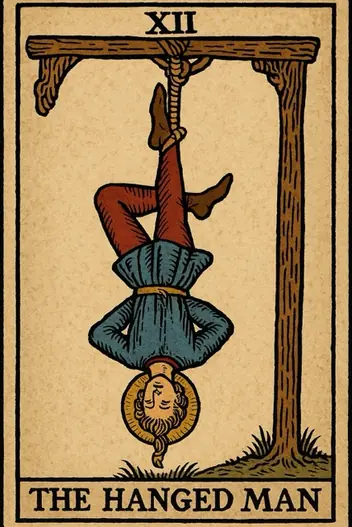
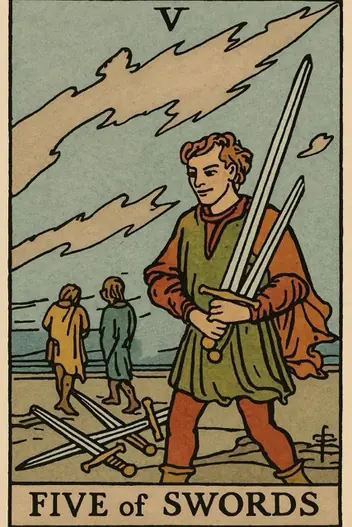
The Hanged Man and Five of Swords Tarot as Feelings
- Arcana
- The Hanged Man — Major Arcana; Five of Swords — Minor Arcana, Swords
- Elements
- The Hanged Man — Water; Five of Swords — Air
- Elemental interaction
- Neutral elements — energies coexist without conflict
- Numerology
- 12 + 5 = 17 → 8
When the Hanged Man’s suspension meets the Five of Swords’ conflict, you face a psychological paradox: the need to win by not fighting. This combination often appears when you are stuck between sacrificing your position for peace, or fighting a battle that may cost you more than it’s worth. The Hanged Man asks you to see the situation from a new angle—often from a place of vulnerability—while the Five of Swords warns that winning the argument might leave you isolated.
In practical terms, this pair signals a moment where ego-driven action leads to hollow victories, but passive acceptance may feel like defeat. The key is discerning when to hold still and when to walk away. This is not about giving up; it’s about strategic withdrawal to preserve energy for a more meaningful fight later.
The Hanged Man and Five of Swords Combination Meaning
The core tension here is between suspension and aggression. The Hanged Man represents a voluntary pause—a period of waiting, reflection, or sacrifice that ultimately leads to a shift in perspective. The Five of Swords, however, brings conflict, competition, and the aftermath of a battle where one party wins at the expense of another. When combined, you are likely caught between the urge to fight for your position and the wisdom of stepping back.
Psychologically, this mirrors the Jungian concept of the “wounded healer” —you must first endure a period of discomfort or defeat to gain insight. The Hanged Man’s energy says, “Stop struggling, and you will see the solution.” The Five of Swords warns, “If you struggle, you may win the battle but lose the war.” The real insight is recognizing that the fight you’re contemplating may be a projection of your own unresolved conflict.
In practice, this combination often appears when you are reassessing a power struggle—in a relationship, at work, or within yourself. The advice is to choose your battles carefully. If you push forward aggressively, you may achieve a short-term win that damages long-term trust. If you surrender passively, you risk resentment. The optimal path is strategic non-action: pause, observe, and let the other party exhaust themselves while you gather information.
Your pair is already on the table. Ask your question and draw the clarifying card
or simply focus on it
What Do The Hanged Man and Five of Swords Indicate for Your Career?
Strategic Opportunities:
Reevaluate your competitive stance—a pause now can reveal a better angle for negotiation later.
Strategic Opportunities:
Use the Hanged Man’s perspective to identify hidden weaknesses in your opponent’s position.
Calculated Risks:
Avoid public confrontations or resigning in anger. A pyrrhic victory here could damage your reputation.
Professionally, this pair warns against engaging in office politics or legal battles that drain resources without clear gain. The Five of Swords indicates a zero-sum game—someone will lose, and it might be you if you act impulsively. The Hanged Man’s energy is better applied to research, restructuring, or waiting for a better offer. Bold financial warning: do not sign contracts or make major investments under duress. Instead, use this time to gather intelligence on competitors or consider a lateral move. The strategic advantage comes from knowing when to fold and when to hold.
Love and Relationships
If you are single:
This pair suggests you may be attracted to someone who brings conflict or competition into your life. Pause before committing—ask if the intensity you feel is genuine connection or a reactive dynamic.
If you are in a relationship:
You are likely in a power struggle where one partner feels they must “win” an argument. The Hanged Man advises you to stop defending your position and listen for the underlying need.
In relationships, this combination signals a toxic cycle of one-upmanship. The Five of Swords often represents a partner who values being right over being connected. The Hanged Man asks you to sacrifice your need for validation in order to break the pattern. Key relationship advice: do not engage in a battle you cannot win without losing respect. Instead, practice strategic silence—let your partner have the last word, then revisit the issue when emotions have cooled. This is not weakness; it is emotional intelligence that preserves the relationship’s foundation.
Deepen your understanding
Find out exactly what this reading means for your current life situation with our oracle.
Reversed Positions: What Changes?
If The Hanged Man is reversed:
This points to reckless resistance. You refuse to acknowledge the obvious and continue banging your head against the wall, even though the situation has long been lost. Instead of a wise pause, you choose chaotic and destructive actions. Advice: Stop trying to prove you are right — it exhausts your resources with no chance of success.
If the Five of Swords is reversed:
This is a symptom of internal conflict and paralysis of will. You fear conflict so much that you prefer to sabotage your own interests. You "lose" before the fight even begins, succumbing to feelings of guilt or shame. Warning: This is a position of self-destruction masquerading as nobility.
If BOTH cards are reversed:
A complete imbalance arises. You are simultaneously a victim and an aggressor towards yourself. This is a state of chronic neurosis: you constantly provoke conflicts and then punish yourself for them. The logical way to correct this: Immediate cessation of all activity. You need complete isolation for reflection and to re-establish contact with your own values, otherwise you risk destroying all your social connections.
The Hanged Man and Five of Swords: Warning Signs
The shadow of this combination is self-sabotage through martyrdom or spite. You might convince yourself that sacrificing your happiness is noble, when really you are avoiding confrontation out of fear. Alternatively, you may fight for a hollow victory just to prove you are not weak, only to find yourself isolated and resentful. Cognitive bias alert: the “sunk cost fallacy” is strong here. You may feel you’ve already invested too much to back down, but the cards advise that cutting your losses is the more mature choice.
Another pitfall is passive-aggression—pretending to surrender while secretly plotting revenge. This drains your energy and delays resolution. The Hanged Man’s true gift is genuine release, not fake compliance. If you feel stuck, ask yourself: Am I holding onto this conflict because I’m afraid of what I’ll discover about myself if I let go?
Synthesis: Strategic Conclusion
Constructive use of this pair requires mental discipline. The energy of the Hanged Man is not passivity, but contemplation aimed at gathering information. The Five of Swords is not merely conflict, but a lesson about the price of victory. Your task is to use the former to correctly interpret the latter. Ask yourself: "What war am I fighting, and what is the real cost of my involvement?"
Strategic advice: turn your sacrifice into an investment. If you have already lost or sacrificed something, do not let that experience go to waste. Conduct a "post-mortem analysis": which of your specific beliefs led to defeat? Where did you overestimate your opponent's loyalty? Use the pain as fuel to change your strategy. You cannot win a game whose rules you do not understand. The Hanged Man offers you a chance to see the board from above, while the Five of Swords reminds you which pieces have already been taken. Your next move must be not emotional, but strictly rational.
Applying This to Your Situation
The Hanged Man and Five of Swords together deliver a clear message: stop fighting for a win that costs your peace. The insight you need is not in the battle itself, but in the stillness before it. Whether in love or career, your next move is to pause, observe, and choose a path that preserves your integrity over your ego.
This article provides the general archetype, but the true power of Tarot lies in its application to your unique situation. To get a deep, personalized interpretation of this exact combination for your specific question, use the Fortune Cards app. Available on the web or as a download, it analyzes your energies and delivers tailored guidance based on your context. Stop guessing—let the cards speak directly to you.
Interpretation by the Fortune Cards editorial team, based on the Rider–Waite tradition and Jungian archetypes. About our methodology · Updated: 2026-08-26
Other Combinations with The Hanged Man
Other Combinations with Five of Swords
Explore Individual Card Meanings
Table of Contents
Ready to find answers to your questions?
Start your first reading now and look at your situation with fresh clarity. The cards are ready to reveal deeper meaning.