The Hanged Man and Nine of Swords Together in Tarot
- Arcana
- The Hanged Man — Major Arcana; Nine of Swords — Minor Arcana, Swords
- Elements
- The Hanged Man — Water; Nine of Swords — Air
- Elemental interaction
- Neutral elements — energies coexist without conflict
- Numerology
- 12 + 9 = 21 → 3
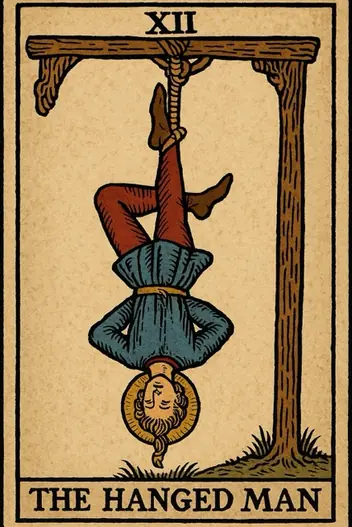
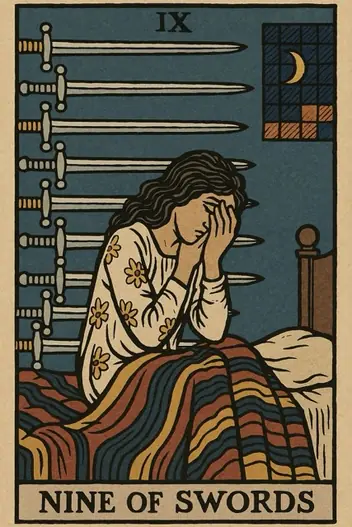
When the Hanged Man meets the Nine of Swords, you are facing a psychological crossroads where forced stillness collides with mental torment. The Hanged Man represents a state of suspension—a necessary pause where you must surrender control to gain a new perspective. The Nine of Swords, however, brings the harsh reality of sleepless nights, obsessive worry, and the feeling of being trapped by your own thoughts. Together, they create a powerful tension: you are called to wait without action, yet your mind is screaming for resolution. This combination often appears when you are stuck in a loop of rumination, where the only way forward is to shift your perception rather than change your external circumstances.
Practically, this pairing signals a period where strategic inaction is the most intelligent move, but it feels unbearable because your anxiety demands immediate answers. The Hanged Man’s wisdom lies in seeing the situation from a new angle, while the Nine of Swords warns that your current mental framework is poisoning your judgment. The key insight here is that the suffering is not from the situation itself, but from your resistance to the pause. To break free, you must first accept the suspension, then examine what your anxiety is actually trying to protect you from.
The Hanged Man and Nine of Swords Combination Meaning
The core dynamic of The Hanged Man and Nine of Swords is a battle between surrender and resistance. On one level, the Hanged Man invites you to stop struggling against the current—to accept that certain outcomes are beyond your control. On another level, the Nine of Swords represents the catastrophizing mind that refuses to let go, creating worst-case scenarios that keep you awake at night. This psychological conflict often manifests as analysis paralysis: you overthink every possibility, yet feel incapable of making any decision. The result is a state of chronic stress where you are neither fully present nor able to move forward.
From a Jungian perspective, this combination highlights the shadow of the martyr complex. The Hanged Man can become a passive victim who tolerates suffering unnecessarily, while the Nine of Swords amplifies guilt and self-blame. The real work here is to distinguish between productive surrender and toxic resignation. Ask yourself: Is this pause truly teaching me something, or am I using it to avoid responsibility? The answer lies in whether your stillness is leading to clarity or deeper despair. If you can observe your anxiety without identifying with it, you gain the perspective needed to see the hidden solution.
Your pair is already on the table. Ask your question and draw the clarifying card
or simply focus on it
What Do The Hanged Man and Nine of Swords Indicate for Your Career?
Strategic Opportunities:
Use this period to reassess your career path from a completely different angle. The Hanged Man suggests that a temporary setback (e.g., a project delay, a missed promotion) is actually a chance to gain clarity on your long-term goals.
Strategic Opportunities:
Leverage your anxiety as a diagnostic tool. What specific fear keeps you up at night? That fear is pointing directly to a problem you have been avoiding. Address it methodically rather than catastrophizing.
Calculated Risks:
Avoid making major financial decisions while in this state of mind. The Nine of Swords distorts risk perception, making you either overly cautious or impulsively desperate. Wait at least one week before signing any contracts.
From a career perspective, this combination often appears when you are stuck in a role that feels like a sacrifice—perhaps you are overworking for a boss who doesn’t appreciate you, or you are in a position that stifles your creativity. The Hanged Man’s wisdom is to stop trying to force a breakthrough and instead observe the patterns that keep you stuck. Your financial strategy should be defensive, not aggressive. Focus on building an emergency fund or cutting unnecessary expenses rather than chasing high-risk investments. The Nine of Swords warns that financial anxiety can lead to panic selling or poor judgment—so if you feel the urge to make a drastic change, step back and consult a trusted advisor.
What Do The Hanged Man and Nine of Swords Say About Love?
If you are single:
This combination suggests you may be idealizing a connection that is causing you more anxiety than joy. Pause before committing—your mind is projecting fears from past wounds onto a new person. Take a step back to see if this person is actually aligned with your needs or if you are repeating a pattern.
If you are in a relationship:
You or your partner may be withholding communication out of fear, leading to sleepless nights and unspoken resentments. The Hanged Man advises a temporary pause, but the Nine of Swords warns that silence will only deepen the rift. Initiate a calm, honest conversation about what is really bothering you.
In relationships, this pairing often reveals a power imbalance where one person feels trapped while the other is emotionally unavailable. The Hanged Man’s energy can manifest as one partner sacrificing their own needs to keep the peace, while the Nine of Swords represents the resulting anxiety and guilt. The crucial relationship advice here is to stop trying to control the outcome. Instead of obsessing over what your partner thinks or feels, focus on your own emotional boundaries. If the relationship is causing chronic stress, the pause may be a signal to reconsider its viability. True intimacy requires mutual surrender, not one-sided martyrdom.
Ask your specific question
Don't rely on generic meanings. Get a customized reading tailored specifically to your energies.
Reversed Positions: What Changes?
When cards appear in reversed positions, the dynamics become more chaotic, yet also more manageable.
Reversed Hanged Man + Upright Nine of Swords:
You are resisting a necessary pause. You are afraid to stop because silence will bring anxiety crashing down on you. Advice: forcibly take a time-out. If you don't stop voluntarily, life will do it for you (illness, accident, job loss). Anxiety is a signal that you need to rest, not run faster.
Upright Hanged Man + Reversed Nine of Swords:
This is a blockage of awareness. You are in a state of victimhood but refuse to acknowledge your anxiety. You say "everything is fine," while inside it's a catastrophe. Advice: start keeping an emotion journal. Write down specific fears. The reversed Nine of Swords is suppressed aggression that destroys from within.
Both cards reversed:
Complete imbalance and denial of reality. You are neither a victim nor anxious, but you are living in an illusion of control. You may act recklessly, thinking "everything is under control." Advice: seek feedback from a trusted colleague or friend. Your worldview is distorted. The only way to correct this is to get an outside perspective. Use the "Rule of Three Questions": ask three different people how they see your situation.
What Are the Risks of The Hanged Man and Nine of Swords?
The dark manifestation of this combination is chronic victimhood and self-sabotage. The Hanged Man’s shadow can turn into a passive-aggressive refusal to act, where you use “waiting for clarity” as an excuse to avoid responsibility. Meanwhile, the Nine of Swords’ shadow amplifies guilt spirals and shame loops—you replay past mistakes endlessly, convincing yourself that you deserve to suffer. This creates a cognitive bias known as “learned helplessness” : you believe no action will improve your situation, so you stop trying altogether. The result is a self-fulfilling prophecy where your inaction leads to the very outcome you feared.
Another pitfall is misplaced martyrdom, where you sacrifice your well-being for people or causes that don’t reciprocate. This is especially dangerous in relationships or careers where you give more than you receive. The shadow asks you to examine your motives: Are you pausing out of wisdom, or are you punishing yourself? If your stillness is accompanied by self-loathing, you are not in a state of surrender—you are in a state of depression disguised as spiritual patience. The only way out is to actively challenge your negative thoughts with evidence, and to take one small, concrete action that breaks the cycle of inaction.
The Hanged Man and Nine of Swords Combined Message
The energy of The Hanged Man is not a punishment, but a tool for shifting perspective. To balance the tormenting Nine of Swords, you must use this pause not for self-rumination, but for structured analysis. Transform this "suspension" into a strategic session: take a sheet of paper and write down three specific scenarios for how events might unfold. This will switch your brain from "anxiety" mode to "planning" mode.
Key Insight:
The Hanged Man offers you a voluntary sacrifice — the relinquishment of control. The Nine of Swords demands you acknowledge that control is an illusion. The synthesis of these cards is active acceptance of uncertainty. You do not wait for fear to pass. You act despite fear, in small steps. Your new mantra: "I don't need to know everything in advance. I need to take the first step."
Practical Action Algorithm:
- Identify one specific problem that causes the greatest anxiety.
- Break it down into 3 micro-steps. For example, if you fear being fired: step 1 — update your resume, step 2 — send it to one recruiter, step 3 — call an old colleague.
- Complete the first step within 24 hours. Do not analyze, do not wait for the "right" moment. Just do it.
- Record the result. Even if it is negative, you have broken the cycle. The Nine of Swords loses its power when you take action.
Applying This to Your Situation
The Hanged Man and Nine of Swords call you to distinguish between a necessary pause and a prison of your own making. The core message is that your current suffering is a symptom of how you are interpreting the situation, not the situation itself. To move forward, you must first accept the suspension, then use your anxiety as a compass to identify what truly needs to change. The answer is not to fight harder, but to shift your perspective.
While this article provides a general framework for this tarot combination, the true power of Tarot lies in its personal relevance to your unique life. Your specific question, emotional state, and circumstances will change the nuance of this reading dramatically. That’s why we built the Fortune Cards app—to give you a deep, personalized interpretation of this exact combination for your specific situation right now. Whether you are navigating love, career, or personal growth, the app analyzes your question and delivers actionable insights tailored to you. Use it on the web or download it today to transform this archetypal wisdom into your next step forward.
Interpretation by the Fortune Cards editorial team, based on the Rider–Waite tradition and Jungian archetypes. About our methodology · Updated: 2026-08-26
Other Combinations with The Hanged Man
Other Combinations with Nine of Swords
Explore Individual Card Meanings
Table of Contents
- The Hanged Man and Nine of Swords Combination Meaning
- What Do The Hanged Man and Nine of Swords Indicate for Your Career?
- What Do The Hanged Man and Nine of Swords Say About Love?
- Reversed Positions: What Changes?
- What Are the Risks of The Hanged Man and Nine of Swords?
- The Hanged Man and Nine of Swords Combined Message
- Applying This to Your Situation
Ready to find answers to your questions?
Start your first reading now and look at your situation with fresh clarity. The cards are ready to reveal deeper meaning.