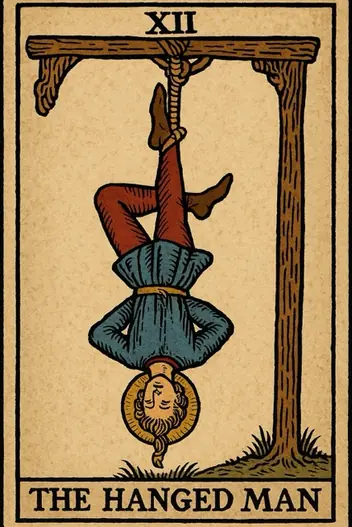
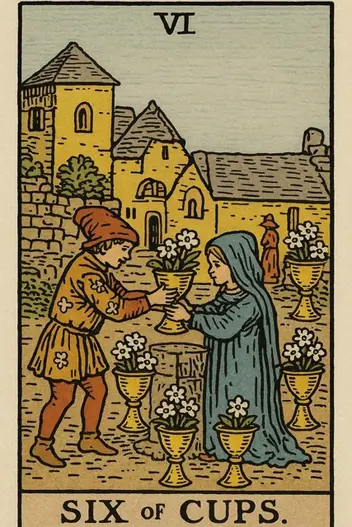
The Hanged Man and Six of Cups Meaning in Tarot
- Arcana
- The Hanged Man — Major Arcana; Six of Cups — Minor Arcana, Cups
- Elements
- The Hanged Man — Water; Six of Cups — Water
- Elemental interaction
- Same element — energies intensify each other
- Numerology
- 12 + 6 = 18 → 9
When the Hanged Man—the archetype of voluntary suspension and reversed perspective—meets the Six of Cups—the symbol of nostalgia, innocent generosity, and emotional debt—you are not simply looking back. You are being asked to pause inside a memory and examine its power over your present decisions. This pairing often signals a situation where past kindness, unresolved childhood patterns, or a sentimental attachment is actively holding you in a state of limbo. The psychological tension here is between the comfort of what was and the necessity of seeing it from a completely new angle.
The strategic reality is that this combination rarely allows for forward momentum. Instead, it demands a period of reflective stasis where you disentangle genuine emotional value from the fear of loss. The Six of Cups can offer a soft landing, but the Hanged Man warns that this softness may become a trap if you mistake comfort for progress. Together, they create a powerful, albeit slow, crucible for re-evaluating core emotional scripts that no longer serve your adult life.
The Hanged Man and Six of Cups Card Meaning Explained
The core dynamic here is a psychological paradox: you are being asked to surrender control (Hanged Man) over a situation that feels deeply personal and emotionally safe (Six of Cups). This often manifests as a cognitive dissonance—you know you need to change, but you are tethered to a person, a memory, or a version of yourself that feels like home. The Hanged Man’s energy forces you to invert your usual problem-solving approach. Instead of fighting to keep the past alive, you must willingly hang upside down and see that this emotional attachment is actually a sacrifice of your current potential.
In practice, this combination suggests a period of voluntary waiting that is not passive, but deeply active in its introspection. You are examining the psychological contracts you made in the past—perhaps a promise to always be the giver, the caretaker, or the one who never leaves. The Six of Cups provides the raw material (the memory, the gift, the gesture), while the Hanged Man provides the critical lens to see how that material is currently trapping you. The key insight is that you must stop trying to "fix" the situation. The solution lies in changing your perspective on what that situation means to you now.
The Hanged Man and Six of Cups: Career and Money
Strategic Opportunities:
Use this period to revisit old contacts, mentors, or projects with a fresh, detached perspective. A past failure may now reveal a valuable lesson.
Strategic Opportunities:
Consider voluntary sabbaticals or role changes that allow you to step back and observe the team dynamics without the pressure to perform.
Calculated Risks:
Avoid making financial decisions based on sentiment. Do not invest in a business or project simply because it has "history" or "loyalty" attached to it. The nostalgia tax is real.
Professionally, this combination warns against career inertia disguised as loyalty. You may be staying in a role or industry because it feels familiar, or because you feel a sense of duty to a mentor or team. The Hanged Man asks: What is this sacrifice costing you in terms of growth? The Six of Cups suggests that the reward for this sacrifice is emotional comfort, not professional advancement. The strategic move is to negotiate a temporary pause—a sabbatical, a lateral move, or a reduced workload—to gain a bird's-eye view of your career trajectory. Financially, be wary of "gift" investments where you are tempted to lend money or invest based on personal history rather than sound due diligence. The most pragmatic action is to wait until the emotional fog clears before signing any long-term contracts.
Your pair is already on the table. Ask your question and draw the clarifying card
or simply focus on it
The Hanged Man and Six of Cups Love Outcome
If you are single:
This pairing often signals a recurring pattern of being drawn to people who remind you of a past caretaker or first love. Pause before acting on nostalgia. Ask yourself if this is genuine attraction or a comfortable emotional script playing out again.
If you are in a relationship:
The dynamic may feel stagnant but safe. One partner may be sacrificing their needs to maintain a "perfect past" image of the relationship. Open communication about unmet expectations is critical to avoid building resentment.
In relationships, The Hanged Man and Six of Cups together demand a high degree of emotional intelligence. You may find yourself in a dynamic where one partner is overly generous (Six of Cups) while the other feels trapped by that generosity (Hanged Man). This is not about blame; it is about unbalanced emotional accounting. The advice here is to conduct an honest audit of your emotional debts. Are you staying because of genuine connection, or because you feel obligated by past kindness? The boldest move is to pause the usual cycle of giving and receiving. Allow the relationship to exist in a neutral, suspended state long enough for both parties to see if the bond is based on mutual growth or mutual nostalgia. Boundaries are not a betrayal of the past; they are a requirement for a sustainable future.
The Hanged Man and Six of Cups Reversed Meaning
If The Hanged Man is Reversed:
Sacrifice loses its meaning. Instead of voluntary waiting, a person displays recklessness and impatience. They may destroy valuable relationships or quit a job without a Plan B. Advice: Do not confuse liberation from the past with impulsive self-destruction. Your "sacrifice" should be a tool, not an end in itself.
If the Six of Cups is Reversed:
The past ceases to be a resource and becomes an anchor. This is an internal resistance to any change, rooted in the fear of losing even a bad kind of stability. The person is not nostalgic but stuck in grievances about the past. Advice: Forgiveness is not an act of mercy, but an act of freeing your own resources for the future.
If BOTH are Reversed:
Complete imbalance. The person simultaneously fears the past and is unable to leave it. This is a state of paralysis of the will, where any action seems meaningless. The path to correction: A harsh, rational revision of life is required. Keep a decision journal and start small: one action per day that breaks the old pattern. A psychologist or coach here is not a luxury, but a necessity.
Deepen your understanding
Find out exactly what this reading means for your current life situation with our oracle.
Negative Meaning of The Hanged Man and Six of Cups
The shadow side of this combination is self-imposed martyrdom disguised as kindness. You may convince yourself that you are "sacrificing" for the greater good, when in reality, you are avoiding the discomfort of change. This is a classic cognitive bias known as the "sunk cost fallacy" —you continue to invest time, energy, or money into a relationship or project because of what you have already given, not because of what you will receive. The Six of Cups can amplify a nostalgia trap, where you romanticize the past and refuse to see the present reality. The Hanged Man, in its shadow, can lead to passive-aggressive waiting—staying stuck as a form of punishment or protest. If you find yourself feeling resentful while "generously" giving, you are likely operating from this shadow space. The pitfall is mistaking endurance for virtue. Real surrender is not about suffering; it is about letting go of the need to control the outcome.
Overall Meaning of The Hanged Man and Six of Cups
How to constructively utilize the energy of this pair? The key lies in redefining the concept of "victim". The Hanged Man teaches us that sometimes we must release control to see a situation from a different angle. The Six of Cups provides a resource in the form of warm memories and experience. Strategic Synthesis: Use the past as a springboard, not a bed. Take the best experience from the Six of Cups (skills, connections, wisdom) and apply it to the current situation of the Hanged Man to find an unconventional solution.
Your primary task is to transform passive waiting into active observation. You are not a victim of circumstance, but a researcher who has taken a time-out for analysis. Stop waiting for someone to come and "save" you, enveloping you in the care of the past. Instead, ask yourself: "What beliefs from my past compel me to endure what is destroying me?". The Hanged Man is the price for new vision, and the Six of Cups is the card showing that you are already capable of more. You do not have to pay this price forever. Set a clear deadline for your "suspended state" and use this time to reassemble your value system. Only then can you emerge from this combination not broken, but renewed.
Where to Go From Here
The core message of The Hanged Man and Six of Cups is that your past holds a key, but it is not the lock. You are being asked to pause, observe your emotional attachments with clinical honesty, and decide which memories are anchors and which are wings. This is a powerful period for reprogramming your emotional software, but only if you are willing to see things from a radically new angle.
While this article provides a deep archetypal analysis, the true power of Tarot lies in its application to your unique life. The meaning of this combination changes dramatically based on your specific question, your current relationship status, and your career goals. To get a personalized, real-time interpretation of The Hanged Man and Six of Cups for your exact situation, use the Fortune Cards app. You can access it on the web or download it now. Get the deep, actionable insight you need to turn this emotional pause into a strategic advantage.
Interpretation by the Fortune Cards editorial team, based on the Rider–Waite tradition and Jungian archetypes. About our methodology · Updated: 2026-08-26
Other Combinations with The Hanged Man
Other Combinations with Six of Cups
Explore Individual Card Meanings
Table of Contents
- The Hanged Man and Six of Cups Card Meaning Explained
- The Hanged Man and Six of Cups: Career and Money
- The Hanged Man and Six of Cups Love Outcome
- The Hanged Man and Six of Cups Reversed Meaning
- Negative Meaning of The Hanged Man and Six of Cups
- Overall Meaning of The Hanged Man and Six of Cups
- Where to Go From Here
Ready to find answers to your questions?
Start your first reading now and look at your situation with fresh clarity. The cards are ready to reveal deeper meaning.