The Hermit and Two of Swords Meaning in Tarot

- Arcana
- The Hermit — Major Arcana; Two of Swords — Minor Arcana, Swords
- Elements
- The Hermit — Earth; Two of Swords — Air
- Elemental interaction
- Opposing elements — energies create tension
- Numerology
- 9 + 2 = 11 → 2
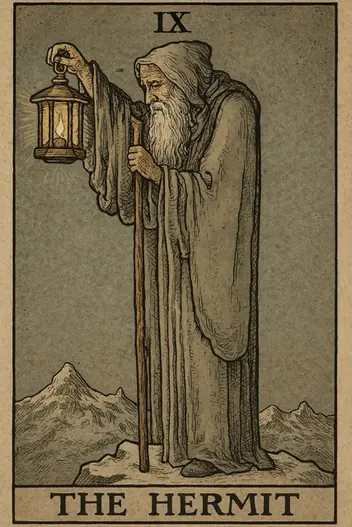
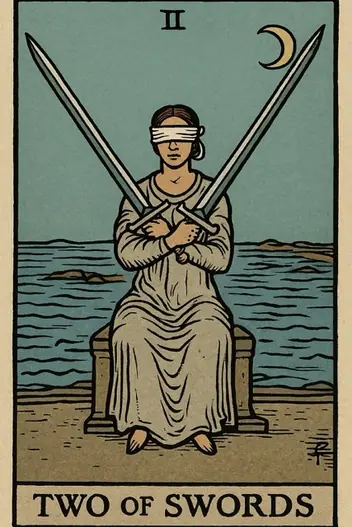
When the Hermit’s solitary lantern meets the Two of Swords’ blindfolded stalemate, we encounter a powerful psychological tension. The Hermit represents deliberate withdrawal—a quest for internal clarity through introspection and isolation. The Two of Swords, however, depicts a paralyzed decision-maker, blinded to external facts while holding two opposing truths at bay. Together, they create a state of calculated pause: you are not avoiding reality, but actively choosing to withhold judgment until your inner compass aligns with observable data. This combination demands you stop seeking answers from others and instead trust the slow, uncomfortable process of self-discovery.
In practical terms, this pairing signals a strategic retreat from external noise. You may feel torn between two paths, but the Hermit insists that neither path can be chosen until you understand why you are torn. The Two of Swords warns that premature action—driven by fear or social pressure—will only deepen the conflict. This is a time for rigorous self-examination rather than decisive action. The core question is: What are you refusing to see about yourself that keeps the stalemate in place?
The Hermit and Two of Swords Card Meaning Explained
The core dynamic of the Hermit and Two of Swords is a structural conflict between knowledge and will. The Hermit seeks wisdom through solitude and introspection, while the Two of Swords represents a deliberate blindness—a refusal to integrate new information that might shatter a fragile emotional equilibrium. Psychologically, this creates a cognitive dissonance loop: you know you need to make a choice, but you also sense that the choice requires confronting a painful truth you’ve been avoiding. The result is a productive paralysis—not laziness, but a necessary incubation period.
This state is not weakness but strategy. The Hermit’s lantern illuminates the internal landscape—your values, fears, and unspoken needs—while the Two of Swords’ blindfold forces you to ignore external distractions (others’ opinions, societal expectations, short-term rewards). The real risk here is premature resolution: forcing a decision before the inner truth is fully formed. The mind will try to shortcut this process by choosing the "lesser evil," but the cards demand you hold the tension until a third, more authentic option emerges. Action without self-awareness is the enemy here.
In a Jungian sense, this combination activates the Shadow of indecision. The Two of Swords often masks a fear of commitment—to a person, a career, or a personal identity. The Hermit counters this by asking: What part of yourself are you afraid to meet alone? The answer is rarely external. It is your own capacity for radical honesty that is being tested. The longer you sit in this discomfort, the clearer the path becomes—not because the world changes, but because you change your relationship to the uncertainty.
The Hermit and Two of Swords: Career and Money
Strategic Opportunities:
Audit your current role or project for hidden inefficiencies. The Hermit’s insight can reveal a skill gap or a misalignment with company values that you’ve been ignoring. Use this period to update your resume or learn a new skill—but do not job-hunt yet.
Strategic Opportunities:
Re-evaluate your financial priorities. This is an ideal time to create a 6-month budget based on your actual needs, not your aspirational lifestyle. The Two of Swords’ blindness to money is common; the Hermit’s discipline can fix it.
Calculated Risks:
Avoid making any major financial commitments (loans, investments, job offers) for at least 30 days. The combination warns that you are missing critical data—either about the market, the other party’s motives, or your own risk tolerance. Do not sign anything until you have slept on it for three nights.
Professionally, this pairing signals a strategic pause in your career trajectory. You may feel torn between two offers, two paths, or two roles. The Hermit advises that neither is right if you are not clear on your own definition of success. The Two of Swords warns that indecision is not the same as inaction—it is a form of data collection. Use this time to conduct informational interviews with people in both fields, but do not commit. The goal is to gather enough evidence to make a decision that aligns with your long-term identity, not your short-term anxiety. Financially, this is a period of conservation, not expansion. Bold the following: Your greatest financial risk right now is acting on incomplete information. Wait until the fog clears.
Your pair is already on the table. Ask your question and draw the clarifying card
or simply focus on it
The Hermit and Two of Swords Love Outcome
If you are single:
This combination suggests you are idealizing a potential partner while ignoring red flags—or, conversely, rejecting someone because of a fear of vulnerability. Take a 30-day break from dating apps and social events. Use this time to journal about your non-negotiable values versus your surface-level preferences. The answer is not in finding "the one," but in understanding what you are truly ready to give and receive.
If you are in a relationship:
You and your partner are likely stuck in a silent standoff—both of you avoiding a difficult conversation about boundaries, commitment, or unmet needs. The Hermit advises that one partner must take the lead in self-reflection before the dialogue can begin. This is not about winning an argument, but about creating emotional safety for honesty.
In relationships, the Hermit and Two of Swords often appear when emotional intimacy is blocked by intellectual stalemate. One or both partners may be using "logic" to avoid feeling vulnerable, or using "space" to avoid conflict. The key is to distinguish between healthy solitude and emotional avoidance. The Hermit’s withdrawal is productive when it leads to insight; the Two of Swords’ blindness is destructive when it becomes a permanent shield. Your next step is not to force a resolution, but to schedule a structured conversation where each person speaks without interruption, focusing on their own feelings rather than blaming the other. This is a time for emotional precision, not emotional fireworks.
Uncover hidden insights
Let our advanced Tarot system interpret these archetypes specifically for your personal path.
The Hermit and Two of Swords Reversed: What Changes?
When cards appear in a reversed position, the dynamic becomes distorted, and a constructive pause turns into a destructive standstill.
Reversed Hermit + Upright Two of Swords. Here, the potential for wisdom is blocked. The person is unwilling to learn from their mistakes. They have isolated themselves, not for reflection, but for self-justification. Risk: You become a hostage to your own pride, refusing to see obvious paths to a solution. Advice: Step out of isolation and seek counsel from someone wiser than you.
Upright Hermit + Reversed Two of Swords. This is a scenario of internal resistance. You know the truth but are afraid to voice it. The blindfold has fallen, but you refuse to open your eyes. Risk: Psychosomatics – your body will start signaling through pain to force you to finally make a decision. Advice: Write a letter (to yourself or a partner) containing the most frightening conclusion you are currently denying.
Both cards reversed. Complete imbalance. High anxiety and paranoia. The person cannot bear to be alone (fleeing from silence) but is also incapable of connection (fearing betrayal). This is a state of an "emotional pendulum": you swing from aggression to apathy. Method of correction: Strict discipline and routine. You need an external, structured schedule (sports, work, hobbies) to pull yourself out of the chaos of your thoughts. Consult a psychologist – this is not just a "bad period," but a clinical picture of nervous system exhaustion.
When The Hermit and Two of Swords Signal Trouble
The shadow of the Hermit and Two of Swords is chronic isolation fueled by perfectionism. The seeker may use "needing more time to think" as a permanent excuse to avoid making any decision at all. This manifests as analysis paralysis—an endless cycle of research, journaling, and self-help that never leads to action. The underlying cognitive bias is loss aversion: the fear of making the wrong choice becomes so overwhelming that the status quo—no matter how painful—feels safer than the risk of change.
Another pitfall is intellectualizing emotions. The Hermit can become a cold, detached observer, while the Two of Swords rationalizes away gut feelings. This leads to self-betrayal: you may convince yourself that a logical decision is correct, even though your body is screaming "no." Watch for signs of physical stress—insomnia, tension headaches, digestive issues—as indicators that you are ignoring a deep truth. The shadow also includes passive-aggressive communication in relationships, where silence is used as a weapon rather than a tool for reflection. If you find yourself saying "I just need space" without a clear intention to return with clarity, you are likely in the shadow.
The Hermit and Two of Swords: Tarot Advice
How to constructively use the Hermit's energy to balance the Two of Swords? Answer: transform contemplation into action. The Hermit provides you with the lantern's light to illuminate the dark forest of your fears. The Two of Swords is the blade you must take in hand to cut the Gordian knot of uncertainty. Your strategy is "from reflection to decision."
The first step is an honest inventory. Write down three possible scenarios (best, worst, neutral). The Hermit will help you see them without emotion. The second step is choosing the "lesser evil." Since the Two of Swords blocks the perfect solution, you must select the one that will cause the least damage to your self-esteem and resources. Do not wait for the perfect moment—it does not exist.
The third step is execution in silence. Do not tell anyone about your decision until it is 50% implemented. The Hermit teaches you to keep silence so as not to succumb to outside influence. A deep strategic insight: use this combination as a "point of no return." If you feel stuck at a crossroads, this pair of cards grants you permission for a radical step. Resignation, divorce, relocation, career change. Your clarity will come not through analysis, but through action.
Applying This to Your Situation
The Hermit and Two of Swords is not a call to wait forever—it is a call to wait with purpose. The core message is that clarity cannot be forced, but it can be cultivated. Your next step is to create a structured decision-making framework: write down the pros and cons of each path, but also write down what you would do if you had no fear of judgment or failure. Then, sit with that answer for 72 hours before acting. The truth is already within you—it’s just wearing a blindfold.
Ready to break the stalemate? This article gives you the archetype, but only you know the full story. The Fortune Cards app uses advanced AI to apply these exact card meanings to your unique situation—your relationship history, your career context, your personal blind spots. Get a deep, personalized interpretation of The Hermit and Two of Swords right now, on the web or by downloading the app. Stop waiting for answers. Start finding your truth.
Interpretation by the Fortune Cards editorial team, based on the Rider–Waite tradition and Jungian archetypes. About our methodology · Updated: 2026-08-26
Other Combinations with The Hermit
Other Combinations with Two of Swords
Explore Individual Card Meanings
Table of Contents
- The Hermit and Two of Swords Card Meaning Explained
- The Hermit and Two of Swords: Career and Money
- The Hermit and Two of Swords Love Outcome
- The Hermit and Two of Swords Reversed: What Changes?
- When The Hermit and Two of Swords Signal Trouble
- The Hermit and Two of Swords: Tarot Advice
- Applying This to Your Situation
Ready to find answers to your questions?
Start your first reading now and look at your situation with fresh clarity. The cards are ready to reveal deeper meaning.