Judgement and Eight of Cups Tarot Combination


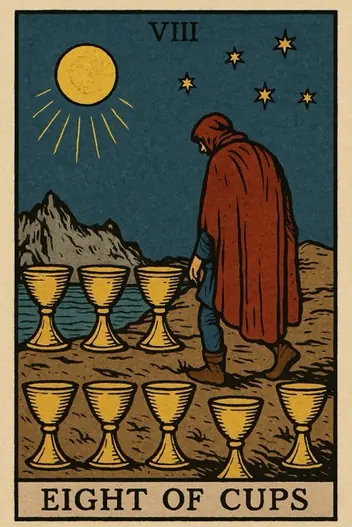
- Arcana
- Judgement — Major Arcana; Eight of Cups — Minor Arcana, Cups
- Elements
- Judgement — Fire; Eight of Cups — Water
- Elemental interaction
- Opposing elements — energies create tension
- Numerology
- 20 + 8 = 28 → 1
The intersection of Judgement and Eight Of Cups represents a profound psychological crossroads. Judgement, as the archetype of awakening and final reckoning, forces a clear-eyed evaluation of your life’s trajectory. The Eight Of Cups, by contrast, embodies the deliberate act of leaving behind what no longer serves you—a quiet, self-directed exit from emotional or material attachments. When these two energies collide, they create a moment of ruthless clarity: you must judge what is worth keeping and what must be abandoned for the sake of your own evolution.
This combination is not about impulsive flight or dramatic endings. Instead, it signals a calculated withdrawal based on a sober assessment of past patterns. The seeker is called to confront the gap between their stated values and their actual behaviors. The psychological tension arises from the need to integrate Judgement’s demand for accountability with Eight Of Cups’ call for emotional detachment. In real-world terms, this is the moment you decide to leave a job, relationship, or belief system because you can no longer justify staying.
Judgement and Eight of Cups: How These Energies Interact
When Judgement and Eight Of Cups merge, the primary psychological state is one of critical self-evaluation followed by decisive action. The Judgement card activates the superego—the internalized voice of conscience and societal expectation—while the Eight Of Cups engages the ego’s capacity for strategic withdrawal. This is not a passive or victimized leaving; it is a sovereign choice made after weighing costs, benefits, and long-term consequences.
The core dynamic involves breaking a cycle of denial. Judgement forces you to see your situation as it truly is, without romanticizing or minimizing. The Eight Of Cups then provides the operational blueprint for exit: you pack up what you can carry, leave the rest, and walk toward unknown terrain. The key insight here is that this combination favors pragmatic closure over emotional catharsis. You are not required to forgive, forget, or reconcile—only to act on your newfound truth.
This pairing often surfaces in readings when the seeker has been overstaying their welcome in a situation out of guilt, obligation, or fear of judgment from others. The cards demand you stop seeking external validation for your departure. The psychological work is to separate your authentic needs from the internalized voices of parents, partners, or society. The result is a liberation that feels less like victory and more like quiet relief.
Your pair is already on the table. Ask your question and draw the clarifying card
or simply focus on it
Judgement and Eight of Cups: Career and Money
Strategic Opportunities:
Exit a stagnant role or industry that no longer challenges you. The Judgement call is to assess your career trajectory with brutal honesty; the Eight Of Cups action is to resign or pivot with a clear plan.
Strategic Opportunities:
Release a failed project or business model that consumes resources without return. This is the time to cut losses and redirect energy toward ventures that align with your evolving values.
Calculated Risks:
Avoid burning bridges or making dramatic exits without a financial safety net. The Eight Of Cups warns against impulsive flight; plan your departure methodically to preserve professional reputation and liquidity.
In the professional realm, this combination demands strategic disinvestment. You are being called to judge your career path against your current skills, values, and market realities. If you feel stuck, the Eight Of Cups provides the emotional permission to leave—but only after a rational cost-benefit analysis. A key financial warning: do not confuse liberation with recklessness. The shadow of this pairing can manifest as quitting without a backup plan or abandoning a network prematurely.
Instead, use Judgement’s clarity to identify the specific aspects of your work that drain you (e.g., toxic culture, misaligned values, plateaued growth). Then, use Eight Of Cups’ methodology to execute a graceful exit: update your resume, network strategically, and secure a transition. The most strategic move is to leave on your own terms, not when you are forced out by burnout or failure.
Deepen your understanding
Find out exactly what this reading means for your current life situation with our oracle.
Judgement and Eight of Cups as Feelings
If you are single:
This combination suggests you are being called to judge your past relationship patterns honestly and walk away from the fantasy of a "perfect partner." The next step is to leave behind the emotional baggage of previous disappointments.
If you are in a relationship:
The cards indicate a necessary reckoning with whether the partnership supports your growth. One or both partners may need to release an outdated dynamic—such as codependency, resentment, or unmet expectations—through direct, honest conversation.
In relationships, Judgement and Eight Of Cups together signal a pivotal moment of emotional accountability. This is not about blame but about assessing the structural health of the bond. If you are in a committed partnership, the cards urge you to evaluate what you are tolerating and whether it aligns with your long-term well-being. The key relationship advice here is to prioritize authenticity over harmony. You may need to have a difficult conversation about ending a pattern of sacrifice or disconnection.
For singles, this combination warns against repeating the same mistakes by choosing partners who mirror unresolved issues. The psychological task is to judge your own role in past failures and then leave those patterns behind. This might mean taking a deliberate break from dating to process lessons, or consciously choosing a partner who challenges rather than comforts your old wounds. Bold action here means walking away from the comfort of familiar dysfunction.
When Judgement and Eight of Cups Signal Trouble
When this energy is blocked or distorted, the seeker may fall into cognitive biases that justify inaction. The most common shadow is analysis paralysis—endlessly evaluating without ever leaving. You may judge yourself harshly for past mistakes but fail to translate that insight into behavioral change. Alternatively, the Eight Of Cups’ shadow can appear as chronic escapism: using the "need to move on" as a rationalization for avoiding commitment or accountability in relationships or work.
Another pitfall is moral superiority. Judgement’s archetype can inflate the ego, making you feel you are "above" a situation or person, leading to a cold, dismissive exit without empathy. This can damage relationships you might later need. The psychological trap is confusing judgment with condemnation. True Judgement is about clarity, not punishment. Self-sabotage emerges when you leave not because it is wise, but because you fear failure or intimacy. The Eight Of Cups then becomes a pattern of running away rather than a strategic retreat.
Judgement and Eight of Cups Reversed: How to Read It
When cards appear in a reversed position, the dynamic becomes distorted, transforming a constructive crisis into destructive stagnation.
If Judgment is Reversed:
The potential for awakening is blocked. You are denying obvious facts, clinging to the past, or falling into recklessness by acting impulsively. Warning: you risk missing the moment when leaving would still have been honorable and timely. Instead of a strategic withdrawal, you risk being ejected from the situation with losses.
If the Eight of Cups is Reversed:
This indicates internal resistance to change. You are aware of the need to leave (Judgment is at work), but cannot take the step due to fear, guilt, or false hope. Advice: realize that your inaction is also a choice, one that will lead to worse consequences than an active departure.
If BOTH are Reversed:
Complete imbalance. You are in a state of paralysis of the will. Judgment offers no clarity (self-deception), and the Eight provides no energy for action (apathy). Logical way to correct this: start small. Take one rational step to bring order to your life (sort through documents, have an honest conversation). This will set the mechanism of Judgment in motion.
Judgement and Eight of Cups: Tarot Advice
How to constructively use the energy of Judgment to balance the Eight of Cups? The key lies in integrating judgment and action. It is not enough to simply recognize the problem (Judgment) or simply walk away (Eight of Cups). You must create an evacuation plan based on the conclusions of Judgment.
Your task is to transform an emotional crisis into a rational project. Judgment gives you evaluation criteria (what went wrong, what lessons were learned). The Eight of Cups provides a vector of movement (where and how to leave to avoid repeating mistakes). A profound strategic piece of advice: draw up an "Exit Map." Describe:
Objective Reality (Judgment):
Facts, figures, irrefutable evidence of the dead end.Destination Point (Eight of Cups):
A clear, realistic vision of what you want to build in the new place.The Route:
Concrete steps with deadlines and resources.
Only when "judgment" becomes not a sentence, but a tool for decision-making, and "leaving" becomes not an escape, but a strategic maneuver, does this combination bring liberation and growth. You are not a victim of fate, but a crisis manager of your own life. Use this clarity to cut away the excess and move toward your goal without regret.
Applying This to Your Situation
The core message of Judgement and Eight Of Cups is this: you have the clarity to see what must change, and the courage to walk away from it. This is not a time for half-measures or waiting for external permission. Your next step is to translate your inner reckoning into outer action—whether that means ending a relationship, leaving a job, or releasing an old identity. The psychological work is to trust your own judgment and act with deliberate, compassionate resolve.
While this article provides a general archetype, the true power of Tarot lies in its application to your unique situation. To get a deep, personalized interpretation of this exact combination for your specific question, use the Fortune Cards app. Whether you access it on the web or download it, the app will guide you through a tailored reading that considers your personal context, past patterns, and current challenges. Take the next step now—let the cards speak directly to your life.
Interpretation by the Fortune Cards editorial team, based on the Rider–Waite tradition and Jungian archetypes. About our methodology · Updated: 2026-08-26
Other Combinations with Judgement
Other Combinations with Eight of Cups
Explore Individual Card Meanings
Table of Contents
- Judgement and Eight of Cups: How These Energies Interact
- Judgement and Eight of Cups: Career and Money
- Judgement and Eight of Cups as Feelings
- When Judgement and Eight of Cups Signal Trouble
- Judgement and Eight of Cups Reversed: How to Read It
- Judgement and Eight of Cups: Tarot Advice
- Applying This to Your Situation
Ready to find answers to your questions?
Start your first reading now and look at your situation with fresh clarity. The cards are ready to reveal deeper meaning.