Love Tarot: Judgement and Four of Cups


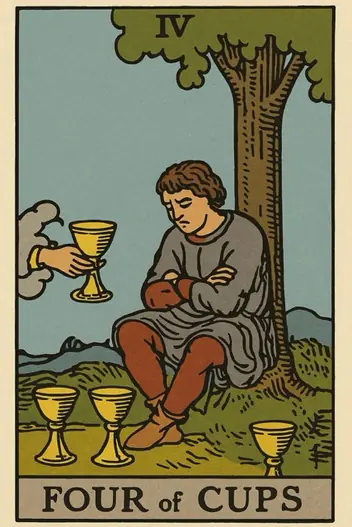
- Arcana
- Judgement — Major Arcana; Four of Cups — Minor Arcana, Cups
- Elements
- Judgement — Fire; Four of Cups — Water
- Elemental interaction
- Opposing elements — energies create tension
- Numerology
- 20 + 4 = 24 → 6
When the Judgement card—a call to radical self-evaluation and rebirth—meets the Four of Cups—a state of emotional withdrawal and discontent—you get a potent psychological paradox. You are being summoned to a major life review, but you are too absorbed in your own apathy to hear the alarm. This combination often signals a critical moment where opportunity is disguised as dissatisfaction, and where the path forward requires you to break a cycle of passive waiting.
From a Jungian perspective, Judgement represents the integration of the shadow self and the emergence of a more authentic identity, while the Four of Cups reflects a numbed conscious ego that has lost touch with its deeper drives. Together, they create a tension: the psyche is ready for transformation, but the individual is stuck in a depressive or complacent holding pattern. The strategic question is not what to do, but how to re-engage with the life you are meant to live.
What Do Judgement and Four of Cups Mean Together?
The core dynamic here is a conflict between external expectation and internal readiness. The Judgement card acts as a relentless psychic summons—a career change, a relationship ultimatum, a health scare, or a sudden insight that demands you "wake up." However, the Four of Cups indicates you are currently in a state of emotional satiation or burnout, where new offers feel like burdens rather than gifts. You may be staring at an opportunity (symbolized by the fourth cup being offered by a hand in the clouds) but your perception is clouded by cynicism or fear of change.
This combination forces a confrontation with the apathy defense mechanism. Instead of making a decision, you are likely overthinking, withdrawing, or waiting for a sign that is already present. The Judgement energy demands accountability for your own stagnation. You cannot use the Four of Cups' "I'm just not feeling it" as a valid excuse when the universe is knocking loudly. The practical implication is clear: your next step requires you to act despite a lack of enthusiasm. The emotional payoff comes after you commit, not before.
Psychologically, this pair suggests you are in a liminal space between an old identity and an emerging one. The Four of Cups represents the comfort of the familiar, even if it is painful. Judgement represents the terrifying freedom of the unknown. The key insight is that your current dissatisfaction is not a signal to retreat, but a signal that the old structure must die. To move forward, you must consciously choose to accept the judgment and take the offered cup, even if your hands feel heavy.
Your pair is already on the table. Ask your question and draw the clarifying card
or simply focus on it
Career Meaning of Judgement and Four of Cups
Strategic Opportunities:
Re-evaluate your current role with a critical eye. The Judgement card suggests a performance review, a job offer, or a project that forces you to assess your long-term trajectory. The Four of Cups says you may be undervaluing a stable but unexciting opportunity that could be a stepping stone.
Strategic Opportunities:
Use dissatisfaction as data. If you feel bored or stuck, that is a signal to initiate a conversation about growth with your manager or to pivot your skills into a new area. Do not wait for the perfect job to find you; create a plan to make your current situation more challenging.
Calculated Risks:
Avoid quitting out of frustration. The Four of Cups can lead to impulsive resignation simply because you feel "over it." Do not burn bridges. Instead, use the Judgement energy to conduct a rigorous audit of your finances and career options before making any move. The risk is rejecting a solid offer or a promotion because it doesn't feel "right" in the moment.
Practical analysis: This combination is a powerful call to strategic action, not passive waiting. In career terms, Judgement is the external catalyst—a deadline, a review, or a market shift—that forces you to make a decision. The Four of Cups is the internal resistance—the boredom, the "I don't care" attitude, or the fear of commitment to a new path. Your job is to separate the signal from the noise. If you are in a negotiation, do not let your lack of enthusiasm lower your value. You may feel indifferent, but you must act as if you are fully engaged. Financially, this warns against ignoring a bill, a tax notice, or an investment opportunity because you are tired of dealing with it. The Judgement card says: Face the numbers. Now. The Four of Cups says: Do not let your mood dictate your money decisions. A disciplined, objective review of your budget and goals is non-negotiable.
Love and Relationships
If you are single:
This combination suggests you are being overly selective or emotionally closed off to a potential partner who actually meets your deeper criteria. You may be rejecting someone not because they are wrong, but because you are not ready to be seen in your full vulnerability. Stop waiting for a "perfect" sign and evaluate the person on their actions, not your mood.
If you are in a relationship:
You and your partner are likely stuck in a rut of unspoken grievances or emotional distance. One of you is calling for a major conversation or change (Judgement), while the other is retreating into a "leave me alone" stance (Four of Cups). The longer you avoid the reckoning, the more resentment builds.
Key relationship advice: This is a moment for brutal honesty wrapped in compassion. The Judgement card demands a full accounting of the relationship's health. Are you staying because of comfort, fear, or genuine love? The Four of Cups indicates that apathy is a choice, not a condition. If you are the one withdrawing, ask yourself: "Am I protecting myself from a necessary conversation, or am I avoiding the pain of change?" If you are the one calling for change, do not expect enthusiasm from your partner. Lead with clarity, not pressure. The most powerful move you can make is to schedule a deliberate, no-distraction conversation and commit to listening as much as you speak. This is not about winning an argument; it is about deciding if the relationship can evolve into its next stage.
Ask your specific question
Don't rely on generic meanings. Get a customized reading tailored specifically to your energies.
Shadow Side & Pitfalls
The shadow side of this combination is a dangerous cocktail of self-righteousness and denial. You may use the Judgement card's call to "rise up" as an excuse to judge others harshly while ignoring your own stagnation. The Four of Cups' withdrawal can morph into a passive-aggressive refusal to participate in your own life. You might tell yourself you are "waiting for clarity," but in reality, you are using apathy as a shield against accountability.
Cognitive biases at play include the "sunk cost fallacy" (staying in a bad situation because you've already invested time) and the "optimism bias" (believing a magical solution will appear without effort). The most common self-sabotage pattern is rejecting a genuine opportunity because it arrives at an inconvenient time. You tell yourself you'll take the next one, but the next one may not come. This is a classic case of the ego preferring the misery of the known over the risk of the unknown. To avoid this pitfall, you must consciously override your feelings and act on your values. Ask yourself: "If I were not tired, bored, or scared, what would I do right now?" Then do that.
What If Judgement or Four of Cups Appears Reversed?
When cards appear in a reversed position, the energy shifts direction, but does not disappear.
If Judgment is reversed:
The potential for transformation is blocked, but not destroyed. You may experience guilt over past mistakes or, conversely, refuse to acknowledge your responsibility. Warning: do not try to "skip" the stage of apathy – this will lead to impulsive decisions you will regret. Your task is to accept that you are not ready for change right now, and to stop judging yourself for it.
If the Four of Cups is reversed:
Internal resistance escalates into active sabotage. You are not just passively waiting, but consciously destroying your chances. Advice: check whether you are receiving secondary gain from your apathy (e.g., pity from others or the right to do nothing).
If BOTH are reversed:
The imbalance reaches a critical point. Judgment reversed – you hear the call, but are afraid. Four of Cups reversed – you are angry at the whole world for demanding action from you. A logical way to correct this: artificially create a deadline for yourself. Judgment reversed represents missed deadlines. Set a date by which you must make a decision, and stick to it.
Judgement and Four of Cups Combined Message
How to constructively use the energy of Judgment to balance the Four of Cups? The answer lies in the realm of paradoxical intention. Do not try to force yourself to want change. Instead, acknowledge your right to apathy—and act in spite of it.
Strategic Algorithm:
- Accept the fact that you are not obligated to "feel" the right decision. Your task is to take an action, not to experience an emotion. Judgment is a card of action, not feeling.
- Use apathy as a filter. The Four of Cups cuts away everything inessential. Ask yourself: "If I could do only one thing a day, what would I choose?" That is your priority.
- Create a "switching" ritual. Judgment demands clarity, while the Four of Cups demands stillness. Find 15 minutes a day when you completely disconnect from external stimuli (no phone, books, or conversations). This allows your unconscious to process information without resistance.
Deep Advice:
Do not try to "fix" your apathy—use it as a tool. In a state of emotional numbness, you make the most rational decisions because they are uncolored by illusions. In this combination, Judgment is not about "passion" but about "truth." Trust cold calculation, not a fiery heart.
Your Next Step: Personal Context Matters
The core message of Judgement and Four of Cups is that you are being called to a new chapter, but your current emotional state is making you miss the call. The solution is not to wait until you feel ready—it is to take one deliberate action despite your indifference. Whether it's sending that email, having that difficult conversation, or accepting that offer, movement breaks the spell of stagnation.
Get Your Personalized Reading Now. While this analysis provides a powerful overview of the Judgement and Four of Cups archetypes, the true meaning depends entirely on your specific question and life context. The Fortune Cards app uses advanced AI to analyze your exact situation, providing a deep, personalized interpretation of this combination in relation to your love life, career, or personal dilemma. Don't rely on generic meanings for life-changing decisions. Use the Fortune Cards app on the web or download it today to discover what this wake-up call means for you—right now.
Interpretation by the Fortune Cards editorial team, based on the Rider–Waite tradition and Jungian archetypes. About our methodology · Updated: 2026-08-26
Other Combinations with Judgement
Other Combinations with Four of Cups
Explore Individual Card Meanings
Table of Contents
Ready to find answers to your questions?
Start your first reading now and look at your situation with fresh clarity. The cards are ready to reveal deeper meaning.