Judgement and Seven of Pentacles Meaning in Tarot

- Arcana
- Judgement — Major Arcana; Seven of Pentacles — Minor Arcana, Pentacles
- Elements
- Judgement — Fire; Seven of Pentacles — Earth
- Elemental interaction
- Neutral elements — energies coexist without conflict
- Numerology
- 20 + 7 = 27 → 9
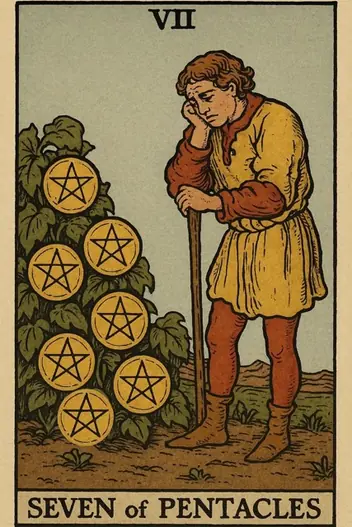
The intersection of Judgement and Seven of Pentacles is a powerful psychological crossroads. Judgement represents a calling to account—a moment of profound self-evaluation, rebirth, and the need to answer for past actions. The Seven of Pentacles, on the other hand, embodies the virtue of patience and assessment—the farmer pausing to survey his growing crop, evaluating whether his efforts have yielded sufficient results. Together, they create a dynamic where you are not just waiting for results but are being summoned to judge the quality of your work and the direction of your life.
In practical terms, this pairing signals a period of strategic pause and moral inventory. You are likely standing at a threshold where the universe (or your own unconscious) is demanding a clear-eyed review of your investments—time, energy, money, or emotion. The question is not simply "What have I done?" but "What must I now answer for?" This article will dissect the psychological archetypes at play, offering pragmatic guidance for navigating this moment of reckoning without falling into paralysis or regret.
Judgement and Seven of Pentacles: How These Energies Interact
When Judgement and Seven of Pentacles appear together, the core dynamic is a tension between urgency and patience. Judgement calls for immediate, transformative action—a "wake-up call" that demands you confront a deeper truth about your life's purpose. Yet the Seven of Pentacles insists that this truth cannot be rushed; it must be assessed through the lens of tangible results. This creates a psychological state of calculated introspection: you are being pushed to re-evaluate your long-term strategies, but only after acknowledging what has actually been accomplished.
The key psychological insight here is the archetype of the "Inner Critic" versus the "Harvester." Judgement activates the Inner Critic—the voice that judges your past choices as worthy or unworthy. The Seven of Pentacles, however, represents the Harvester—the part of you that objectively measures growth, not perfection. The healthiest integration of these energies is to ask: "What is the honest yield of my efforts, and what must I now call myself to account for?" This is not about shame but about strategic recalibration.
Real-world implications are clear: you may be facing a deadline, a performance review, or a relationship crossroads where you must decide whether to continue investing or cut your losses. The danger is either rushing to a premature conclusion (Judgement's shadow) or staying stuck in endless evaluation (Seven of Pentacles' shadow). The balanced path is to take one decisive, well-informed step forward, trusting that the harvest will reveal itself in due time.
Judgement and Seven of Pentacles as Feelings
If you are single:
This combination suggests you are being called to judge a potential partner's long-term viability rather than their immediate appeal. Avoid romanticizing a new connection; instead, evaluate whether their values and life trajectory align with your own.
If you are in a relationship:
You and your partner may be at a critical evaluation point—perhaps revisiting a past conflict or deciding on a major commitment (e.g., moving in, marriage, or ending it). The emphasis is on honest, non-accusatory dialogue about what each of you has invested and what you expect in return.
In relationships, the Judgement-Seven of Pentacles dynamic often surfaces when one partner feels the other is not pulling their weight—emotionally, financially, or in terms of effort. This is not a card of blame but of mutual accountability. The psychological work here is to separate objective facts (the "harvest" of shared experiences) from subjective guilt or resentment. Bold advice: Schedule a "relationship audit" where both partners list what they have given and what they need, without judgment. This allows you to see the crop clearly, rather than fighting over who planted the seeds.
If you are single, this pair warns against repeating patterns from past relationships. Judgement demands you confront the shadow of a previous partner who was "almost right." The Seven of Pentacles asks you to assess whether you are investing in a person who actually shows up. A key takeaway: Don't mistake potential for progress. Wait until you see consistent action, not just promising words.
Your pair is already on the table. Ask your question and draw the clarifying card
or simply focus on it
Judgement and Seven of Pentacles for Career and Money
Strategic Opportunities:
Reassess your long-term career trajectory—this is an ideal time to request a performance review, pitch a project, or apply for a promotion. Your past work is ready for evaluation.
Strategic Opportunities:
Audit your financial portfolio—look at investments, savings, and recurring expenses. Cut what isn't yielding returns and redirect resources to high-potential areas.
Calculated Risks:
Avoid making a major career change on impulse. The Seven of Pentacles warns against quitting a stable job without a clear plan. Instead, gather data for 2-4 weeks before deciding.
In the professional realm, Judgement and Seven of Pentacles create a pivot point between reflection and action. You may feel a strong inner "calling" to change industries, start a business, or take a bold step. However, the Seven of Pentacles insists that this calling must be grounded in reality. Bold financial warning: Do not invest large sums of money into a venture based on a sudden "epiphany." Instead, use a 30-day trial period to test the waters—like a farmer planting a test plot.
This combination is particularly potent for entrepreneurs and freelancers. You are being asked to evaluate the ROI of your time and energy. Which clients or projects are worth continuing? Which are draining you without sufficient reward? The key strategic action is to create a simple spreadsheet or journal tracking your input (hours, money, emotional energy) versus output (income, satisfaction, growth). This data will guide your next move with clarity, not guesswork.
Ask your specific question
Don't rely on generic meanings. Get a customized reading tailored specifically to your energies.
The Shadow Side of Judgement and Seven of Pentacles
The shadow of this pairing manifests as paralysis by analysis or guilt-driven overwork. When Judgement's energy is blocked, you may become overly self-critical, ruminating on past "failures" without moving forward. This can lead to cognitive distortion known as "catastrophizing" —assuming the harvest is worthless before you've even measured it. Conversely, when the Seven of Pentacles is dominant, you may procrastinate on necessary decisions, waiting for the "perfect" moment that never comes.
Another common pitfall is people-pleasing or martyrdom. You might feel "called" to sacrifice your own needs for others (a shadow of Judgement) while ignoring the Seven of Pentacles' warning that your resources are finite. Self-sabotage often appears as believing you must "earn" your rebirth through suffering. In reality, the cards ask for honest assessment, not penance.
Watch for the bias of "sunk cost fallacy" —staying in a dead-end job or relationship because you've already invested so much time. The Judgement card's true power is to liberate you from past decisions, not to chain you to them. If you feel trapped, ask: "If I had no history with this, would I choose it now?" The answer is your compass.
Judgement and Seven of Pentacles Reversed: What Changes?
Judgement Reversed:
You are denying the obvious. A blocking of potential occurs due to the fear of hearing a verdict. You may be ignoring a crisis, hoping it will resolve itself. Advice: Consciously provoke an unpleasant conversation or a test. This will relieve the tension faster than waiting.
Seven of Pentacles Reversed:
Internal resistance to labor. It seems to you that your efforts are futile, and you are ready to give up everything. This is a protective mechanism of the psyche to avoid disappointment. Advice: Do not abandon the task, but change your criteria for evaluating success. The value may lie not in the result, but in the experience gained.
BOTH Reversed:
Complete imbalance — chaos in assessments and actions. You are either grabbing at everything at once or falling into a stupor. A logical way to correct this: Return to basics. Identify one, single most important task for the week and ignore everything else. Judgement reversed demands radical simplification.
Overall Meaning of Judgement and Seven of Pentacles
To use this combination constructively, it is necessary to separate the processes of assessment and action. First — a harsh audit (Judgment). Ask yourself three questions: "What did I do?", "What did I get?", "How do I feel about it?" Honest answers will give you a map of the terrain. Then — micro-steps (Seven of Pentacles). Don't try to change everything at once. Choose one weak point in your strategy and start working on it daily.
Deep strategic advice:
Use the energy of Judgment not for self-flagellation, but for calibrating your internal standards. If you realize the result doesn't match expectations, it doesn't mean you're a failure. It means your map of reality is outdated. Update it. The Seven of Pentacles will give you the patience to wait for the first sprouts of a new strategy.
Clarity comes through action. Don't wait for the verdict to be handed down "from above." Pronounce it yourself, based on the data, and then — take the first step in a new direction. Only in this way does the chaos of assessment transform into the order of growth.
Your Next Step: Personal Context Matters
The Judgement and Seven of Pentacles combination is a powerful invitation to pause, assess, and then act with newfound clarity. It reminds you that growth is not linear, and that true transformation requires both honest self-evaluation and patient observation of your results. Whether you are facing a relationship crossroads, a career decision, or a personal reckoning, the core message is this: Stop guessing. Start measuring. Then decide.
While this article provides the general archetype, the true magic happens when Tarot is applied to your unique situation. Your specific question, your personal history, and the surrounding cards in a spread can shift the meaning dramatically. That is why I recommend using the Fortune Cards app—available on the web or for download. It offers a deep, personalized interpretation of this exact combination for your specific question right now. No generic advice. Just the insight you need, tailored to your life.
Interpretation by the Fortune Cards editorial team, based on the Rider–Waite tradition and Jungian archetypes. About our methodology · Updated: 2026-08-26
Other Combinations with Judgement
Other Combinations with Seven of Pentacles
Explore Individual Card Meanings
Table of Contents
- Judgement and Seven of Pentacles: How These Energies Interact
- Judgement and Seven of Pentacles as Feelings
- Judgement and Seven of Pentacles for Career and Money
- The Shadow Side of Judgement and Seven of Pentacles
- Judgement and Seven of Pentacles Reversed: What Changes?
- Overall Meaning of Judgement and Seven of Pentacles
- Your Next Step: Personal Context Matters
Ready to find answers to your questions?
Start your first reading now and look at your situation with fresh clarity. The cards are ready to reveal deeper meaning.