Justice and Five of Cups Tarot as Feelings
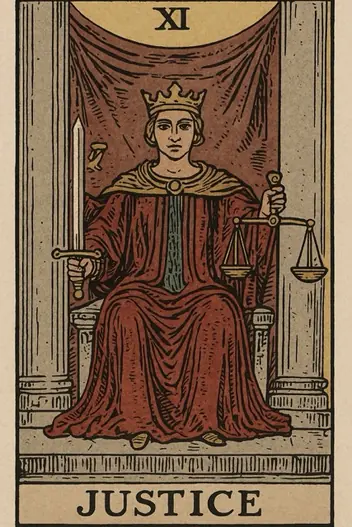

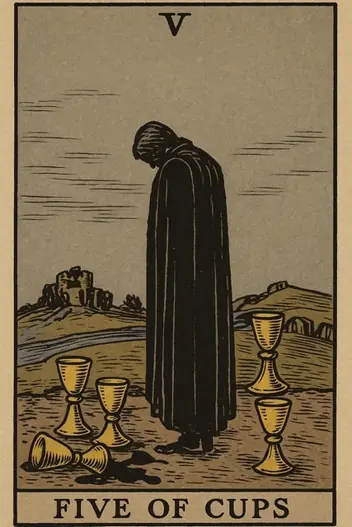
- Arcana
- Justice — Major Arcana; Five of Cups — Minor Arcana, Cups
- Elements
- Justice — Air; Five of Cups — Water
- Elemental interaction
- Neutral elements — energies coexist without conflict
- Numerology
- 11 + 5 = 16 → 7
When the stern, balanced figure of Justice meets the sorrowful, backward-glancing Five of Cups, a powerful psychological tension emerges. This combination represents a moment of accountability for past emotional choices—where the objective truth of a situation clashes with the subjective experience of grief. You are being asked to sit with the consequences of a decision, a betrayal, or a failed expectation, not as a punishment, but as a necessary step toward emotional integrity.
The Five of Cups often signals a focus on what has been lost, while Justice demands that you examine why that loss occurred. This is not merely about feeling sad; it is about understanding the cause-and-effect chain that led to this point. The collision of these archetypes suggests that your current emotional state is directly linked to a previous imbalance—perhaps you gave too much, trusted too easily, or avoided a difficult truth. The path forward requires you to mourn the loss without blaming the universe, and instead, take ownership of your role in the story.
Core Dynamics & Interpretation
The psychological state created by Justice and the Five of Cups is one of painful clarity. You are no longer able to rationalize away the reality of a situation. The Justice card strips away denial, forcing you to see the situation as it is, not as you wish it were. The Five of Cups then colors this clarity with a sense of regret and melancholy. The key insight here is that acceptance is not the same as agreement. You can acknowledge the fairness of an outcome—Justice says the scales have been balanced—while still feeling the sting of what you lost.
This combination often appears when a person is stuck in a cycle of rumination, replaying past events and wondering “what if.” The energy of Justice cuts through this loop by pointing to the objective facts: the contract was broken, the deadline was missed, the trust was violated. It is a call to stop negotiating with reality. The Five of Cups asks you to feel the grief, but Justice insists you do not wallow in it indefinitely. The most strategic action here is to conduct an honest audit of your own contributions to the loss. Did you ignore a red flag? Did you overcommit? Did you fail to enforce a boundary? Answering these questions with brutal honesty is the only way to prevent repeating the pattern.
What Do Justice and Five of Cups Say About Love?
If you are single:
This pairing warns against idealizing a past relationship or a potential partner who has already shown you inconsistency. Evaluate the situation based on actions, not promises. If you are grieving a recent breakup, use the Justice card’s energy to write down the objective reasons it ended—this will prevent you from romanticizing a flawed connection.
If you are in a relationship:
The combination suggests a reckoning with a past betrayal or a significant disappointment. One or both partners may be holding onto resentment or focusing on what the relationship used to be rather than what it is now. Honest, fact-based communication is non-negotiable.
In a relationship reading, Justice and the Five of Cups point to a critical juncture where emotional closure is required. This is not a time for grand gestures or sweeping problems under the rug. The couple must acknowledge a specific loss—perhaps a broken promise, a period of neglect, or a fundamental incompatibility. The healthiest path forward is to treat the relationship like a legal case: present the evidence of the hurt, listen to the other party’s perspective, and agree on a fair resolution. This may mean creating new boundaries, seeking couples therapy, or, in some cases, accepting that the partnership has run its course. Boldly, the advice is to cry over the spilled milk, but then use the remaining milk to make a new plan. Do not confuse temporary sadness with permanent failure.
Your pair is already on the table. Ask your question and draw the clarifying card
or simply focus on it
What Do Justice and Five of Cups Indicate for Your Career?
Strategic Opportunities:
This is a powerful time to renegotiate contracts or settle outstanding debts. The Justice card favors clear, fair agreements. If you have been wronged at work (e.g., passed over for a promotion, underpaid), now is the moment to present your case with documented evidence.
Strategic Opportunities:
Use the Five of Cups’ reflective energy to conduct a post-mortem on a failed project or business venture. Identify the specific mistakes made, not to assign blame, but to extract actionable lessons for your next move.
Calculated Risks:
Avoid making major financial decisions while in a state of emotional disappointment. The Five of Cups can cloud your judgment with scarcity thinking, making you accept a bad deal out of fear of losing everything. Do not sign anything until you have processed the loss.
For career and finances, this combination signals a necessary period of loss-adjustment. You may be facing a budget cut, a layoff, or a failed investment. The Justice card ensures that the outcome is likely fair according to the existing rules, even if it feels harsh. The strategic move is to audit your professional relationships and financial systems with cold objectivity. Boldly, if you have been over-functioning or under-charging, this is the wake-up call to rebalance. The Five of Cups warns against the sunk cost fallacy—do not throw good money after bad simply because you have already invested time or resources. Cut your losses, learn the lesson, and reallocate your energy toward a more equitable opportunity.
What If Justice or Five of Cups Appears Reversed?
When Justice is reversed, the energy of rational judgment is blocked. You may refuse to see your role in what happened, remaining in the position of the "unjustly offended." This is a dangerous state, as it turns the Five of Cups into a chronic cyclical crisis: you will repeatedly step on the same rake, blaming fate. Advice: acknowledge that your interpretation of events may be distorted.
If the Five of Cups is reversed, it points to an internal resistance to the grieving process. A person may try to "skip over" the pain, pretending nothing happened, or conversely, fall into hysterical activity. This is weakness masquerading as strength. The energy of Justice in this context can be used for self-deception: "I've analyzed everything, so I'm not in pain." The truth is that suppressed sadness will inevitably manifest as psychosomatic symptoms or sudden breakdowns.
When BOTH cards are reversed, a complete imbalance arises. This is a state of chaotic injustice, where there are neither rules nor the possibility to mourn a loss. A person oscillates between rage and apathy. The logical way to correct this is to return to the basics: restore at least one external order. Start small: tidy up your workspace or schedule. This will create an anchor for Justice, after which the emotion of loss can be experienced in a healthy way.
Your unique Tarot reading
See how these cards interact with your destiny. Start a free personal reading now.
Justice and Five of Cups: Warning Signs
The shadow manifestation of this combination is bitterness disguised as righteousness. The Justice card’s shadow can become rigid, self-righteous, and legalistic, while the Five of Cups’ shadow is a refusal to move on. Together, they create a person who is stuck in a narrative of victimhood, constantly pointing to the “unfairness” of their loss while ignoring their own agency. This is a cognitive bias known as the “just-world fallacy”—the belief that if something bad happened, it must have been deserved. The danger here is that you will use the idea of “karma” to beat yourself up, or conversely, use it to justify punishing others.
Another pitfall is emotional paralysis. The seeker may become so focused on the “why” of the loss (Justice) that they never actually grieve it (Five of Cups). This leads to a dissociated state where you intellectually understand the situation but remain emotionally numb. Conversely, you might drown in the grief, refusing to look at the objective facts because they are too painful. The shadow warns against using analysis as a defense against feeling. True integration requires both: feel the sadness, then use the lesson to rebuild.
Justice and Five of Cups Combined Message
To constructively harness the energy of this pair, a clear division of roles is necessary. The Five of Cups must not act as the judge, and Justice must not be the mourner. Your strategic task is to use Justice's analytical toolkit to limit the time spent grieving. Set a timer: "I have 24 hours to process the loss, after which I will conduct an audit and formulate an action plan."
Here, the energy of Justice serves as a counterbalance to emotional inflation. It prevents you from drowning in drama by reminding you that every action has a price. If you have lost something valuable, it means you either overpaid or misjudged the asset. Acknowledging this is not a punishment but an act of intellectual honesty that makes you stronger.
A deep strategic piece of advice: transform your pain into a precedent. Formulate for yourself a "Rule of Justice": never again invest resources in objects or people who have not passed your scrutiny. The Five of Cups shows what exactly needs to be released, and Justice gives you the legitimate grounds to do so without guilt. The clarity you gain by accepting this dynamic will allow you to emerge from the crisis not empty-handed, but with a new, stricter, yet functional code of conduct.
Your Next Step: Personal Context Matters
The core message of Justice and the Five of Cups is that healing begins when you stop fighting reality. You cannot change what happened, but you can change your relationship to it. This combination asks you to honor your grief, accept the consequences, and use the clarity of Justice to make a wiser choice going forward. The loss is real, but it is not the end of your story—it is the foundation for a more grounded, honest version of yourself.
While this article provides a deep archetypal analysis, the true power of Tarot lies in its application to your unique situation. The meaning of Justice and the Five of Cups shifts depending on whether you are asking about a breakup, a lawsuit, or a career change. To get a personalized, card-by-card interpretation for your specific question, use the Fortune Cards app. You can access it on the web or download it now. It will analyze your exact spread and life context, giving you the precise psychological and strategic guidance you need to move forward with clarity and purpose.
Interpretation by the Fortune Cards editorial team, based on the Rider–Waite tradition and Jungian archetypes. About our methodology · Updated: 2026-08-26
Other Combinations with Justice
Other Combinations with Five of Cups
Explore Individual Card Meanings
Table of Contents
- Core Dynamics & Interpretation
- What Do Justice and Five of Cups Say About Love?
- What Do Justice and Five of Cups Indicate for Your Career?
- What If Justice or Five of Cups Appears Reversed?
- Justice and Five of Cups: Warning Signs
- Justice and Five of Cups Combined Message
- Your Next Step: Personal Context Matters
Ready to find answers to your questions?
Start your first reading now and look at your situation with fresh clarity. The cards are ready to reveal deeper meaning.