Justice and Nine of Swords Tarot Combination
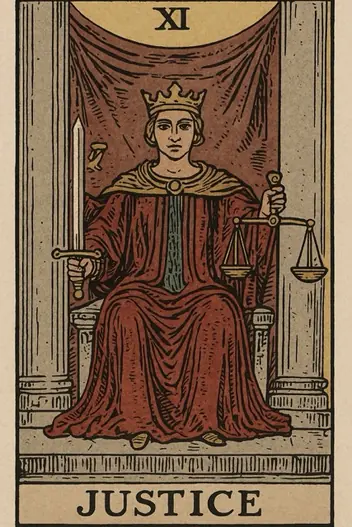

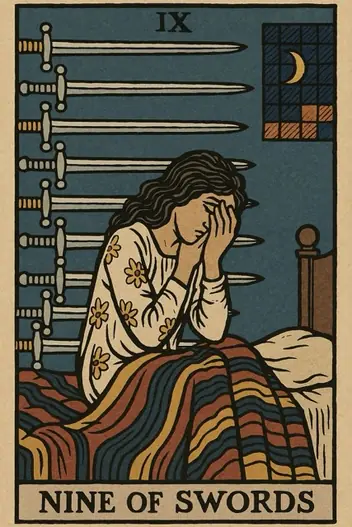
- Arcana
- Justice — Major Arcana; Nine of Swords — Minor Arcana, Swords
- Elements
- Justice — Air; Nine of Swords — Air
- Elemental interaction
- Same element — energies intensify each other
- Numerology
- 11 + 9 = 20 → 2
When the archetype of Justice—representing objective truth, cause-and-effect, and karmic balance—meets the Nine of Swords—the card of anxiety, guilt, and sleepless nights—the result is a psychologically charged confrontation. This combination forces you to face the consequences of your actions (or inactions) head-on, but through a lens of distorted self-judgment rather than clear-eyed accountability. The core conflict is between what is actually true and what your mind fears to be true.
This pairing often appears when you are awaiting a verdict—literal or metaphorical—and your internal critic has already turned the trial into a nightmare. It asks you to separate objective reality from subjective catastrophizing. The path forward requires rigorous self-honesty, but also compassionate reality-testing. You must ask: Is this guilt legitimate, or am I punishing myself for a misstep that hasn't yet occurred?
Justice and Nine of Swords Together: Meaning
The central psychological tension here is between accountability and anxiety. Justice demands you weigh facts and accept responsibility; the Nine of Swords amplifies every doubt into a potential disaster. This creates a feedback loop of self-punishment where you obsess over past mistakes (real or imagined) and predict harsh outcomes. The key insight is that your judgment of yourself is likely harsher than any external verdict will be.
This combination often surfaces in situations involving legal matters, ethical dilemmas, or significant decisions where the stakes feel life-altering. The Nine of Swords' energy can cloud your judgment, making you see threats where only consequences exist. The strategic move is to pause and gather factual evidence before making any major choice. Do not let your emotional state—fear, shame, regret—dictate your next step. Instead, use Justice's energy to create a logical framework: list what you know to be true, what you fear, and what evidence supports each point.
In a Jungian sense, this is the Shadow of the Judge archetype. The Nine of Swords represents the inner critic run amok, projecting personal fears onto external systems (the law, a partner, a boss). The healthy integration requires you to own your mistakes without exaggerating them, and to trust that the universe’s balance—Justice—will not be as cruel as your inner nightmare suggests. Your task is to switch from punishment to problem-solving.
Justice and Nine of Swords for Career and Money
Strategic Opportunities:
Audit your professional decisions. Use Justice's analytical energy to review contracts, performance reviews, or project outcomes. This is an ideal time to correct errors before they escalate.
Strategic Opportunities:
Leverage your anxiety as a risk-assessment tool. The Nine of Swords' hyper-vigilance can be channeled into identifying gaps in a plan—but only if you stop the catastrophic narrative and write down specific, solvable problems.
Calculated Risks:
Do not sign anything or make major financial moves while in a state of high anxiety. The combination warns against impulsive decisions driven by guilt or fear of failure. Wait for emotional equilibrium before committing resources.
In a professional context, this combination frequently appears when you are awaiting a performance review, legal ruling, or financial audit. The Nine of Swords suggests you are overestimating the negative outcome and underestimating your ability to handle it. The strategic response is proactive transparency. If you made a mistake, acknowledge it factually and propose a solution—this aligns with Justice's energy and often mitigates the worst-case scenario. Financially, this is a warning against "penalty thinking" —assuming you will be punished for past financial errors. Instead, create a concrete plan to address debts, tax issues, or budget shortfalls. The anxiety will only subside when you take measurable, fair action.
Bold financial warning:
Do not let shame about past spending prevent you from seeking professional advice. The cost of inaction is often higher than the cost of the mistake itself.
Your pair is already on the table. Ask your question and draw the clarifying card
or simply focus on it
Justice and Nine of Swords in Love and Relationships
If you are single:
This pairing warns against self-sabotage through over-analysis. You may be judging a potential partner based on past relationship traumas rather than their actual behavior. Clarify your own guilt or shame from previous connections before projecting it onto someone new.
If you are in a relationship:
A cycle of blame and guilt is likely active. One partner may feel unjustly accused, while the other is trapped in anxious rumination. This combination demands a fair, fact-based conversation to break the pattern of emotional punishment.
In relationships, Justice and Nine of Swords often signal a crisis of fairness. You may feel you are being punished for a mistake you didn't make, or you may be punishing yourself for a transgression your partner has already forgiven. The psychological trap is confusing remorse with self-flagellation. Healthy relationships require accountability, but not endless guilt. The key action is to establish clear boundaries around what is fair to discuss and rehash. If you are the anxious partner, recognize that your fears of abandonment or betrayal may be creating the very distance you dread. If you are the defensive partner, acknowledge that your partner's anxiety is a signal that something needs to be addressed with compassion, not logic alone.
Bold relationship advice:
Do not let the Nine of Swords' narrative of inevitable catastrophe destroy a relationship that Justice would deem salvageable. Seek a third-party perspective (counseling, a trusted friend) to ground your fears in reality.
Ask your specific question
Don't rely on generic meanings. Get a customized reading tailored specifically to your energies.
Justice and Nine of Swords Reversed: What Changes?
When cards appear in reversed positions, the dynamics become more confusing, yet also more manageable.
If Justice is reversed (and the Nine of Swords is upright):
You feel guilt and anxiety, but cannot find an objective reason. This is a classic neurosis: you fear punishment for something you did not do, or you unfairly blame yourself. Advice: Check the facts. Your guilt may be false. Stop searching for "truth" where it doesn't exist—focus on relieving the symptoms of anxiety (sleep, routine, exercise).
If the Nine of Swords is reversed (and Justice is upright):
You refuse to acknowledge the consequences of your actions. Internal resistance to the truth. You know you acted wrongly but suppress the anxiety. Warning: This is a dangerous position. Ignoring the problem (Justice) will cause the anxiety to return as psychosomatic symptoms or a sudden crisis.
If BOTH are reversed:
Complete imbalance. You are in a state of "self-judgment", where there is neither objective law nor real fears. This could be paranoia or, conversely, a total denial of reality. Way to correct it: Return to the basic facts. Write on a sheet of paper: "What actually happened?" and "What am I actually afraid of?". Separate these lists.
The Shadow Side of Justice and Nine of Swords
The shadow of Justice and Nine of Swords is moral masochism—the unconscious belief that you must suffer to atone for your errors. This manifests as self-imposed isolation, refusal to accept help, or a compulsion to confess to every minor misstep. The cognitive bias at play is catastrophizing combined with personalization: assuming every negative event is your fault and will lead to total ruin. You may also project your inner critic onto others, believing they are judging you as harshly as you judge yourself. The pitfall is turning accountability into self-destruction. If you find yourself unable to sleep, obsessing over a single mistake, or avoiding necessary conversations, you have slipped into the shadow. The remedy is to ask: "What would a fair, compassionate judge say about this situation?" Then act on that answer.
Overall Meaning of Justice and Nine of Swords
How to constructively use the energy of this pair? Justice is your tool for liberation from the Nine of Swords. Anxiety is not an enemy, but a signal. It points to an area where your actions have diverged from your values. Instead of reproaching yourself for the past, use the energy of Justice to create a plan of reparation.
Your strategy is rationalizing fear. Take a sheet of paper and answer the questions: "In what exactly have I broken the balance?", "What specific action can I take to restore justice?", "What are the real, rather than catastrophic, consequences of my mistake?". Once you have a plan (even if it is complex), the intensity of anxiety (the Nine of Swords) will begin to decrease.
Deep strategic advice:
Use this combination as a bifurcation point. This is a moment when you can stop being a victim of circumstances or your own fears and become the author of your own destiny. Acknowledge your responsibility — this will give you strength. Justice does not punish; it balances. By accepting the consequences, you strip the Nine of Swords of its destructive power. Anxiety fades when you stop running from the truth.
Applying This to Your Situation
The core message of Justice and Nine of Swords is that truth does not have to be terrifying. Your anxiety is a signal to examine your actions with clarity, not to punish yourself. The path forward lies in separating fact from fear, taking responsibility without over-identifying with guilt, and trusting that fair outcomes are possible—even when your mind insists otherwise. Balance your inner critic with objective evidence.
While this article provides the general archetype, the true power of Tarot lies in applying it to your specific question. The Fortune Cards app allows you to input your exact situation—whether it's a legal issue, relationship conflict, or career crossroads—and receive a deep, personalized interpretation of this combination. You can use it on the web or download it now to get the precise guidance you need to turn your nightmare into a clear, actionable verdict.
Interpretation by the Fortune Cards editorial team, based on the Rider–Waite tradition and Jungian archetypes. About our methodology · Updated: 2026-08-26
Other Combinations with Justice
Other Combinations with Nine of Swords
Explore Individual Card Meanings
Table of Contents
- Justice and Nine of Swords Together: Meaning
- Justice and Nine of Swords for Career and Money
- Justice and Nine of Swords in Love and Relationships
- Justice and Nine of Swords Reversed: What Changes?
- The Shadow Side of Justice and Nine of Swords
- Overall Meaning of Justice and Nine of Swords
- Applying This to Your Situation
Ready to find answers to your questions?
Start your first reading now and look at your situation with fresh clarity. The cards are ready to reveal deeper meaning.