Justice and Six of Cups Tarot as Feelings
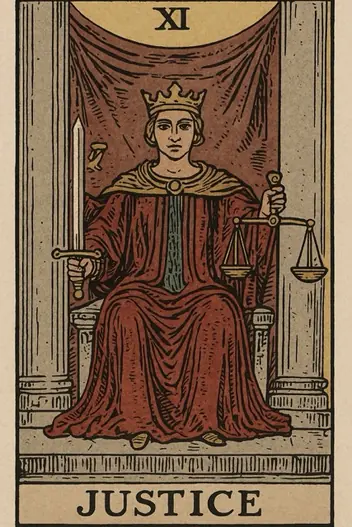

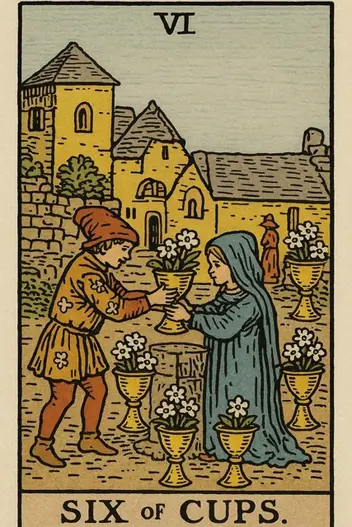
- Arcana
- Justice — Major Arcana; Six of Cups — Minor Arcana, Cups
- Elements
- Justice — Air; Six of Cups — Water
- Elemental interaction
- Neutral elements — energies coexist without conflict
- Numerology
- 11 + 6 = 17 → 8
When the archetype of Justice—representing truth, accountability, and cause-and-effect—meets the Six of Cups—symbolizing nostalgia, innocent generosity, and emotional bonds from the past—the result is a powerful psychological tension. This combination asks you to examine the fairness of your emotional history. Are you idealizing a past relationship, opportunity, or version of yourself? Or are you being called to settle an old debt—whether emotional, financial, or karmic—with clear eyes and a balanced heart?
In practical terms, this pairing suggests a decision point where emotional memory must be reconciled with objective reality. You cannot move forward without first acknowledging what was given, what was taken, and what is still owed—either to others or to yourself. The Six of Cups softens Justice’s cold logic, while Justice prevents the Six of Cups from slipping into sentimental fantasy. Together, they demand both compassion and clarity.
What Do Justice and Six of Cups Mean Together?
The core dynamic here is the intersection of emotional history and moral obligation. Psychologically, this combination activates what Jung called the "shadow of the past"—unresolved feelings of guilt, gratitude, or resentment that distort your current judgment. The Justice card forces you to see these feelings as data, not destiny. The Six of Cups reminds you that the data is human, not statistical.
When these energies merge, the mind tends to oscillate between two poles: over-romanticizing past choices (believing "it was all meant to be") or over-punishing yourself (believing you deserve to suffer for past mistakes). The healthy middle ground is compassionate accountability. You must ask: "What did I learn from that experience, and what do I owe—if anything—to the people involved or to my future self?"
The key strategic insight is that this combination rarely signals a fresh start. Instead, it signals a review—a chance to renegotiate the terms of an old agreement, whether with a person, a career path, or your own self-image. Do not rush to forgive or forget. Take time to audit the emotional ledger. Only then can you make a decision that is both fair and kind.
Love and Relationships
If you are single:
This combination suggests you may be comparing new potential partners to an idealized figure from your past. Objectively assess whether that past person was truly as good as you remember, or if nostalgia is clouding your judgment. A fair evaluation will prevent you from repeating old patterns.
If you are in a relationship:
You and your partner may be revisiting an old conflict or unresolved issue. This is a call to address the imbalance with honesty, not blame. Use "I" statements and focus on what is fair for both parties now, not what happened years ago.
In intimate relationships, Justice and Six of Cups often appear when one partner feels indebted to the other—perhaps for emotional support during a crisis, or for financial sacrifices made early in the relationship. This can create a subtle power imbalance where gratitude morphs into obligation. The healthiest path is to openly acknowledge the debt, then consciously release it. True love is not a transaction; it is a continuous, voluntary exchange. Boldly, the card pair warns against using past kindness as leverage in current arguments. That is emotional manipulation, not justice.
Your pair is already on the table. Ask your question and draw the clarifying card
or simply focus on it
What Do Justice and Six of Cups Indicate for Your Career?
Strategic Opportunities:
Reconnect with a former mentor, colleague, or client who treated you fairly in the past. They may offer a new opportunity that feels like a "second chance." Leverage the goodwill you earned honestly.
Strategic Opportunities:
Audit your current professional relationships. Are you giving more than you receive? This is the time to renegotiate a contract, ask for a raise, or set clearer boundaries with a team member who takes credit for your work.
Calculated Risks:
Avoid making a major financial decision based purely on nostalgia. Do not invest in a business or property simply because it reminds you of a happy time. Run the numbers objectively. Sentimentality is a poor substitute for due diligence.
In your career, this combination points to a decision that involves both emotional history and professional fairness. You may be offered a role similar to one you held before, or asked to collaborate with someone from your past. The key is to evaluate the offer based on current circumstances, not past emotions. Ask: "Is this fair to me now? Does this align with my present skills and goals?" If the answer is yes, proceed with gratitude. If no, decline with grace. Financially, be cautious of "deals" that feel too good to be true—the Six of Cups can make you overly trusting, while Justice demands you verify every detail.
Deepen your understanding
Find out exactly what this reading means for your current life situation with our oracle.
Justice and Six of Cups: Warning Signs
The shadow of this combination manifests as moral superiority or victimhood. You may believe you are the only one who has been fair in a past relationship, using your "good behavior" as a weapon to demand repayment. Conversely, you may feel perpetually indebted, unable to accept that you have already given enough. The cognitive bias here is "hindsight bias"—rewriting history to make yourself look either saintly or helpless. This blocks genuine resolution.
Another pitfall is using nostalgia to avoid present accountability. For example, you might refuse to confront a toxic family member because you remember "how good things used to be." This is self-sabotage disguised as loyalty. The Justice card demands that you see the full picture, not just the pleasant parts. If you are blocking your own growth by clinging to a past version of a person or situation, this combination is a wake-up call. Act now, or the imbalance will only deepen.
What If Justice or Six of Cups Appears Reversed?
When cards appear in a reversed position, the constructive dialogue between past and present is disrupted.
If Justice is reversed:
You are facing injustice or self-deception. In the past, you may have made a decision that now seems dishonest to you. Or you are trying to "force" reality to fit your version of events. Advice: Stop looking for someone to blame. Instead of proving you are right, acknowledge your share of responsibility. This will remove the block and allow you to move forward.
If the Six of Cups is reversed:
You are stuck in grievances or unable to let go of the past. Nostalgia turns into a toxic fixation. You may be idealizing the past or, conversely, devaluing it. Advice: Perform a "closure" ritual. Write a letter to your past self or to the person connected with these memories, and burn it. Your task is not to forget, but to stop being a hostage to memory.
If BOTH are reversed:
Complete imbalance: you are unjust to yourself and others, being attached to false memories. This is a victim state where "everyone is to blame, and I am suffering." A logical way to correct it: Bring all active actions to a complete halt. Take a pause for 3-7 days. During this time, record any of your thoughts about the past and question them: "Is this a fact or my interpretation?" Only after this should you begin making plans.
What Is the Overall Message of Justice and Six of Cups?
How can the energy of Justice be used constructively to balance the Six of Cups? The answer lies in creating an "emotional balance." The Six of Cups provides the raw material—memories, feelings, attachments. Justice provides the tool—logic, objectivity, the principle of equilibrium. Your strategic task is to transform nostalgia into a resource, not a shackle. Do not try to get rid of the past or ignore it. Instead, ask yourself: "What specific lesson can I extract from this situation and apply today?"
This requires mental discipline. You must learn to separate two things: the emotional value of a memory and its practical applicability. For example, you may cherish a friendship that has lasted 10 years (Six of Cups), but also objectively assess that this friend no longer shares your values and is holding you back (Justice). A deep strategic piece of advice: make a decision that will be honest towards your future 'Self,' not your past 'Self.' Ask yourself: "In a year, looking back on this choice, will I be proud of my honesty or regret my weakness?"
Practical Algorithm of Actions:
Inventory:
Make a list of 3-5 key "emotional contracts" (promises, debts, grievances, obligations) that you are still carrying.Audit:
Next to each item, write down what benefit (psychological or material) you gain by maintaining this contract. Be honest: perhaps it is beneficial for you to feel like a victim?Decision:
Choose one item and make a final decision regarding it: either you close it (forgive, repay the debt, sever the connection), or you renegotiate it on new, honest terms.
This synthesis bestows upon you clarity and strength. You cease to be a puppet of the past and become the architect of your present.
Applying This to Your Situation
The core message of Justice and Six of Cups is this: Honor your past, but do not let it dictate your future. Audit your emotional and practical debts with fairness, then release what no longer serves you. Whether in love, career, or self-growth, the healthiest path is one of compassionate accountability.
While this analysis provides a general framework, the true power of Tarot lies in its application to your unique situation. The Fortune Cards app allows you to input your specific question—about a relationship, a career move, or a personal dilemma—and receive a deep, personalized interpretation of this exact card combination, tailored to the context of your life right now. You can use it on the web or download it to your device. Stop guessing. Get your clear, actionable answer today.
Interpretation by the Fortune Cards editorial team, based on the Rider–Waite tradition and Jungian archetypes. About our methodology · Updated: 2026-08-26
Other Combinations with Justice
Other Combinations with Six of Cups
Explore Individual Card Meanings
Table of Contents
- What Do Justice and Six of Cups Mean Together?
- Love and Relationships
- What Do Justice and Six of Cups Indicate for Your Career?
- Justice and Six of Cups: Warning Signs
- What If Justice or Six of Cups Appears Reversed?
- What Is the Overall Message of Justice and Six of Cups?
- Applying This to Your Situation
Ready to find answers to your questions?
Start your first reading now and look at your situation with fresh clarity. The cards are ready to reveal deeper meaning.