King of Cups and Eight of Swords Tarot as Feelings
- Arcana
- King of Cups — Minor Arcana, Cups; Eight of Swords — Minor Arcana, Swords
- Elements
- King of Cups — Water; Eight of Swords — Air
- Elemental interaction
- Neutral elements — energies coexist without conflict
- Numerology
- 14 + 8 = 22 → 4
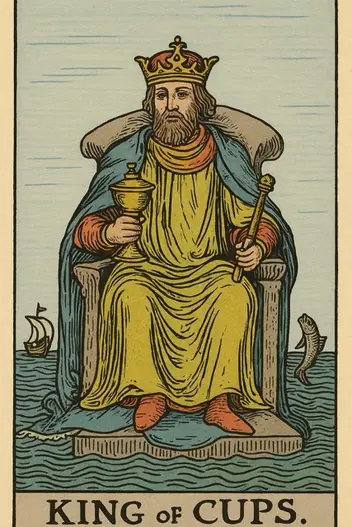
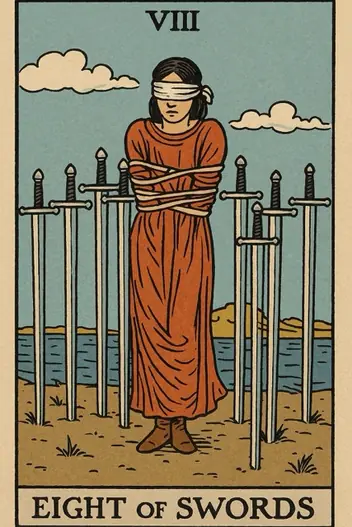
This card pairing presents a powerful psychological tension: the mastery of emotional intelligence colliding with the paralysis of self-imposed limitation. The King of Cups represents a state of calm authority over feelings—someone who navigates relationships with empathy, composure, and strategic emotional control. The Eight of Swords, by contrast, depicts a figure bound and blindfolded, surrounded by swords, symbolizing a mindset trapped by fear, overthinking, and perceived powerlessness.
When these archetypes intersect, the core question becomes: How can you wield your emotional wisdom to dismantle the mental barriers that hold you back? This is not a battle between external forces, but an internal negotiation between your highest emotional maturity and your deepest cognitive distortions. The solution lies in recognizing that the prison is largely perceptual, and the King’s calm insight is the key.
What Do King of Cups and Eight of Swords Mean Together?
The central dynamic here is the conflict between emotional control and cognitive restriction. The King of Cups offers a mature, grounded perspective—he sees emotions as data, not directives. He can sit with discomfort without being consumed by it. However, the Eight of Swords introduces a self-reinforcing loop of anxiety and victimhood. The seeker may feel trapped by their own thoughts, believing they have no options when, in reality, the barriers are largely mental constructs.
Psychologically, this combination often arises when a person has the emotional capacity to handle a situation but is being blocked by irrational fears or past trauma. The King’s energy is the antidote: he does not ignore the pain, but he refuses to let it dictate his actions. The practical implication is that the seeker must apply their emotional intelligence to identify which fears are real and which are imagined. This is a call for cognitive reframing—using the King’s detached awareness to observe the Eight’s drama without being swept away.
For those in leadership or caregiving roles, this pairing warns against over-functioning for others at the cost of your own clarity. You may be so focused on managing others’ emotions that you neglect to untangle your own mental knots. The key is to pause, breathe, and systematically question each assumption that feels like a wall. What feels like a trap is often just a pattern of thought you have not yet examined.
Career Meaning of King of Cups and Eight of Swords
Strategic Opportunities:
Leverage your emotional intelligence to lead a team through uncertainty. Your ability to stay calm under pressure can help others see solutions they missed.
Strategic Opportunities:
Use this period to audit your professional assumptions. Which career paths have you ruled out due to fear rather than facts? The King’s wisdom can help you re-evaluate.
Calculated Risks:
Avoid making major financial moves while feeling trapped or pressured. The Eight of Swords often precedes impulsive decisions born from panic rather than strategy. Wait for clarity before committing capital.
In the professional realm, this combination signals a crisis of confidence masked by competence. You may appear composed and capable (King of Cups), but internally feel stuck, undervalued, or unable to see a way forward (Eight of Swords). This is a common experience for high-performers who carry emotional labor for others but neglect their own strategic needs. The trap is believing that your emotional control means you have no problems.
Important financial warning:
Do not accept a role or deal that requires you to suppress your intuition in exchange for stability. The Eight of Swords can manifest as golden handcuffs—a comfortable prison where you feel you cannot leave despite being miserable. The King of Cups advises you to use your emotional data as a compass: if a situation consistently drains you, that is not weakness—it is information. Calculate the true cost of staying stuck and consider whether the perceived risks of change are actually smaller than the cost of inaction.
Your pair is already on the table. Ask your question and draw the clarifying card
or simply focus on it
King of Cups and Eight of Swords in Love Tarot
If you are single:
This combination suggests you may be emotionally ready for a mature connection, but self-doubt or past disappointments are creating invisible barriers. You are likely attracting partners who sense your depth, but your own fear of vulnerability keeps you at a distance. The King’s energy advises you to lead with calm honesty rather than guardedness.
If you are in a relationship:
A power dynamic may be emerging where one partner (likely the King) is emotionally stable, while the other feels trapped or misunderstood. The challenge is to avoid rescuing or controlling your partner; instead, foster open dialogue about their perceived limitations.
In relationship readings, this pair highlights a critical communication gap between emotional competence and emotional expression. The King of Cups represents a partner who can handle intense feelings without reacting—but the Eight of Swords suggests that the other person (or the seeker themselves) feels silenced, judged, or stuck in a narrative of helplessness. The danger is that the King’s composure may be mistaken for coldness, while the Eight’s anxiety is mistaken for weakness.
Key relationship advice:
Use your emotional intelligence to ask specific, open-ended questions rather than assuming you know your partner’s inner state. The blindfold in the Eight of Swords is not just about the person wearing it—it is also about your inability to see their true perspective. Break the cycle by naming the fear out loud without judgment. For example: “I sense you feel trapped by this situation. Let’s list what options we actually have, even the uncomfortable ones.” This turns abstract anxiety into actionable clarity.
Uncover hidden insights
Let our advanced Tarot system interpret these archetypes specifically for your personal path.
What If King of Cups or Eight of Swords Appears Reversed?
If the King of Cups is Reversed:
This points to emotional immaturity or manipulation. The person may use their empathy for control rather than support. Advice: Check if you are using "understanding" as an excuse for inaction or passive aggression.
If the Eight of Swords is Reversed:
This signals the beginning of liberation. Fear is still present, but you are starting to see a way out. Warning: Do not deceive yourself — you are still in the process, not at the finish line. Take action, but do not overestimate your strength.
If BOTH are Reversed:
Complete imbalance: emotional instability (reversed King) combined with an acute sense of powerlessness (reversed Eight). Strategy: External help is required — a coach, psychologist, or mentor. It is extremely difficult to break out of this cycle of self-sabotage and hysteria on your own.
Shadow Side & Pitfalls
The shadow of this pairing emerges when the King of Cups’ emotional mastery becomes emotional manipulation or repression. Rather than using his calm to heal, the seeker may use it to control others’ perceptions or to avoid their own vulnerability. The Eight of Swords then becomes a weapon of passive-aggression: “I’m fine, but you’re the one who’s trapped.” This creates a dynamic where one person plays the enlightened savior while the other is cast as the helpless victim.
A key cognitive bias here is the illusion of transparency—the belief that others can see our internal state when they cannot. The King may assume their partner should know they care, while the Eight’s person assumes their suffering is obvious. This leads to mutual frustration and misattunement. Another pitfall is analysis paralysis: the King’s reflective nature can spiral into overthinking, turning the Eight’s temporary confusion into a chronic state of indecision.
If you recognize yourself in this shadow, ask: Am I using my emotional control to avoid discomfort, or to navigate it wisely? The Eight of Swords is a warning that denial is not the same as mastery. True emotional intelligence requires facing the blindfolded parts of yourself, not just managing the feelings of others.
What Is the Overall Message of King of Cups and Eight of Swords?
Constructive use of this combination requires a paradoxical approach: you must apply the maturity of the King of Cups to analyze the fears of the Eight of Swords. The task is not to soothe the anxiety, but to understand its source. Use your emotional competence to separate real threats from irrational ones. Ask yourself: "If I were not afraid, what action would I take right now?" The answer to that question is your next step.
Strategically, you need to stop being "good" and start being effective. Your empathy is a tool for understanding the situation, not for avoiding discomfort. The Eight of Swords demands not sympathy, but courage. You must break the vicious cycle of thoughts with action. Even a small, imperfect step will shatter the illusion of complete blockage. Remember: you are not a victim of circumstances; you are a mature leader who has temporarily forgotten their own strength.
Applying This to Your Situation
The core message of King Of Cups and Eight Of Swords is this: Your emotional maturity is your greatest tool for cutting through the illusion of powerlessness. The prison you see is real in its effects, but it is built from thoughts, not walls. By applying calm, strategic self-awareness, you can identify which fears are valid warnings and which are outdated scripts. You have the capacity to lead yourself out of this mental maze—but only if you stop trying to escape and start examining the bars.
Want to apply this insight to your exact situation? While this article outlines the general archetype, the true power of Tarot lies in personal context. Your specific question, your unique history, and the surrounding cards change everything. The Fortune Cards app gives you a deep, personalized interpretation of this exact combination for your love life, career, or personal growth—right now. Use it on the web or download it to get the clarity you need to turn emotional wisdom into decisive action.
Interpretation by the Fortune Cards editorial team, based on the Rider–Waite tradition and Jungian archetypes. About our methodology · Updated: 2026-08-26
Other Combinations with King of Cups
Other Combinations with Eight of Swords
Explore Individual Card Meanings
Table of Contents
- What Do King of Cups and Eight of Swords Mean Together?
- Career Meaning of King of Cups and Eight of Swords
- King of Cups and Eight of Swords in Love Tarot
- What If King of Cups or Eight of Swords Appears Reversed?
- Shadow Side & Pitfalls
- What Is the Overall Message of King of Cups and Eight of Swords?
- Applying This to Your Situation
Ready to find answers to your questions?
Start your first reading now and look at your situation with fresh clarity. The cards are ready to reveal deeper meaning.