Knight of Cups and Nine of Swords Tarot Combination
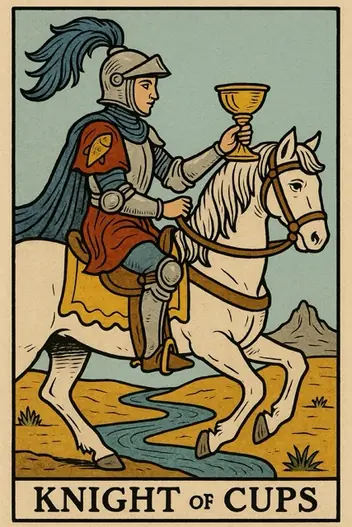
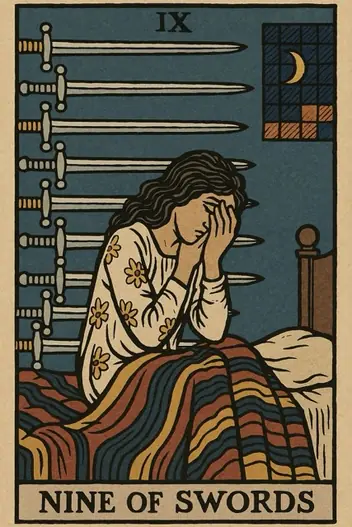
- Arcana
- Knight of Cups — Minor Arcana, Cups; Nine of Swords — Minor Arcana, Swords
- Elements
- Knight of Cups — Water; Nine of Swords — Air
- Elemental interaction
- Neutral elements — energies coexist without conflict
- Numerology
- 12 + 9 = 21 → 3
The Knight of Cups represents the archetype of the romantic idealist—driven by emotion, creative vision, and a desire to pursue what feels meaningful. The Nine of Swords, in stark contrast, embodies the nightmare of anxiety, guilt, and overthinking. When these two cards appear together, a fascinating psychological tension emerges: your deepest emotional aspirations are colliding with your worst fears.
In pragmatic terms, this combination signals a moment where high emotional investment triggers a spiral of catastrophic thinking. The Knight’s idealism can fuel the Nine’s anxiety, creating a feedback loop where your dreams become sources of dread. This is not a time for blind faith or reckless passion; it is a time for emotional regulation and reality-testing. Understanding how these archetypes interact is key to navigating the internal conflict they represent.
Knight of Cups and Nine of Swords Card Meaning Explained
At its psychological core, this pairing reveals a cognitive dissonance between what you desire and what you fear. The Knight of Cups brings forward a longing for connection, creative expression, or a meaningful pursuit—often with a sense of urgency and naivety. The Nine of Swords then superimposes a narrative of worst-case scenarios: rejection, failure, or betrayal. The result is a paralyzing state of emotional turmoil where the seeker feels torn between chasing a dream and retreating from imagined disaster.
This dynamic often manifests in real life as overthinking a romantic interest, obsessing over a creative project’s potential flaws, or second-guessing a career move driven by passion. The Knight’s energy is forward-moving but untethered; the Nine’s energy is inward-turning and self-critical. The key insight here is that the Nine of Swords is not a prophecy—it is a psychological projection. Your anxiety is not telling you the future; it is showing you your unresolved fears about vulnerability and worth. The strategic action is to separate the Knight’s genuine desire from the Nine’s distorted fears, using logic and external feedback to ground your next move.
Knight of Cups and Nine of Swords for Career and Money
Strategic Opportunities:
Channel your creative passion into a structured project—write a proposal, pitch an idea, or start a side venture that aligns with your values.
Strategic Opportunities:
Use your anxiety as a diagnostic tool—ask yourself what specific risk you’re avoiding, then create a contingency plan for it.
Calculated Risks:
Avoid making impulsive financial decisions based on emotional highs or lows. Do not invest in a “dream” venture without a solid business plan or professional advice.
Professionally, this combination warns against letting romanticism cloud your judgment. The Knight of Cups can inspire you to pursue a career that feels meaningful, but the Nine of Swords suggests you may be overwhelmed by self-doubt or fear of failure. The pragmatic approach is to break your goal into small, measurable steps. For example, if you want to start a creative business, first conduct market research or test your product with a small audience. Financially, be wary of “too good to be true” opportunities—the Knight’s optimism can blind you to red flags that the Nine’s anxiety is actually highlighting. Reframe your anxiety as a risk management signal, not a reason to quit. The most strategic move is to seek a mentor or advisor who can offer objective perspective.
Your pair is already on the table. Ask your question and draw the clarifying card
or simply focus on it
Knight of Cups and Nine of Swords Love Outcome
If you are single:
This pair suggests you may be idealizing a potential partner while simultaneously fearing rejection or disappointment. Evaluate the connection based on consistent actions, not your anxious fantasies.
If you are in a relationship:
You or your partner may be projecting past hurts onto the present, creating unnecessary drama. Focus on transparent communication to break the cycle of suspicion.
In relationships, the Knight of Cups and Nine of Swords together often indicate a power struggle between emotional expression and emotional suppression. One partner may be pursuing grand romantic gestures while the other is consumed by insecurities or unspoken resentments. The danger here is that the Knight’s overtures can trigger the Nine’s anxiety, leading to a dynamic where love feels like a battlefield. Practical advice: schedule a calm, neutral conversation to discuss fears without accusation. Use “I statements” to own your anxieties rather than projecting them. Boundaries are essential—do not let the Knight’s intensity overwhelm the Nine’s need for reassurance, and do not let the Nine’s fears extinguish the Knight’s genuine affection. The healthiest outcome requires both partners to acknowledge that their fears are not facts.
Negative Meaning of Knight of Cups and Nine of Swords
When the Knight of Cups and Nine of Swords operate in their shadow forms, the result is emotional self-sabotage and irrational decision-making. The Knight’s idealism can morph into codependency or obsession, where the seeker believes that a person or project will “save” them from their inner turmoil. The Nine’s anxiety then feeds this by creating catastrophic narratives that feel real. Common cognitive biases at play include confirmation bias (interpreting neutral events as proof of your worst fears) and catastrophizing (assuming the worst possible outcome is inevitable). The pitfall is acting on these distorted thoughts—sending an angry text, quitting a job impulsively, or making a dramatic ultimatum. To avoid this, implement a 24-hour rule before any major emotional decision. Ask yourself: “Is this action based on a fact or a fear?” Recognize that the shadow of this pair is a feedback loop of fantasy and fear—break the loop with reality checks.
Uncover hidden insights
Let our advanced Tarot system interpret these archetypes specifically for your personal path.
Knight of Cups and Nine of Swords Reversed: How to Read It
If the Knight of Cups is reversed:
Blocked emotional potential. The person either completely renounces the expression of feelings (becoming a cold cynic), or their "offer" is a manipulation. Advice: Stop waiting for someone to "save" you from your anxiety. Work on your emotional intelligence on your own.
If the Nine of Swords is reversed:
Resistance to acknowledging the problem. The anxiety is present, but the person denies it, "drowns it out" with food or activity. This is a dangerous state, as it can lead to psychosomatic issues. Warning: Ignoring an internal crisis does not make it any less real. Professional reflection or consultation is necessary.
If BOTH are reversed:
Complete imbalance and self-deception. The person may aggressively impose their "help" (unhealthy Knight), while simultaneously panicking over non-existent threats (unhealthy Nine). Logical course of correction: A complete halt to any external activity. An "information detox" and work on basic trust in the world are necessary.
Knight of Cups and Nine of Swords: Tarot Advice
Constructive use of this pair requires rigorous mental discipline. Your task is to use the energy of the Knight of Cups (inspiration, empathy, desire to act) as fuel to rationally overcome the fears of the Nine of Swords. Do not try to get rid of the anxiety—it is a signal that you have entered important territory for you.
Strategic algorithm of action: 1) Write your fear down on paper. Specify exactly what you are afraid of. 2) Ask yourself: "What is the worst that could happen?" and "What is the probability of that happening 100%?" 3) Take one small action from the state of the Knight of Cups that directly contradicts your fear. For example, if you are afraid your proposal will be rejected, make it. If you are afraid of failure, start the project.
Key insight: The Knight of Cups is not about "it will be good," but about "I am ready to offer." The Nine of Swords is not about "it will be bad," but about "I am afraid it will be bad." By separating these concepts, you will see that reality lies exactly in the middle. Your strength lies in the ability to act despite fear, not in waiting for the fear to disappear.
Where to Go From Here
The Knight of Cups and Nine of Swords together deliver a powerful message: your deepest desires are triggering your deepest fears, but neither defines your reality. The path forward requires you to acknowledge your emotions without letting them dictate your actions. Use logic to examine your fears, and use your passion to fuel disciplined effort—not impulsive escapes. This combination is a call to integrate heart and mind, not to choose one over the other.
While this analysis provides a solid framework for understanding these two archetypes, the true power of Tarot lies in its personal relevance. Your specific question, life circumstances, and emotional history will shape how these cards speak to you. For a deep, personalized interpretation of this exact combination right now, use the Fortune Cards app. Whether on the web or downloaded, it will apply these psychological insights directly to your unique situation, giving you actionable clarity. Don’t just read about the cards—let them guide your next step.
Interpretation by the Fortune Cards editorial team, based on the Rider–Waite tradition and Jungian archetypes. About our methodology · Updated: 2026-08-26
Other Combinations with Knight of Cups
Other Combinations with Nine of Swords
Explore Individual Card Meanings
Table of Contents
- Knight of Cups and Nine of Swords Card Meaning Explained
- Knight of Cups and Nine of Swords for Career and Money
- Knight of Cups and Nine of Swords Love Outcome
- Negative Meaning of Knight of Cups and Nine of Swords
- Knight of Cups and Nine of Swords Reversed: How to Read It
- Knight of Cups and Nine of Swords: Tarot Advice
- Where to Go From Here
Ready to find answers to your questions?
Start your first reading now and look at your situation with fresh clarity. The cards are ready to reveal deeper meaning.