Nine of Cups and Four of Swords Together in Tarot

- Arcana
- Nine of Cups — Minor Arcana, Cups; Four of Swords — Minor Arcana, Swords
- Elements
- Nine of Cups — Water; Four of Swords — Air
- Elemental interaction
- Neutral elements — energies coexist without conflict
- Numerology
- 9 + 4 = 13 → 4
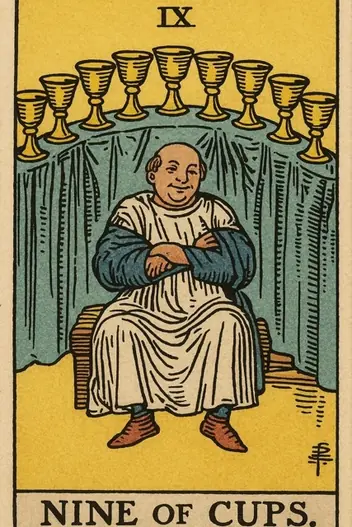
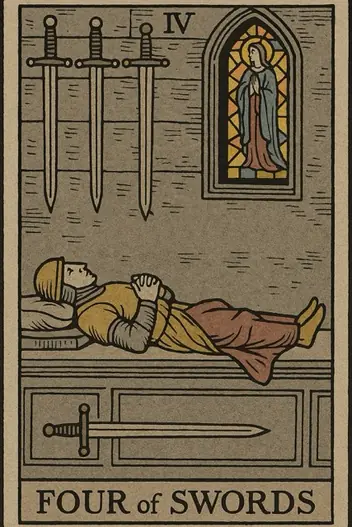
When the Nine of Cups—the card of emotional fulfillment, wish fulfillment, and self-satisfaction—meets the Four of Swords—the card of strategic rest, mental recovery, and deliberate withdrawal—a fascinating psychological tension emerges. This isn't a clash of opposites; it's a sophisticated negotiation between achievement and recovery.
The Nine of Cups represents a peak moment: a desire realized, a goal met, a deep sense of personal contentment. Yet the Four of Swords insists that the celebration must be followed by a pause. This pairing suggests that true satisfaction isn't just about getting what you want—it's about having the wisdom to rest and integrate that success before moving forward. In practical terms, this combination often appears when a client has worked hard, achieved a milestone, and now faces the counterintuitive challenge of not immediately chasing the next goal.
What Do Nine of Cups and Four of Swords Mean Together?
The core psychological dynamic here is the tension between external validation and internal recovery. The Nine of Cups is a public-facing card of personal pride—the feeling of having "made it" or being seen as successful. The Four of Swords, however, pulls the seeker inward, demanding solitude and mental rest. This creates a critical decision point: do you bask in the applause, or do you retreat to recharge?
In practical terms, this combination often signals a post-achievement slump that is actually a necessary recalibration. The mind, having pursued a goal with intensity, now needs to process the emotional and cognitive load. The strategic insight here is that rest is not laziness—it is the highest form of self-respect. If you ignore the Four of Swords' call for stillness, you risk turning your Nine of Cups satisfaction into burnout or hollow victory.
The shadow risk in this pairing is overconfidence or complacency. The Nine of Cups can make you feel invincible, while the Four of Swords might be misinterpreted as permission to stagnate. The healthy path is to celebrate your wins, then schedule a deliberate period of low-demand reflection—this is how you convert short-term pleasure into long-term wisdom.
Your pair is already on the table. Ask your question and draw the clarifying card
or simply focus on it
What Do Nine of Cups and Four of Swords Indicate for Your Career?
Strategic Opportunities:
This is an excellent time to review and document your recent successes for future leverage (resumes, portfolios, promotions). The rest period allows you to analyze what worked.
Strategic Opportunities:
Use this lull to renegotiate your terms—whether it's a salary adjustment, project scope, or work-life balance. Your recent success gives you leverage, but the Four of Swords ensures you don't overcommit.
Calculated Risks:
Avoid making major financial investments or career changes during this period. The Four of Swords indicates a need for mental clarity; decisions made while tired or overconfident can lead to costly errors.
In the professional realm, the Nine of Cups and Four of Swords combination is a strategic signal to pause after a win, not before a challenge. If you've just closed a deal, completed a project, or received a promotion, do not immediately pivot to the next high-stakes move. Instead, take 1-3 weeks to let the dust settle. This is a critical risk-management window: your ego (Nine of Cups) wants to prove you can do it again, but your cognitive resources (Four of Swords) need replenishment. Financially, this is a time for consolidation, not expansion. Pay down debt, build an emergency fund, or review your budget. The biggest financial warning is to resist the urge to "treat yourself" excessively—the Nine of Cups can tempt you into overspending on validation items that lose value quickly.
Deepen your understanding
Find out exactly what this reading means for your current life situation with our oracle.
Nine of Cups and Four of Swords in Love Tarot
If you are single:
This combination suggests you may be attracting partners who admire your success, but true connection requires you to show vulnerability, not just your achievements. Take a break from the dating scene to clarify what you actually want, not what you think you should want.
If you are in a relationship:
The Nine of Cups can indicate a period of mutual satisfaction, but the Four of Swords warns that one partner may be using "rest" as a way to avoid addressing unspoken tensions. Check if your contentment is shared or one-sided.
In relationships, this pairing often highlights a power dynamic in emotional availability. One partner (the Nine of Cups) may feel fulfilled and ready to celebrate, while the other (the Four of Swords) needs space to process. The key relationship advice here is to negotiate rest as a team. If you feel satisfied, ask your partner: "What do you need to feel safe enough to share in my joy?" Conversely, if you're the one withdrawing, communicate clearly that your need for solitude is not rejection—it's your way of recharging to be more present later. Avoid the trap of assuming that silence equals agreement. The Four of Swords can mask resentment if not paired with honest dialogue.
What Are the Risks of Nine of Cups and Four of Swords?
The shadow side of this combination emerges when the seeker confuses rest with resignation or satisfaction with stagnation. The Nine of Cups can trigger a cognitive bias called the "peak-end rule" —where you overvalue the current good feeling and ignore the need for future planning. Meanwhile, the Four of Swords, if misinterpreted, can become a rationalization for avoidance: "I'm just resting" can mask a fear of the next challenge.
A common pitfall is emotional numbing. The Nine of Cups' pleasure may be used to avoid the quiet, uncomfortable introspection the Four of Swords requires. This leads to a hollow satisfaction—you feel good on the surface but are disconnected from deeper needs. Self-sabotage can occur when you celebrate too publicly, inviting envy or unrealistic expectations from others, then retreat into isolation when the pressure mounts. The shadow solution is to schedule your rest intentionally—treat it as a non-negotiable appointment with yourself, not as an escape from responsibility.
Reversed Positions: What Changes?
Reversed cards complicate the dynamics, introducing elements of internal resistance and irrational behavior.
If the Nine of Cups is reversed:
Blocked Potential. You don't feel satisfaction from your achievements, even if they are objectively present. This could be a result of inflated expectations or imposter syndrome. Advice: stop seeking external approval and focus on an objective assessment of your results. Your need for rest (Four of Swords) is justified, but it should not turn into self-deprecation.
If the Four of Swords is reversed:
Internal Resistance to Rest. You refuse to take a pause, fearing that success (Nine of Cups) will vanish the moment you stop. This is a direct path to burnout. Warning: a reversed Four of Swords is a sign that your nervous system is at its limit. Ignoring this signal will lead to a sharp decline in productivity.
If BOTH are reversed:
Complete Imbalance and Exhaustion. You are simultaneously dissatisfied with the results (reversed Nine) and refusing to recover (reversed Four). This creates a vicious cycle: you work yourself to the bone but receive neither pleasure nor rest. A logical way to correct this: forcibly introduce a 24-hour "digital detox" regime and lower your expectations bar. First, restore your resources, then adjust your goals.
What Is the Overall Message of Nine of Cups and Four of Swords?
Constructive use of this combination requires a conscious cyclical approach. The energy of the Nine of Cups should become fuel for the strategic analysis of the Four of Swords. Instead of simply rejoicing in success, use the feeling of satisfaction as a resource for objective self-assessment. When you are content, you are less anxious and capable of seeing the whole picture without distorting it with fear.
Your strategic move is to formalize rest. The Four of Swords is not merely "doing nothing"; it is an active mental pause. Go for a walk without your phone, keep a journal to record insights that come in silence. Connect the "celebration" (Nine of Cups) with "reflection" (Four of Swords) by creating a ritual of summing up. For example, after receiving a bonus or praise, set aside an hour to write down which of your actions led to success and what could be improved.
The deep synthesis of these cards teaches us maturity in managing our lives. This is not about renouncing pleasures, but about integrating them into a long-term strategy. You can enjoy the moment while remaining the architect of your future. The key decision here is not to choose between joy and peace, but to learn to see them as two sides of the same coin.
Where to Go From Here
The core message of the Nine of Cups and Four of Swords is that fulfillment requires both celebration and stillness. You have earned your moment of satisfaction—now honor it by giving yourself permission to rest without guilt. This pause is not a step backward; it is the foundation for sustainable success. The key is to distinguish between healthy recovery and avoidance, and to communicate your needs clearly if you're in a relationship.
To truly understand how this combination applies to your specific life situation, you need a reading that considers your personal context—your exact question, your emotional state, and the other cards in your spread. Use the Fortune Cards app on the web or download it now to get a deep, personalized interpretation of the Nine of Cups and Four of Swords for your unique question. The general archetypes are powerful, but the real magic happens when Tarot meets your individual story.
Interpretation by the Fortune Cards editorial team, based on the Rider–Waite tradition and Jungian archetypes. About our methodology · Updated: 2026-08-26
Other Combinations with Nine of Cups
Other Combinations with Four of Swords
Explore Individual Card Meanings
Table of Contents
- What Do Nine of Cups and Four of Swords Mean Together?
- What Do Nine of Cups and Four of Swords Indicate for Your Career?
- Nine of Cups and Four of Swords in Love Tarot
- What Are the Risks of Nine of Cups and Four of Swords?
- Reversed Positions: What Changes?
- What Is the Overall Message of Nine of Cups and Four of Swords?
- Where to Go From Here
Ready to find answers to your questions?
Start your first reading now and look at your situation with fresh clarity. The cards are ready to reveal deeper meaning.