Love Tarot: Nine of Swords and Three of Pentacles
- Arcana
- Nine of Swords — Minor Arcana, Swords; Three of Pentacles — Minor Arcana, Pentacles
- Elements
- Nine of Swords — Air; Three of Pentacles — Earth
- Elemental interaction
- Opposing elements — energies create tension
- Numerology
- 9 + 3 = 12 → 3
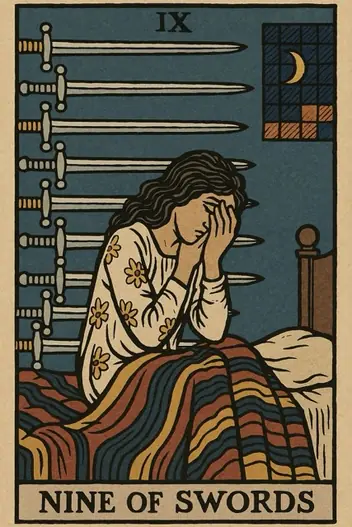
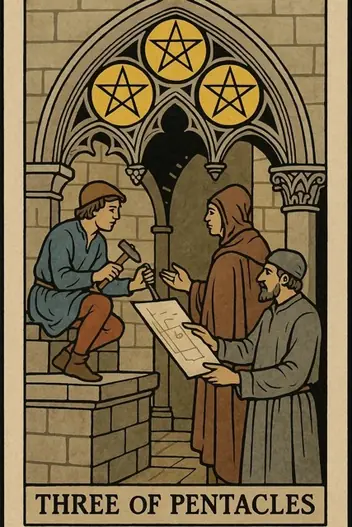
The intersection of the Nine of Swords and the Three of Pentacles reveals a psychological paradox: the mind’s obsession with worst-case scenarios clashing with the external demand for tangible, team-based output. The Nine of Swords represents the archetype of the "Nightmare" or the "Inner Critic"—a state of acute anxiety, self-doubt, and rumination over past mistakes. The Three of Pentacles embodies the "Apprentice" or "Craftsman"—a focus on skill development, teamwork, and mastering a craft through disciplined, practical effort.
When these cards appear together, they describe a person who is highly competent and detail-oriented, yet paralyzed by the fear of not being good enough. The seeker may be working diligently on a project or relationship, but their internal monologue is a loop of catastrophic predictions. The core dynamic is a conflict between the objective reality of progress (Three of Pentacles) and the subjective torment of perceived failure (Nine of Swords). The key is to recognize that the anxiety is a signal, not a verdict.
Core Dynamics & Interpretation
This pairing creates a powerful tension between internal pressure and external performance. The Nine of Swords amplifies the Three of Pentacles’ natural drive for quality into a relentless demand for perfection. The seeker may find themselves working longer hours, double-checking every detail, and losing sleep over minor errors that others would never notice. This is not laziness or lack of skill; it is a cognitive distortion known as "imposter syndrome"—the feeling that one’s competence is a fluke and that exposure is imminent.
The Three of Pentacles provides a grounding counterbalance. It asks the seeker to focus on the objective feedback loop of work and collaboration. Are you meeting deadlines? Is your team satisfied? Are you learning new skills? The answer is often "yes," but the Nine of Swords filters this reality through a lens of fear. The psychological work here is to separate facts from feelings. The anxiety (Nine of Swords) is real, but it does not necessarily reflect the quality of your work (Three of Pentacles). The strategic action is to use the anxiety as fuel for precision, not as evidence of inadequacy.
In practice, this combination often appears when someone is preparing for a presentation, audit, or review. The seeker has done the preparation (Three of Pentacles) but is now experiencing a crisis of confidence (Nine of Swords). The solution is not to stop worrying but to externalize the worry—ask a trusted colleague for feedback, review data objectively, or create a checklist of completed tasks. This shifts the focus from internal dread to external validation.
Your pair is already on the table. Ask your question and draw the clarifying card
or simply focus on it
What Do Nine of Swords and Three of Pentacles Say About Love?
If you are single:
This pair suggests you may be overanalyzing a new connection. Your fear of rejection or inadequacy is distorting your perception of a potential partner’s interest. Focus on concrete actions: Are they initiating conversations? Do they follow through on plans? Use factual evidence, not anxious speculation.
If you are in a relationship:
You or your partner may be withholding concerns to avoid conflict, leading to sleepless nights and emotional distance. The relationship requires a structured, honest conversation about expectations and fears, rather than silent suffering.
In relationships, the Nine of Swords and Three of Pentacles often signal a power imbalance in communication. One partner may be a "worrier" who internalizes every small issue, while the other focuses on practical tasks and shared goals. The danger is that the anxious partner will silently sabotage the relationship by assuming the worst without checking reality. The key relationship advice is to schedule a "check-in" conversation where both partners can discuss fears (Nine of Swords) and concrete relationship goals (Three of Pentacles) in a structured, non-accusatory way.
If you are the anxious partner, write down your specific fears and ask your partner to respond with facts. For example, "I worry you’re losing interest because you’ve been quiet this week." Their response—"I’ve been busy with a work deadline"—is the Three of Pentacles evidence that counters the Nine of Swords narrative. This card pair warns against emotional isolation; the solution is collaboration, not worry.
Uncover hidden insights
Let our advanced Tarot system interpret these archetypes specifically for your personal path.
Career and Finances
Strategic Opportunities:
Leverage your attention to detail for quality control roles or auditing tasks. Your anxiety can be a superpower if channeled into systematic review.
Strategic Opportunities:
Seek mentorship or structured feedback to break the cycle of self-doubt. A senior colleague can provide objective assessment of your progress.
Calculated Risks:
Avoid over-committing to perfection at the expense of deadlines. The cost of rework and lost sleep may outweigh the benefit of marginal quality improvements.
For career and finances, this combination is a red flag for burnout in high-stakes environments. The seeker may be in a role that demands both precision and speed—such as accounting, law, or project management—where the Nine of Swords’ anxiety is actually a functional response to real consequences. However, the Three of Pentacles reminds you that you are not alone. The card represents teamwork, apprenticeship, and shared responsibility. If you are micromanaging yourself out of fear, you are misusing the Three of Pentacles energy.
Financially, this pair warns against anxiety-driven decisions. You may be checking your bank account obsessively, worrying about hypothetical expenses, or avoiding necessary financial planning out of fear of bad news. The strategic move is to automate your finances (budgeting apps, automatic savings) to remove the emotional trigger. Focus on the tangible, collaborative aspects of your career—ask for a raise based on documented contributions, not on your perceived inadequacy. The biggest financial risk here is inaction driven by fear.
What Are the Risks of Nine of Swords and Three of Pentacles?
The shadow side of this combination is self-sabotage through overwork. The seeker may believe that if they just work harder, they can eliminate their anxiety. In reality, this creates a vicious cycle: the more they work, the more exhausted they become, and the more their inner critic amplifies their fears. Cognitive bias alert: the "availability heuristic"—the brain overestimates the likelihood of a feared outcome because the anxiety is so vivid and accessible. The seeker may ignore objective evidence of success (Three of Pentacles) because the nightmare (Nine of Swords) feels more real.
Another pitfall is perfectionism as a form of control. The seeker may refuse to delegate tasks or accept feedback, believing that only they can do the job "right." This alienates colleagues and partners, turning the Three of Pentacles’ collaborative energy into isolation. The shadow manifests as a martyr complex—"I must suffer for this work to be good." This is a cognitive distortion that leads to resentment and burnout. The antidote is to intentionally seek imperfection by testing a small, low-stakes task with a "good enough" standard and observing the outcome.
Finally, this pair can indicate a fear of visibility. The seeker may avoid presenting their work, asking for a promotion, or sharing their feelings because they anticipate criticism. This is the Nine of Swords’ "worst-case scenario" bias overriding the Three of Pentacles’ evidence of competence. The shadow lesson is that visibility is a skill, not a threat. Practice it in low-risk environments—share a draft with a trusted peer, or express a small concern to a partner—to build tolerance for the anxiety.
Reversed Positions: What Changes?
When the Nine of Swords is reversed, the sharpness of anxiety subsides, but the risk of reckless denial of the problem emerges. The person says "I don't care" or "I'll handle it," but in reality, they are simply repressing the fear. Advice: do not ignore the signals from your body (insomnia, tension), even if your mind insists everything is fine. Use the energy of the Three of Pentacles to create simple rituals of safety.
If the Three of Pentacles is reversed, it points to internal resistance to learning and collaboration. The person may sabotage teamwork out of fear of looking foolish (rooted in the Nine of Swords) or, conversely, refuse help in an attempt to prove their self-sufficiency. Warning: this is a path to burnout. You need to acknowledge that you are not required to know everything.
When BOTH cards are reversed, a complete imbalance arises: anxiety is suppressed, and skills remain unused. This is a state of apathy and professional stagnation. The person feels no fear, but also takes no action. A logical way to correct this: start with a small action that requires no evaluation. Do something with your hands (Three of Pentacles), even if it seems meaningless. This will break you out of the stupor.
Nine of Swords and Three of Pentacles Combined Message
Constructive use of this combination requires a strict separation of emotions and facts. The Nine of Swords is a signal, not a guide to action. It says: "You are afraid." The Three of Pentacles replies: "Okay, you're afraid. What's the first step we can take to reduce the risk?" Your task is not to fight the fear, but to act in spite of it, using fear as an indicator of the task's importance. If you're scared, it means this is a truly significant project.
The second strategic move is to break the task down. The Three of Pentacles teaches us that a masterpiece is built brick by brick. The Nine of Swords sees only the finished cathedral and panics, believing it cannot be built. The synthesis lies in adopting an iterative methodology: you don't have to do it perfectly the first time. You only have to do it better than yesterday. Adopt a "three attempts" rule: the first draft is terrible, the second is passable, the third is good. This will break the cycle of perfectionism.
Finally, use the energy of the Three of Pentacles to create an external structure. When the inner world is chaotic (Nine of Swords), outer order becomes an anchor. Schedules, checklists, team meetings, deadlines — all these are physical objects that are not subject to your anxiety. Trust the process, not your mood. A deep piece of advice: imagine you are a mentor to yourself. How would you calm and guide a frightened student? Do that for yourself.
Your Next Step: Personal Context Matters
The Nine of Swords and Three of Pentacles together deliver a clear message: your anxiety is not a sign of failure, but a signal that you are taking your work and relationships seriously. The challenge is to stop using worry as a substitute for action. Focus on tangible evidence of progress—completed tasks, positive feedback, shared goals—and treat your fears as hypotheses to be tested, not as truths to be obeyed. The path forward is collaborative, not solitary.
Want to know how this exact card combination applies to your specific question, relationship, or career decision? Download the Fortune Cards app or use it on the web for a deep, personalized Tarot reading. Our AI interprets these archetypes through your unique context—your situation, your goals, your shadow—giving you a practical, actionable roadmap. Don’t guess; get clarity. Try Fortune Cards now.
Interpretation by the Fortune Cards editorial team, based on the Rider–Waite tradition and Jungian archetypes. About our methodology · Updated: 2026-08-26
Other Combinations with Nine of Swords
Other Combinations with Three of Pentacles
Explore Individual Card Meanings
Table of Contents
- Core Dynamics & Interpretation
- What Do Nine of Swords and Three of Pentacles Say About Love?
- Career and Finances
- What Are the Risks of Nine of Swords and Three of Pentacles?
- Reversed Positions: What Changes?
- Nine of Swords and Three of Pentacles Combined Message
- Your Next Step: Personal Context Matters
Ready to find answers to your questions?
Start your first reading now and look at your situation with fresh clarity. The cards are ready to reveal deeper meaning.