Nine of Wands and Nine of Swords Together in Tarot
- Arcana
- Nine of Wands — Minor Arcana, Wands; Nine of Swords — Minor Arcana, Swords
- Elements
- Nine of Wands — Fire; Nine of Swords — Air
- Elemental interaction
- Friendly elements — energies support each other
- Numerology
- 9 + 9 = 18 → 9
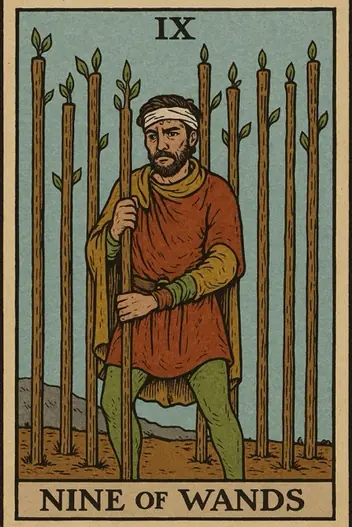
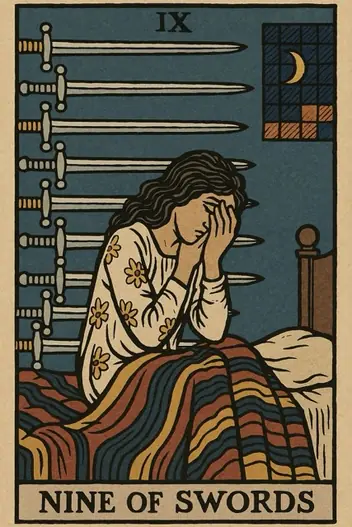
When the Nine of Wands—the card of defensive resilience, battle fatigue, and guarded boundaries—collides with the Nine of Swords—the card of anxiety, insomnia, and catastrophic thinking—the result is a high-stakes psychological state. This pairing represents a person who is physically and emotionally exhausted from defending their position, yet their mind refuses to rest, replaying worst-case scenarios on a loop.
In practical terms, this combination often appears when a seeker has been fighting a long battle (career conflict, relationship strain, personal project) and is now suffering from chronic vigilance. The body wants to rest, but the mind is stuck in hyper-arousal, scanning for threats that may or may not exist. The core dynamic is a feedback loop of self-protection and self-torment: the more you guard your boundaries, the more isolated and anxious you become.
What Do Nine of Wands and Nine of Swords Mean Together?
This pairing reveals a psychological paradox: the Nine of Wands demands constant readiness, while the Nine of Swords undermines that readiness with paralyzing doubt. The seeker is likely trapped in a "fight or flight" state that has become chronic. They are not in immediate danger, but their nervous system acts as if they are. Cognitive distortions—especially catastrophizing (imagining the worst outcome) and hypervigilance (over-identifying threats)—dominate their decision-making.
The archetypal shadow here is the Wounded Sentinel: someone who has been hurt before and now builds walls so high that they cannot see the help arriving. The Nine of Swords adds the inner critic's voice, whispering that the walls are not enough, that the enemy is already inside. This combination often signals burnout from over-responsibility—the seeker feels they must handle everything alone because no one else can be trusted.
The strategic insight is that this is a self-imposed prison. The seeker must distinguish between real threats (which the Nine of Wands is designed to handle) and imagined threats (which the Nine of Swords creates). The path forward requires breaking the cycle of rumination before it drains the last reserves of energy. Practical steps include setting strict "worry windows" (time-limited periods for anxiety), delegating tasks to rebuild trust, and creating a physical boundary between work and rest to signal safety to the nervous system.
Your pair is already on the table. Ask your question and draw the clarifying card
or simply focus on it
What Do Nine of Wands and Nine of Swords Indicate for Your Career?
Strategic Opportunities:
Audit your workload for non-essential tasks. The Nine of Wands often indicates you are holding onto responsibilities that could be delegated or eliminated. Freeing up mental bandwidth is your top priority.
Strategic Opportunities:
Use this hypervigilance as a quality control tool. If you are in a field requiring attention to detail (auditing, compliance, engineering), channel the anxiety into systematic checks rather than general worry.
Calculated Risks:
Avoid major financial decisions or career pivots. The combination of exhaustion and anxiety clouds judgment. Do not sign contracts, invest new capital, or quit your job until you have had at least 48 hours of genuine rest.
Professionally, this pairing often appears for managers, entrepreneurs, or frontline workers who have been "holding the line" during a crisis. The risk is decision fatigue: making impulsive choices to escape the anxiety rather than to advance strategically. The pragmatic path is to create a decision matrix: list your options, assign weights to pros and cons, and wait 24 hours before acting. This forces the rational mind (not the anxious mind) to lead.
Financially, the Nine of Swords can indicate money anxiety that is disproportionate to actual risk. Check your bank statements and budget objectively before assuming a crisis. The Nine of Wands suggests you have more resources than you think—you just need to access them without panic. Bold financial warning: Do not borrow money to solve a cash flow problem right now. The anxiety will compound the debt.
Ask your specific question
Don't rely on generic meanings. Get a customized reading tailored specifically to your energies.
What Do Nine of Wands and Nine of Swords Say About Love?
If you are single:
This combination suggests you are evaluating potential partners through a lens of past wounds. You may be projecting fears from previous relationships onto new connections, causing you to withdraw prematurely. Ask yourself: Am I protecting myself from a real risk, or from a memory?
If you are in a relationship:
The energy here points to one partner feeling besieged and unsupported, while the other feels shut out. There is a risk of emotional stonewalling—one person retreats into silence (Nine of Wands), while the other spirals into anxiety about the relationship's future (Nine of Swords).
The core relationship dynamic is a mutual reinforcement of fear. The guarded partner's defensiveness triggers the anxious partner's catastrophic thoughts, which in turn makes the guarded partner feel even more attacked. The key intervention is to break this cycle with explicit, low-stakes communication. Use "I" statements to express needs without accusation: "I feel overwhelmed and need space to regroup, but I will check in with you in two hours." This provides structure for the Nine of Wands partner and reassurance for the Nine of Swords partner.
Bold advice: Do not make permanent decisions about the relationship during this period. Both cards indicate temporary states of heightened stress, not permanent truths. Schedule a neutral time—after a good night's sleep and a meal—to discuss the relationship's future. Prioritize emotional safety over being "right."
Shadow Side & Pitfalls
The shadow manifestation of this combination is paralytic paranoia. The seeker becomes so consumed by potential threats that they stop taking actual action. Cognitive biases in play include confirmation bias (seeking evidence that reinforces the fear) and negativity bias (over-weighting negative possibilities over positive ones). This can lead to self-sabotage through inaction—missing opportunities because the mind was too busy preparing for disaster.
Another common pitfall is martyrdom: the seeker unconsciously identifies as the "wounded hero" who must suffer alone. This narrative is seductive because it provides a sense of purpose, but it prevents genuine support from arriving. The shadow asks: Are you protecting yourself, or are you protecting your story of being the victim? The answer often reveals that the greatest threat is not external, but the internal commitment to suffering.
Reversed Positions: What Changes?
When the Nine of Wands is reversed:
Defense becomes reckless attack. You are not just defending—you are striking first, creating conflicts out of thin air. Key warning: your aggression is a mask for fear. Before acting, ask yourself: "Am I defending or attacking?"
When the Nine of Swords is reversed:
Anxiety internalizes into passive resistance. You don't scream about fear, but it paralyzes you from within. Advice: start with micro-actions. Even 5 minutes of work on the problem will break the cycle of helplessness.
When BOTH are reversed:
Complete imbalance—paranoia without action. You are simultaneously afraid and unable to defend yourself. This is a state of deep vulnerability. How to fix it: return to basic needs (sleep, food, safety). Any strategy is useless until you stabilize your physiology.
What Is the Overall Message of Nine of Wands and Nine of Swords?
Constructive use of this dynamic requires conscious separation of functions. The Nine of Wands is your guardian, who must protect not your fears, but your resources and boundaries. The Nine of Swords is your scout, who can foresee dangers but must not govern your decisions.
The strategic algorithm for action is as follows: Facts first, then feelings. Write down all your fears on paper. Then, next to each one, write objective evidence of its probability. In 80% of cases, you will see that the anxiety is not supported by reality. The remaining 20% is the zone for genuine protection.
Key insight:
Your strength lies not in withstanding the blow, but in stopping the expectation of a blow. Shift from a defensive mode to a developmental mode. Use the vigilance of the Nine of Wands to build systems, and the energy of the Nine of Swords for strategic planning, not for self-torment.
Remember: you are not obligated to carry the weight of all possible catastrophes. Your task is to carry only what truly rests on your shoulders. By clearing the space of imagined threats, you will gain the energy for real action.
Applying This to Your Situation
The Nine of Wands and Nine of Swords together deliver a clear message: Your defenses are draining you, and your mind is exaggerating the danger. The core task is to distinguish between prudent caution and paralyzing fear. You have survived the battle; now you must learn to rest without guilt and trust without naivety. The solution is not to lower all walls, but to install a gate—one you can open when help arrives.
The true power of Tarot lies not in general archetypes, but in how they intersect with your specific life. To get a deep, personalized interpretation of this exact combination for your unique situation—your relationship, your career, your question—use the Fortune Cards app. Available on the web or as a download, it provides a tailored reading that considers your context, not just the card meanings. Stop guessing. Start acting with clarity. Try Fortune Cards now.
Interpretation by the Fortune Cards editorial team, based on the Rider–Waite tradition and Jungian archetypes. About our methodology · Updated: 2026-08-26
Other Combinations with Nine of Wands
Other Combinations with Nine of Swords
Explore Individual Card Meanings
Table of Contents
- What Do Nine of Wands and Nine of Swords Mean Together?
- What Do Nine of Wands and Nine of Swords Indicate for Your Career?
- What Do Nine of Wands and Nine of Swords Say About Love?
- Shadow Side & Pitfalls
- Reversed Positions: What Changes?
- What Is the Overall Message of Nine of Wands and Nine of Swords?
- Applying This to Your Situation
Ready to find answers to your questions?
Start your first reading now and look at your situation with fresh clarity. The cards are ready to reveal deeper meaning.