Page of Cups and Three of Swords Reversed in Tarot
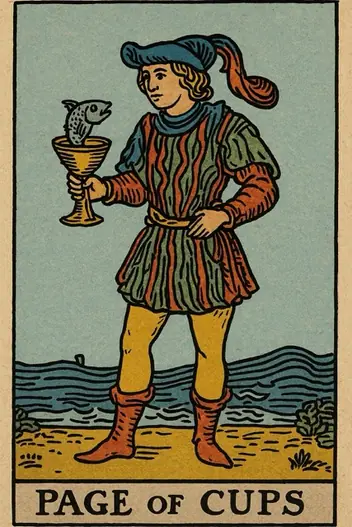
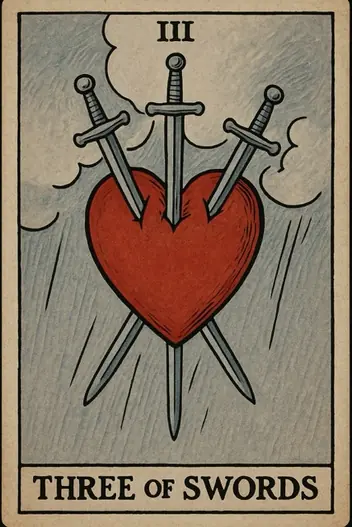
- Arcana
- Page of Cups — Minor Arcana, Cups; Three of Swords — Minor Arcana, Swords
- Elements
- Page of Cups — Water; Three of Swords — Air
- Elemental interaction
- Neutral elements — energies coexist without conflict
- Numerology
- 11 + 3 = 14 → 5
This combination reveals a psychological collision between raw emotional vulnerability and cognitive dissonance. The Page of Cups represents a nascent, unguarded emotional impulse—a desire to connect, express, or create from a place of innocence. The Three of Swords, however, introduces a sharp, painful truth: betrayal, heartbreak, or a reality check that shatters that emotional openness. When these two archetypes meet, the central question becomes: Can you process emotional pain without retreating into cynicism, or will the wound distort your capacity for authentic expression?
The strategic intersection here is about emotional risk management. The Page of Cups energy wants to trust, to offer an olive branch, or to explore a creative idea. The Three of Swords warns that this trust may be met with rejection, deceit, or a painful lesson. This is not a warning to avoid vulnerability—it is a call to refine your emotional intelligence by distinguishing between healthy openness and naive exposure. The pragmatic task is to hold your heart's impulse while examining the evidence of past hurts.
Page of Cups and Three of Swords: How These Energies Interact
The core dynamic is a psychological tug-of-war between emotional expression and intellectual analysis of pain. The Page of Cups embodies the anima/animus in its early, unintegrated stage—raw feeling without filter. The Three of Swords represents the shadow of rationalization, where the mind cuts through emotion with cold logic to protect itself. Together, they create a state of conflicted vulnerability: you feel the urge to express something tender, but your mind keeps replaying the moment you got hurt.
In real-world terms, this often manifests as second-guessing your creative or romantic impulses. You might have a brilliant idea or a genuine compliment to share, but a voice inside says, “Don’t bother—they’ll just criticize you.” Alternatively, you may be holding onto a wound as an identity, using past pain to justify emotional withdrawal. The key psychological insight is that the Three of Swords pain is not the enemy of the Page of Cups’ creativity—it is the raw material for it. The most sophisticated response is to acknowledge the hurt without letting it define your next move. This requires a cognitive reframe: the pain is data about what didn’t work, not a prophecy of future failure.
Your pair is already on the table. Ask your question and draw the clarifying card
or simply focus on it
Page of Cups and Three of Swords for Career and Money
Strategic Opportunities:
Use emotional intelligence as a competitive advantage—your ability to sense team morale or client sentiment can uncover hidden needs. Consider creative roles that involve storytelling or brand narrative, where vulnerability becomes a strength.
Strategic Opportunities:
Leverage past professional disappointments as case studies for what not to repeat. Document lessons learned from failed projects; this turns pain into process.
Calculated Risks:
Avoid making financial decisions based on emotional impulse or guilt. Do not invest in a venture solely because it “feels right” or because someone appeals to your sympathy. Objectively verify numbers and contracts.
In professional life, this card pair often signals a project or partnership that carries emotional baggage. You may be tempted to take on a role because it feels like redemption, or to avoid a necessary confrontation because you fear conflict. The strategic move is to separate your emotional narrative from the objective facts of the deal. For example, if you’re negotiating a contract and feel the pull to concede because you don’t want to “hurt feelings,” pause and ask: “What is the data saying?” Financially, the Three of Swords warns against “bleeding heart” investments—don’t lend money to friends or family without a clear, written agreement. The Page of Cups’ creativity is best applied to brainstorming solutions, not to funding emotional debts.
Deepen your understanding
Find out exactly what this reading means for your current life situation with our oracle.
Page of Cups and Three of Swords in Love and Relationships
If you are single:
This pair suggests you may be attracted to emotionally unavailable or wounded partners, mistaking their pain for depth. Objectively evaluate whether your desire to “heal” them is a projection of your own unprocessed hurt.
If you are in a relationship:
You or your partner may be using past betrayals as a shield against intimacy. The conflict is not about the present situation but about unresolved grief from previous chapters.
The relationship dynamics here demand emotional honesty without self-flagellation. The Page of Cups wants to offer love, but the Three of Swords whispers that love is dangerous. The healthiest path is to name the specific fear (e.g., “I’m afraid you’ll leave like my ex did”) rather than acting it out through passive-aggression or withdrawal. Boundaries are critical: you can be open without being a doormat. Ask yourself: Am I staying in this dynamic because of genuine connection, or because I’m trying to rewrite a past failure? The bold relationship advice is to schedule a “reality check” conversation—not to accuse, but to align expectations and clarify what each person can actually give right now.
When Page of Cups and Three of Swords Signal Trouble
The shadow side of this combination is emotional martyrdom—using past pain to justify present avoidance. The Page of Cups’ vulnerability can turn into manipulative helplessness, where you play the victim to gain sympathy or avoid responsibility. The Three of Swords’ pain can become chronic cynicism, where you preemptively reject any new opportunity because “it will only hurt again.” This is a cognitive bias known as overgeneralization: one betrayal becomes proof that all trust is foolish.
Another pitfall is splitting—seeing yourself as the pure, wounded innocent (Page of Cups) and others as the cruel aggressors (Three of Swords). In reality, you may be unconsciously repeating patterns that invite rejection. The shadow asks: Are you holding onto this pain because it gives you a sense of identity? Self-sabotage here looks like starting a creative project only to abandon it the moment criticism arises, or entering a relationship only to sabotage it with accusations of betrayal. The most dangerous move is to act out the wound without reflecting on your own role in its creation.
Page of Cups and Three of Swords Reversed: How to Read It
If the Page of Cups is Reversed:
The potential for sincerity is blocked. The person is either suppressing their feelings or using them manipulatively. Instead of the pain of truth (Three of Swords), you get a protracted conflict stemming from unspoken grievances. Advice: Stop playing the victim. If you cannot speak honestly, remain silent, but do not resort to passive aggression.
If the Three of Swords is Reversed:
The pain is denied or postponed. This is an internal resistance to healing. You know the truth but do not want to see it. Warning: This is a path to chronic stress and psychosomatic issues. You must give yourself permission for a "ritual of farewell" to the illusion.
If BOTH are Reversed:
Complete imbalance. Emotional deafness combines with an inability to process loss. The situation stagnates. The logical way to correct this: External intervention is required—consultation with a psychologist or mentor. Breaking this cycle of self-sabotage alone is nearly impossible.
Page of Cups and Three of Swords: Tarot Advice
How can the energy of the Page of Cups be used constructively to balance the Three of Swords? The answer is paradoxical: you must accept the pain as the price for clarity. The Page of Cups is your capacity for empathy and creativity. Do not kill it within yourself after disappointment. Instead, redirect it from the external world (toward another person) to the internal world (toward yourself).
Your task is to transform the "wound" of the Three of Swords into a surgical instrument. Use the painful information you have received to cut away toxic connections, illusory projects, and immature behavioral patterns. A deep strategic piece of advice: Become the "Page of Cups" for yourself. Show the same tenderness and openness toward your own feelings that you so generously offered to others. Ask yourself: "What truth about myself am I refusing to see?" The answer to that question is the very Three of Swords that will bring you not destruction, but liberation.
Applying This to Your Situation
The core message of Page Of Cups and Three Of Swords is this: Your emotional wounds are not obstacles to your creativity—they are the raw clay you must shape. You cannot bypass the pain, but you can choose to process it rather than repeat it. The path forward requires courageous vulnerability: to feel the hurt without letting it dictate your future, and to express your heart’s impulse without abandoning your discernment.
Get a truly personalized reading for this exact card combination based on your specific question. The Fortune Cards app uses advanced AI to analyze your unique context—your love life, career crossroads, or personal growth challenge—and delivers a detailed, practical interpretation in seconds. Stop guessing and start acting with clarity. Use the app on the web or download it now to unlock the specific guidance these cards hold for you today.
Interpretation by the Fortune Cards editorial team, based on the Rider–Waite tradition and Jungian archetypes. About our methodology · Updated: 2026-08-26
Other Combinations with Page of Cups
Other Combinations with Three of Swords
Explore Individual Card Meanings
Table of Contents
- Page of Cups and Three of Swords: How These Energies Interact
- Page of Cups and Three of Swords for Career and Money
- Page of Cups and Three of Swords in Love and Relationships
- When Page of Cups and Three of Swords Signal Trouble
- Page of Cups and Three of Swords Reversed: How to Read It
- Page of Cups and Three of Swords: Tarot Advice
- Applying This to Your Situation
Ready to find answers to your questions?
Start your first reading now and look at your situation with fresh clarity. The cards are ready to reveal deeper meaning.