Page of Wands and Five of Swords Reversed in Tarot
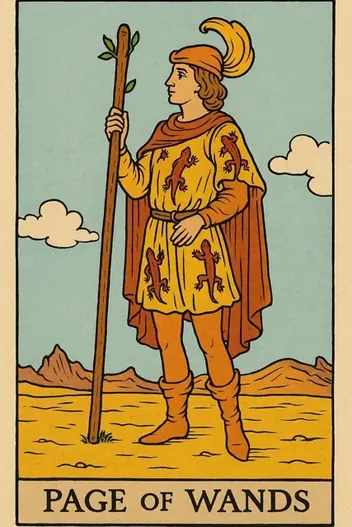

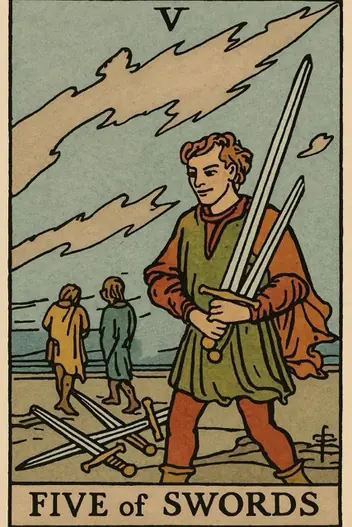
- Arcana
- Page of Wands — Minor Arcana, Wands; Five of Swords — Minor Arcana, Swords
- Elements
- Page of Wands — Fire; Five of Swords — Air
- Elemental interaction
- Friendly elements — energies support each other
- Numerology
- 11 + 5 = 16 → 7
When the Page of Wands—a card of raw enthusiasm, new ideas, and bold experimentation—collides with the Five of Swords—a card of tense victory, hollow wins, and interpersonal conflict—you get a psychological cocktail of unchecked ambition meeting a harsh reality check. This pairing often signals a moment where your eagerness to prove yourself leads you into a battle you weren’t fully prepared for, or where your innovative spark is tested by competitive, even hostile, forces.
The core dynamic here is initiative versus antagonism. The Page of Wands represents the spark of a new project, a creative urge, or a desire to explore uncharted territory. The Five of Swords, however, warns that this path may force you into a zero-sum game where someone—possibly you—ends up feeling defeated. Psychologically, this combination asks: Are you fighting for a cause you truly believe in, or are you just fighting to win? The answer determines whether this pairing leads to growth or burnout.
Page of Wands and Five of Swords Together: Meaning
The psychological state created by the Page of Wands and Five of Wands is one of high energy mixed with defensive aggression. You feel a strong urge to act, to start something new, or to assert your vision. However, you may also perceive others as obstacles or competitors, leading you to approach situations with a win-at-all-costs mentality. This can be productive in high-stakes environments, but it risks alienating allies and burning bridges.
The key insight here is the difference between passion and pettiness. The Page of Wands brings genuine curiosity and drive; the Five of Swords brings the shadow of ego and resentment. When combined, you must ask yourself if your excitement is about the idea itself or about proving you are right. If the latter, you may win the argument but lose the opportunity. In real-world terms, this could look like pitching a brilliant new concept to a team but doing so in a way that triggers defensive reactions, leaving you isolated with your "victory."
Strategic self-awareness is your best tool. Recognize that your enthusiasm can be misinterpreted as arrogance or recklessness. The Five of Swords suggests that others may be triggered by your forward energy, leading to unnecessary conflict. The pragmatic path is to channel your fire into diplomacy—present your ideas with confidence, but also with a willingness to listen and adapt. This pairing rewards those who can balance boldness with emotional intelligence, turning potential battles into productive negotiations.
Page of Wands and Five of Swords: Career and Money
Strategic Opportunities:
Use your competitive drive to launch a new initiative—your enthusiasm can cut through bureaucracy if you present it as a solution to a shared problem.
Strategic Opportunities:
Leverage your fresh perspective to challenge outdated processes—but do so with data and respect, not arrogance.
Calculated Risks:
Avoid public confrontations or "winning" at the expense of a colleague. A short-term victory could damage your reputation and future collaboration.
In the professional realm, this card combination signals a high-risk, high-reward scenario where your ambition is both your greatest asset and your biggest liability. You may be tempted to take on a project that pits you against a rival, or you might be entering a negotiation where the other party is openly hostile. The pragmatic approach is to treat every interaction as a strategic chess move, not a personal vendetta.
A critical financial warning: do not overcommit resources to prove a point. The Five of Swords warns against "throwing good money after bad" just to save face. If you are launching a new business venture or pitching a project, ensure your budget and timeline are realistic. Boldly protect your financial reserves; the Page of Wands' optimism can blind you to the Five of Swords' hidden costs. Instead of competing on price or ego, compete on value and unique positioning. This pairing rewards those who can channel their competitive energy into strategic differentiation, not destructive rivalry.
Your pair is already on the table. Ask your question and draw the clarifying card
or simply focus on it
Page of Wands and Five of Swords as Feelings
If you are single:
This pairing suggests you may be drawn to someone who seems exciting or challenging, but the dynamic could quickly become competitive. Avoid turning dating into a power struggle; focus on mutual curiosity rather than "winning" their attention.
If you are in a relationship:
You or your partner may be pushing for a new direction (e.g., travel, a shared hobby, or a lifestyle change) but doing so in a way that feels like a confrontation. Boldly address the underlying need for autonomy or excitement, not the surface-level argument.
In relationships, the Page of Wands and Five of Wands combination often reveals a clash between personal growth and relational harmony. One partner may feel stifled and want to explore new experiences, while the other perceives this as a threat or a critique of their shared life. The psychological dynamic is one of self-assertion versus fear of abandonment.
The key relationship advice is to separate the message from the messenger. The Page of Wands' desire for novelty is valid; the Five of Swords' tendency toward conflict is a symptom of poor communication. Instead of fighting about what you want to do, discuss why you want to do it. Use "I" statements to express your enthusiasm without implying your partner is holding you back. For example, "I feel excited about this new hobby and would love your support" is far more effective than "You never let me do anything new." This approach transforms a potential battle into a collaborative exploration of shared values and boundaries.
Uncover hidden insights
Let our advanced Tarot system interpret these archetypes specifically for your personal path.
Page of Wands and Five of Swords Reversed Meaning
Page of Wands Reversed:
Enthusiasm is blocked by fear or laziness. You want to start, but you are afraid of failure. In combination with the upright Five of Swords, this creates a paralysis of will — you see a threat (a competitor, a critic), but cannot respond to it. Advice: start with a small action to break the cycle of fear.
Five of Swords Reversed:
Aggression retreats into the shadow. You are not fighting openly, but inside you feel bitterness and a desire for revenge. Warning: suppressed hostility destroys from within. You need to release the negativity in an ecological way — through sports, writing practices, or a conversation with a psychologist.
Both Reversed:
Complete imbalance. You simultaneously want to act (Page), but fear the consequences (Five). This is a state of learned helplessness. The way out is to shift the focus from "who is to blame" to "what to do." Advice: take a 24-hour break from any decisions to reduce anxiety.
Negative Meaning of Page of Wands and Five of Swords
The shadow side of the Page of Wands and Five of Swords is the impulsive warrior—someone who acts before thinking, then doubles down when challenged. This manifests as cognitive biases like the Dunning-Kruger effect (overestimating your competence in a new area) or confirmation bias (only seeing evidence that supports your aggressive approach). You may find yourself in a cycle of starting fights, winning minor victories, but losing long-term trust and support.
Self-sabotage often arises from a fear of being seen as weak. The Page of Wands' natural vulnerability (inexperience, naivety) is overcompensated by the Five of Swords' defensive posturing. This can lead to burning bridges unnecessarily or making enemies out of potential mentors. The psychological trap is believing that assertiveness equals aggression, when in reality, true strength lies in knowing when to hold back. If you notice yourself feeling "right" but also isolated, you are likely caught in this shadow dynamic.
Page of Wands and Five of Swords: Tarot Advice
How can the energy of the Page of Wands be used constructively to balance the Five of Swords? The answer lies in shifting focus from the external enemy to the internal goal. The Page of Wands is about the future, about potential. The Five of Swords is about the past, about grievances and wounds. Your task is not to allow past experience (betrayal, competition) to kill your ability to dream and take risks.
Strategically, you need to "domesticate the swords". Instead of using them for attack, transform them into a tool for analysis. Ask yourself: "Where is my energy going toward struggle rather than creation?" The deep strategic advice: create a "buffer zone" between impulse and action. When you feel the urge to enter an argument or prove yourself right, pause for 10 minutes. During this time, write down three possible scenarios for how events might unfold. In 90% of cases, you will realize the conflict is unnecessary and that your energy is better directed toward real action.
This combination of cards is a test of your psychological maturity. It asks: "Are you capable of keeping the fire in your chest without burning those around you?" The answer is yes, if you learn to separate your ambitions from your ego. Ambitions build empires. The ego destroys them. Choose wisely.
Your Next Step: Personal Context Matters
The Page of Wands and Five of Swords combination is a powerful call to align your enthusiasm with strategic restraint. The core message is: Your fire is valuable, but it must be tempered by emotional intelligence and a clear-eyed assessment of the costs of conflict. This pairing does not ask you to dim your light, but rather to direct it wisely, avoiding battles that drain your energy for hollow wins.
For a truly transformative reading, context is everything. The Fortitude Cards app can provide a personalized interpretation of this exact combination based on your specific question, whether it's about a relationship, a career move, or a personal challenge. Use it on the web or download it today to uncover the unique psychological patterns and strategic advice tailored to your situation. Your journey of self-discovery deserves precision, not guesswork.
Interpretation by the Fortune Cards editorial team, based on the Rider–Waite tradition and Jungian archetypes. About our methodology · Updated: 2026-10-15
Other Combinations with Page of Wands
Other Combinations with Five of Swords
Explore Individual Card Meanings
Table of Contents
- Page of Wands and Five of Swords Together: Meaning
- Page of Wands and Five of Swords: Career and Money
- Page of Wands and Five of Swords as Feelings
- Page of Wands and Five of Swords Reversed Meaning
- Negative Meaning of Page of Wands and Five of Swords
- Page of Wands and Five of Swords: Tarot Advice
- Your Next Step: Personal Context Matters
Ready to find answers to your questions?
Start your first reading now and look at your situation with fresh clarity. The cards are ready to reveal deeper meaning.