Seven of Wands and Ten of Pentacles Reversed in Tarot
- Arcana
- Seven of Wands — Minor Arcana, Wands; Ten of Pentacles — Minor Arcana, Pentacles
- Elements
- Seven of Wands — Fire; Ten of Pentacles — Earth
- Elemental interaction
- Neutral elements — energies coexist without conflict
- Numerology
- 7 + 10 = 17 → 8
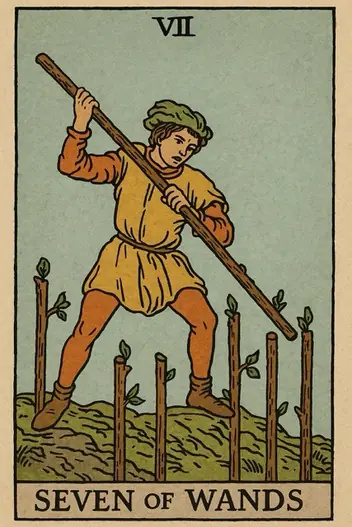
When the defensive resilience of the Seven of Wands meets the structural stability of the Ten of Pentacles, we encounter a psychological tension between protecting what you've built and the fear of losing it. This combination often surfaces when a person is fighting to maintain their position within a established system—whether a family business, a long-term career, or a committed relationship. The core conflict is not about starting something new, but about holding the line against external threats to your hard-won security.
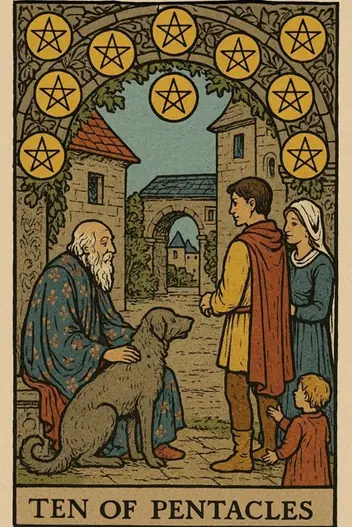
The Seven of Wands archetype represents the underdog defending higher ground, while the Ten of Pentacles embodies the patriarchal inheritance—wealth, tradition, and generational continuity. Together, they create a scenario where you must actively defend your place in a legacy you did not fully create but now must steward. The psychological challenge is to distinguish between legitimate defense and paranoid gatekeeping, ensuring you are fighting for what matters rather than merely protecting ego.
Seven of Wands and Ten of Pentacles Together: Meaning
This combination reveals a defensive posture rooted in material and emotional stakes. The seeker is likely feeling pressure from competitors, family members, or societal expectations to justify their place within a established structure. The Seven of Wands provides the courage to stand firm, but the Ten of Pentacles adds the weight of responsibility to others—ancestors, partners, or future generations. The key psychological insight is that your identity is now fused with your position, making any challenge feel like a personal attack on your worth.
The dynamic operates on two levels: external defense against visible threats (rivals, financial instability, legal issues) and internal defense against self-doubt (imposter syndrome, fear of unworthiness). The Ten of Pentacles demands long-term thinking, while the Seven of Wands forces immediate action. This creates a temporal paradox—you must act decisively in the present without undermining the future stability you are protecting. The most adaptive response is to choose your battles strategically, conserving energy for threats that actually endanger your core values rather than your pride.
When these cards appear together, they signal a test of character within a established framework. The question is not whether you can fight, but whether you can fight wisely. The Seven of Wands warns against becoming a martyr for a dying cause, while the Ten of Pentacles reminds you that true legacy is built on adaptability, not rigid tradition. Your greatest strength lies in knowing when to hold your ground and when to reposition.
Seven of Wands and Ten of Pentacles: Career and Money
Strategic Opportunities:
Consolidating your position within a stable organization by proving your value through results rather than politics. This is a time to document your contributions and build allies among senior stakeholders.
Strategic Opportunities:
Negotiating a promotion or inheritance by demonstrating your ability to protect and grow existing assets. Focus on long-term stewardship rather than short-term wins.
Calculated Risks:
Avoid overextending yourself in turf wars that drain resources without clear ROI. Do not let ego drive financial decisions—the need to be right can cost you real capital.
In the professional realm, this combination signals a high-stakes period of defending your territory. You may be facing a rival for a promotion, a client poaching attempt, or a restructuring that threatens your department. The Seven of Wands gives you the energy to fight, but the Ten of Pentacles demands strategic resource allocation. Your best move is to leverage your track record and institutional knowledge rather than engaging in petty conflicts. If you are an entrepreneur, this pair warns against protecting outdated business models—sometimes the legacy must evolve to survive. Financially, the combination suggests protecting your assets from external threats (market volatility, legal disputes, family claims) while avoiding defensive hoarding that stifles growth. The smartest investment is in systems that reduce future conflict, such as clear contracts, estate planning, or succession protocols.
Your pair is already on the table. Ask your question and draw the clarifying card
or simply focus on it
Seven of Wands and Ten of Pentacles in Love and Relationships
If you are single:
This combination suggests you are being drawn to someone who represents stability and tradition, but you may need to defend your boundaries against their expectations or family pressures. Evaluate whether their "perfect package" actually fits your personal values.
If you are in a relationship:
You are likely defending your partnership against external interference—family opinions, financial stress, or societal judgment. The core issue is shared ownership of your future versus outside control.
In relationships, the Seven of Wands and Ten of Pentacles often point to power struggles over legacy and belonging. One partner may feel the need to prove their worth to the other's family or to justify their role in a long-term commitment. The psychological dynamic involves boundary negotiation: how much influence do external forces (parents, traditions, financial obligations) have on your intimate bond? The healthiest response is to create a shared vision that honors the past without being enslaved by it. If you are fighting to keep a relationship alive, ask yourself: are you defending the actual connection, or merely the idea of what it should look like according to external standards? Bold communication about your needs is essential—silence will only escalate the defensive posture.
Your unique Tarot reading
See how these cards interact with your destiny. Start a free personal reading now.
Seven of Wands and Ten of Pentacles Reversed: What Changes?
Seven of Wands Reversed:
A key warning — you are surrendering without a fight. Instead of healthy defense, you display passivity or, conversely, reckless aggression that destroys your reputation. Advice: Reassess your priorities. Perhaps you are defending the wrong things, and your fatigue is a signal to regroup.
Ten of Pentacles Reversed:
Internal resistance to stability. You are sabotaging your own success because you fear the responsibility that wealth or status imposes. Advice: Acknowledge that your "defense" is actually an escape from commitment. Start small: restore order in your finances or on your desk.
BOTH Reversed:
Complete imbalance and an identity crisis. You simultaneously fear losing what you don't have and refuse to build what you could possess. This is a state of "frozen conflict." A logical way to correct this: Cease all defensive activities and start from scratch. Focus on creating one small but solid "island of stability" (for example, saving a one-month emergency fund).
The Shadow Side of Seven of Wands and Ten of Pentacles
The shadow of this combination reveals defensiveness turned into paranoia. When the Seven of Wands' energy becomes toxic, you may see enemies everywhere, interpreting neutral feedback as attacks and turning allies into adversaries. The Ten of Pentacles shadow manifests as rigid traditionalism—clinging to outdated structures because they feel safe, even when they are crumbling. Together, these shadows create a siege mentality where you isolate yourself from support, believing you must fight alone to protect what is yours.
Cognitive biases at play include confirmation bias (only noticing evidence that validates your fears) and sunk cost fallacy (continuing to defend something simply because you have invested heavily in it). Self-sabotage occurs when you escalate conflicts unnecessarily because your identity is too enmeshed with your position. The most dangerous pitfall is mistaking loyalty for control—you may believe you are protecting a legacy when you are actually suffocating growth. The shadow asks: are you defending a living system, or a museum of your past achievements?
Seven of Wands and Ten of Pentacles: Tarot Advice
How can the energy of the Seven of Wands be used constructively to balance the Ten of Pentacles? Turn defense into strategy. Stop being a "guard" and become a "security director." Your task is not to stand with a spear at the gate, but to develop a system that makes those gates unnecessary.
The Ten of Pentacles symbolizes stability, but stability is not the same as immobility. The true strength of a legacy lies in its ability to adapt. Use the assertiveness and vigilance of the Seven of Wands to conduct an audit of your past. What is it that you are protecting that is actually an anchor, dragging you down? Perhaps it is old beliefs, toxic family ties, or an outdated business model. Stop defending what does not serve your future.
A deep strategic piece of advice: invest in "defensive assets." These are not walls, but skills that make you indispensable. This is not about hoarding money, but about creating systems that generate income. Your best defense is not aggression, but competence and a crystal-clear reputation. When your value is obvious, you don't need to prove anything to anyone. The energy of the Seven of Wands, directed toward self-improvement rather than warring with competitors, transforms the Ten of Pentacles from a static monument into a dynamic, thriving ecosystem.
Your Next Step: Personal Context Matters
The Seven of Wands and Ten of Pentacles together deliver a clear message: protect what matters, but know what you are protecting and why. Your legacy is not a fortress to be sealed; it is a garden to be tended and expanded. The courage to defend must be matched by the wisdom to adapt. Whether you are fighting for a relationship, a career, or a family tradition, the most powerful stance is strategic vulnerability—holding your ground while remaining open to evolution.
This article provides the general archetype, but your situation is unique. To discover exactly how this combination applies to your specific question—whether about a relationship conflict, a career challenge, or a financial decision—use the Fortune Cards app. You can access it on the web or download it to receive a deep, personalized interpretation of this exact combination for your unique context right now. The cards speak to you, not just to the archetypes.
Interpretation by the Fortune Cards editorial team, based on the Rider–Waite tradition and Jungian archetypes. About our methodology · Updated: 2026-08-26
Other Combinations with Seven of Wands
Other Combinations with Ten of Pentacles
Explore Individual Card Meanings
Table of Contents
- Seven of Wands and Ten of Pentacles Together: Meaning
- Seven of Wands and Ten of Pentacles: Career and Money
- Seven of Wands and Ten of Pentacles in Love and Relationships
- Seven of Wands and Ten of Pentacles Reversed: What Changes?
- The Shadow Side of Seven of Wands and Ten of Pentacles
- Seven of Wands and Ten of Pentacles: Tarot Advice
- Your Next Step: Personal Context Matters
Ready to find answers to your questions?
Start your first reading now and look at your situation with fresh clarity. The cards are ready to reveal deeper meaning.